Will Death Be Accepted, But Not 'Shirk'? Arshad Madani on Vande Mataram
Click to start listening
Synopsis
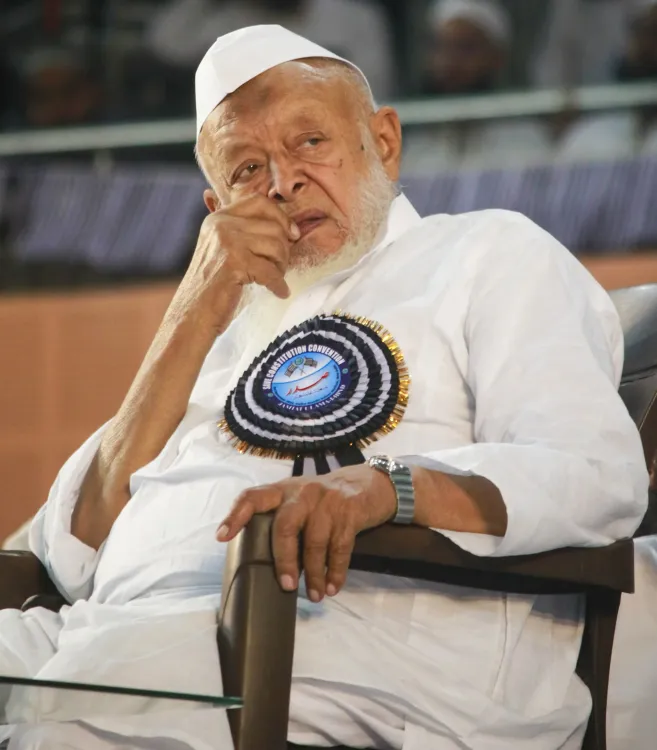
As the debate over Vande Mataram intensifies, Jamiat Ulema-e-Hind President Maulana Arshad Madani asserts that while death may be accepted, shirk is not. His statements raise crucial questions about faith, patriotism, and the essence of worship in a diverse nation.
Key Takeaways
- Madani emphasizes the importance of faith over forced patriotism.
- Religious freedom is a constitutional right in India.
- The significance of Vande Mataram in India's history is acknowledged.
- Debates on national identity and religious beliefs are ongoing.
- Political implications of the discourse are evident.
New Delhi, Dec 9 (NationPress) In light of the ongoing debate over Vande Mataram, Jamiat Ulema-e-Hind President Maulana Arshad Madani expressed on Tuesday, “We will accept death, but we will never accept 'shirk (associating anyone with God).”
Sharing his thoughts on the social media platform X, Madani stated in Hindi, “We do not have any issues with anyone reciting or singing Vande Mataram; however, Muslims worship only one Allah and cannot include anyone besides Allah in their worship. Additionally, the interpretation of 'Vande Mataram' relates to beliefs associated with shirk. Its four verses glorify the nation, equating it with 'Durga Mata' and employing language of devotion. The phrase 'Mother, I worship you' translates the essence of Vande Mataram.”
“This contradicts the fundamental beliefs of any Muslim. Thus, no individual should be compelled to chant any slogan or song that conflicts with their faith. The Indian Constitution ensures every citizen's right to religious liberty (Article 25) and freedom of expression (Article 19),” he added.
“Patriotism is one thing; worshipping the country is another. Muslims do not require validation for their loyalty. Their contributions during the freedom struggle are etched in the annals of history,” he noted.
He emphasized, “We believe in one God (Allah) and worship no one except Allah. We will accept death, but we will never accept 'shirk' (associating anyone with God).”
Meanwhile, the long-standing discussion regarding India’s national song, Vande Mataram, revived in Parliament on Monday, as Prime Minister Narendra Modi led a 10-hour dialogue in the Lok Sabha commemorating the 150th anniversary of the song. The discussions are expected to carry on in a special one-day session of the Rajya Sabha on Tuesday, overseen by Home Minister Amit Shah.
During the discourse, PM Modi traced the song's origins and underscored its significance in India’s liberation movement. He criticized the exclusion of specific stanzas in 1937, labeling it a “division and partition of the song,” which he claimed ultimately contributed to India's Partition. “Vande Mataram was divided first, and then the country was divided,” he asserted, holding the Congress and former Prime Minister Jawaharlal Nehru accountable for compromising on the national song.
Simultaneously, the Opposition has continued to challenge the government, claiming that it is politicizing the matter for electoral advantages.
Point of View
Fostering unity in diversity remains crucial for national harmony. The debate invites not just reflection but dialogue among various stakeholders, ensuring that the values of liberty and respect for all faiths are upheld.
NationPress
10/12/2025
Frequently Asked Questions
What did Arshad Madani say about Vande Mataram?
Maulana Arshad Madani stated that he accepts death but will never accept 'shirk', emphasizing that Muslims worship only Allah and cannot associate anyone else with their faith.
What are the implications of singing Vande Mataram for Muslims?
Madani argued that singing Vande Mataram contradicts Islamic beliefs as it deifies the nation and equates it to worship, which is against their faith.
How does the Indian Constitution relate to this issue?
The Indian Constitution guarantees religious freedom and freedom of expression, allowing individuals to practice their faith without coercion.
What historical context surrounds Vande Mataram?
The song has significant historical value in India's freedom struggle, but its interpretation has led to controversies regarding its religious implications.
What was discussed in Parliament regarding Vande Mataram?
Prime Minister Modi led a discussion on the song's origins during its 150th anniversary, criticizing past decisions regarding its stanzas and their effects on national unity.