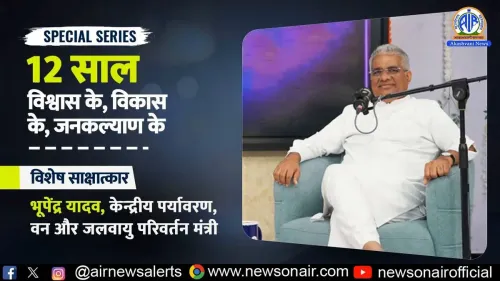
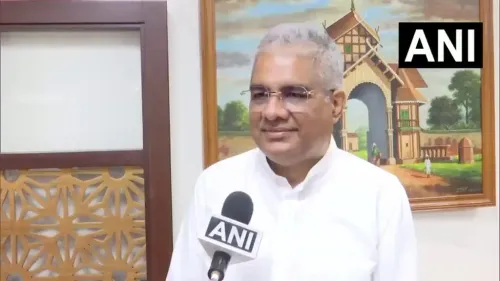
Bhupender Yadav marks 12 years of India's global rise
Synopsis
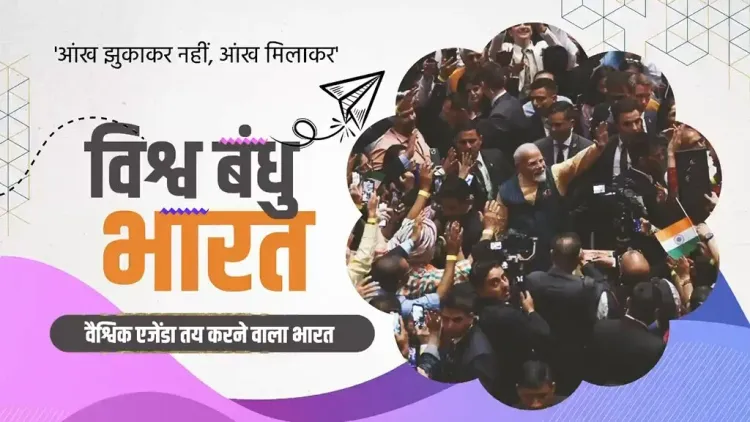
Union Environment Minister Bhupender Yadav has marked 12 years of India's assertive global identity, crediting strong diplomacy, expanding trade, and multilateral cooperation — continuing the BJP's 'India First' messaging on the anniversary of its rise to power.
Key Takeaways
Bhupender Yadav posted on June 19, 2026 , marking 12 years of India's distinct global identity.
The post highlights diplomacy, trade growth, new agreements, and global cooperation as key pillars.
The hashtag #12YearsOfIndiaFirst ties the message to BJP's broader anniversary communications.
India's Neighbourhood First policy (launched 2014) and G20 presidency (2023) are among the landmark foreign policy milestones of this period.
Strategic partnerships such as the Quad and expanded multilateral memberships underpin the 'India First' diplomatic narrative.
Pending trade agreements and upcoming multilateral summits remain the key near-term tests of continued foreign policy momentum.
Union Environment Minister Bhupender Yadav on Friday, June 19, 2026, highlighted 12 years of India's evolving global identity, citing strong diplomacy, expanding trade, new agreements, and deepening international cooperation as markers of the country's steady forward march.
Context
Yadav's post, carrying the hashtag #12YearsOfIndiaFirst, reflects a broader BJP messaging effort to mark the anniversary of the party's rise to power in May 2014. The phrase 'India First' has been a consistent ideological anchor for the ruling dispensation, framing foreign and economic policy choices as driven by national interest rather than bloc alignment.
The minister wrote: 'Over the past 12 years, India has carved a distinct identity for itself globally. With strong diplomacy, growing trade, new agreements, and global cooperation, India continues to move forward steadily.'
Policy Backdrop
Since 2014, New Delhi has pursued what it describes as an assertive, autonomous foreign policy. The Neighbourhood First policy — launched in the first year of the government — sought to deepen regional connectivity and bilateral ties with South Asian neighbours. This was followed by an expanding web of strategic partnerships, including the Quad grouping with the United States, Japan, and Australia.
India's G20 presidency in 2023 was widely used as a platform to project the country's enhanced multilateral leadership, with New Delhi positioning itself as a voice for the Global South. Successive trade negotiations and membership in new multilateral frameworks have reinforced the government's claim of diplomatic and economic autonomy on the world stage.
Stakeholders and Impact
The messaging resonates with a wide constituency: trade partners watching India's evolving tariff and investment posture, the diplomatic community tracking New Delhi's stance on multilateral institutions, and domestic audiences for whom 'India First' signals a break from what the BJP has long described as a more deferential pre-2014 foreign policy.
Business stakeholders, particularly those engaged in bilateral trade corridors, remain attentive to pending free-trade agreement negotiations and the pace at which new economic partnerships are being formalised. Any conclusion or renewal of such agreements would be a concrete marker of the progress Yadav's post alludes to.
What's Next
The government's foreign policy agenda in the months ahead is expected to include participation in upcoming multilateral summits and continued pursuit of pending trade agreements. Observers will watch whether the diplomatic momentum celebrated in BJP's anniversary messaging translates into specific deliverables — signed pacts, new strategic partnerships, or expanded multilateral mandates — that give the 'India First' narrative measurable, verifiable weight.
Point of View
Reinforcing the party's claim that 2014 marked a structural shift in how India engages the world. The 'India First' framing serves a dual purpose: it validates the government's foreign policy record domestically while projecting confidence abroad. Notably, a senior environment minister amplifying foreign policy achievements underscores how the BJP uses its entire ministerial bench to build a unified governance narrative. The real political test lies in whether the coming months deliver concrete diplomatic and trade milestones that give this anniversary messaging substantive grounding.
NationPress
19 Sept 2026
Frequently Asked Questions
What is the 'India First' policy Bhupender Yadav referred to?
'India First' is the BJP government's guiding foreign and economic policy philosophy since 2014, prioritising national interest, diplomatic autonomy, and bilateral trade over bloc-based alignments.
What has India achieved in foreign policy over the past 12 years?
Key milestones include the Neighbourhood First policy launched in 2014, India's G20 presidency in 2023, the Quad strategic partnership, and an expanding network of bilateral trade and investment agreements.
Why is Bhupender Yadav, an environment minister, posting about foreign policy?
Senior BJP ministers routinely amplify party-wide messaging on governance anniversaries; Yadav's post is part of a coordinated effort across the ministerial bench to mark 12 years of the BJP-led government.
What is the significance of the hashtag #12YearsOfIndiaFirst?
The hashtag marks approximately 12 years since the BJP came to power in May 2014 and is being used across party platforms to highlight governance and diplomatic achievements.
What are the next steps for India's foreign policy agenda?
Observers are watching for the conclusion of pending free-trade agreements and India's participation in upcoming multilateral summits as the near-term tests of the diplomatic momentum the government is highlighting.