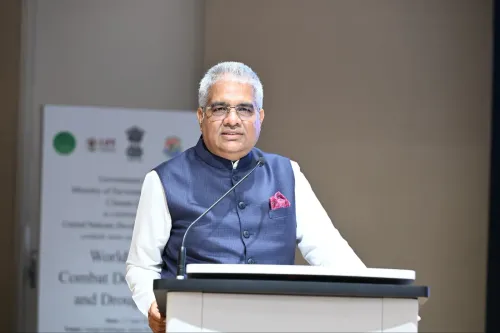
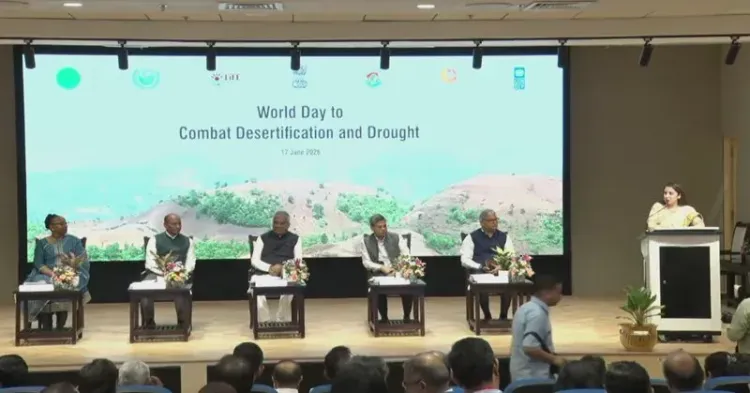
Bhupender Yadav addresses World Desertification Day 2026 in Delhi
Synopsis
Union Environment Minister Bhupender Yadav addressed the World Day to Combat Desertification and Drought 2026 in New Delhi on 17 June, reaffirming India's engagement with its UNCCD commitments to restore 26 million hectares of degraded land by 2030.
Key Takeaways
Union Environment Minister Bhupender Yadav addressed the World Day to Combat Desertification and Drought 2026 event in New Delhi on 17 June 2026 .
The day is an annual UN observance under the UNCCD , the 1994 treaty on combating land degradation.
India's 2021 Desertification and Land Degradation Atlas documented 97.85 million hectares of affected land.
India committed to voluntary land degradation neutrality (LDN) targets via the Delhi Declaration at UNCCD COP14 in 2019 .
India has pledged to restore 26 million hectares of degraded land by 2030 under the Bonn Challenge .
Arid-region farmers, state environment departments, and land restoration agencies are the primary stakeholders in India's desertification response.
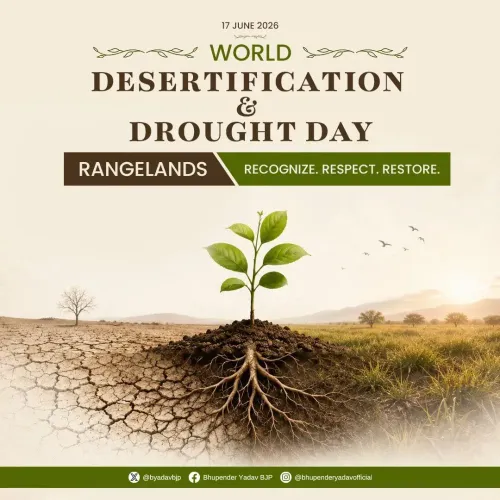
Union Environment Minister Bhupender Yadav addressed an event in New Delhi on Wednesday, 17 June 2026 to mark the World Day to Combat Desertification and Drought, the annual United Nations observance held each year on this date to raise awareness about land degradation and the global drought crisis.
Context
The World Day to Combat Desertification and Drought is observed every year on 17 June under the framework of the United Nations Convention to Combat Desertification (UNCCD), the landmark 1994 treaty that binds member nations to address land degradation. The day serves as a global platform for governments to report progress, coordinate action, and renew commitments on restoring degraded land. Minister Yadav's participation underscores India's continued engagement with its UNCCD obligations at the highest ministerial level.
Policy Backdrop
India has a significant stake in combating desertification. A 2021 government atlas documented 97.85 million hectares of degraded or desertification-affected land across the country, with states such as Rajasthan and Gujarat among the most vulnerable. India hosted UNCCD COP14 in New Delhi in 2019, adopting the Delhi Declaration and committing to voluntary land degradation neutrality (LDN) targets aligned with Sustainable Development Goal 15.3.
India has also pledged under the Bonn Challenge to restore 26 million hectares of degraded land by 2030, integrating this commitment into its broader national climate agenda alongside large-scale afforestation programmes. The annual World Day event in Delhi provides a structured opportunity for the Ministry to take stock of progress against these targets and engage state environment departments in drought-prone regions.
Stakeholders and Impact
The communities most directly affected by desertification and drought are farmers in arid and semi-arid belts, whose livelihoods depend on soil health and reliable water availability. State environment departments and land restoration agencies are key implementation partners for India's LDN commitments. International bodies such as the UNCCD secretariat also watch India's annual observance closely, given the country's scale and its role as a past COP host.
India's integration of UNCCD obligations into its domestic policy framework — spanning afforestation, watershed management, and drought-proofing schemes — means that ministerial-level events like this one carry both symbolic and administrative weight, often serving as occasions to align central and state government action.
What's Next
Attention will now turn to India's next voluntary LDN progress report to the UNCCD and whether the government announces updated national restoration targets ahead of future COP sessions. The Ministry of Environment, Forest and Climate Change is expected to continue coordinating with state governments in drought-prone areas to accelerate on-ground implementation of land restoration programmes ahead of the 2030 deadline.
Point of View
Annual observances like this one are increasingly pressure-points where domestic delivery must match international commitments. The event also signals that the Ministry views land degradation not as a peripheral environmental issue but as central to India's climate and agricultural security agenda. How the government translates this visibility into verifiable on-ground progress in states like Rajasthan and Gujarat will be the real test.
NationPress
16 Sept 2026
Frequently Asked Questions
What is the World Day to Combat Desertification and Drought?
It is an annual United Nations observance held every year on 17 June under the UNCCD framework, aimed at raising awareness about land degradation, desertification, and drought and promoting action to restore degraded land.
Why did Bhupender Yadav address the World Desertification Day 2026 event?
As Union Minister of Environment, Forest and Climate Change, Bhupender Yadav attended the New Delhi event on 17 June 2026 to mark the UN observance and reaffirm India's commitments to combating desertification and land degradation.
How much land in India is affected by desertification?
India's 2021 Desertification and Land Degradation Atlas documented 97.85 million hectares of degraded or desertification-affected land, with Rajasthan and Gujarat among the worst-affected states.
What is India's commitment on land restoration?
India has pledged under the Bonn Challenge to restore 26 million hectares of degraded land by 2030, and has adopted voluntary land degradation neutrality targets under SDG 15.3 via the 2019 Delhi Declaration at UNCCD COP14.