Bhupender Yadav Marks World Anti-Desertification Day, Cites India's Land Restoration Push
Synopsis
Union Environment Minister Bhupender Yadav, speaking at the World Day to Combat Desertification and Drought 2026 in Delhi, said India has restored 21.76 million hectares of land under the Bonn Challenge target of 26 million hectares by 2030, citing the Aravalli Green Wall, CAMPA, and Ek Ped Ma Ke Naam as key drivers.
Key Takeaways
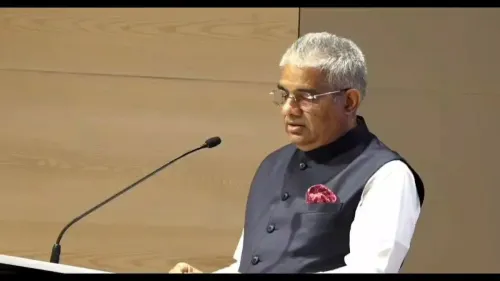
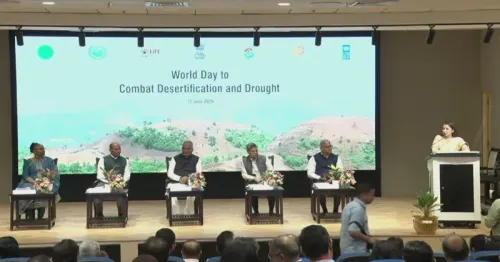
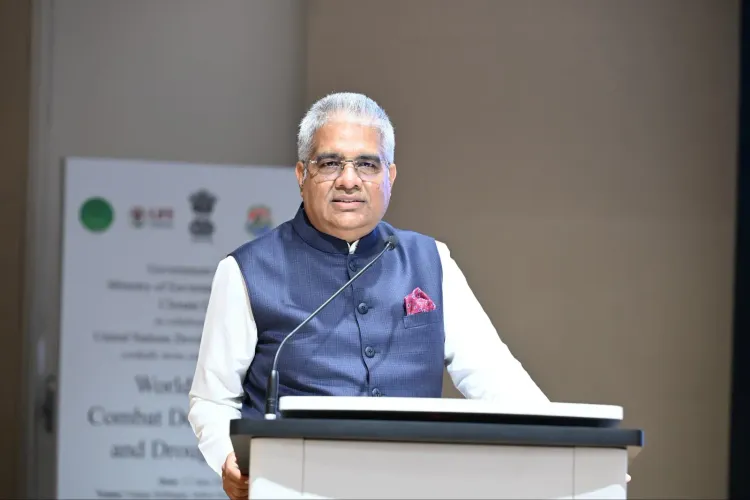
Union Environment Minister Bhupender Yadav addressed the World Day to Combat Desertification and Drought 2026 event at Paryavaran Bhavan, New Delhi on 17 June 2026 .
India has brought 21.76 million hectares of land under restoration efforts against its Bonn Challenge target of 26 million hectares by 2030 .
The Aravalli Green Wall Initiative surpassed its annual restoration targets in financial year 2025–26 .
Programmes driving restoration include Ek Ped Ma Ke Naam , CAMPA , and the Aravalli Green Wall .
Yadav emphasised that desertification directly threatens farmers, pastoralists, and rural families dependent on land and water.
India joined the UNCCD in 1994 and committed to the 26 million hectare restoration pledge at the 2015 UNCCD COP .
Union Environment Minister Bhupender Yadav addressed the national event marking World Day to Combat Desertification and Drought 2026 at Paryavaran Bhavan, New Delhi, on Wednesday, 17 June 2026, highlighting India's progress in land restoration and the human cost of desertification for farmers, pastoralists, and rural families.
Context
Speaking at the event, Yadav framed desertification and drought as crises that go beyond ecology. 'Desertification and drought are not merely environmental crises; they are the concern of farmers who look to the sky with hope, the suffering of pastoralists whose livelihoods depend on grazing lands, and the struggle of families for whom water is the very foundation of life,' he said.
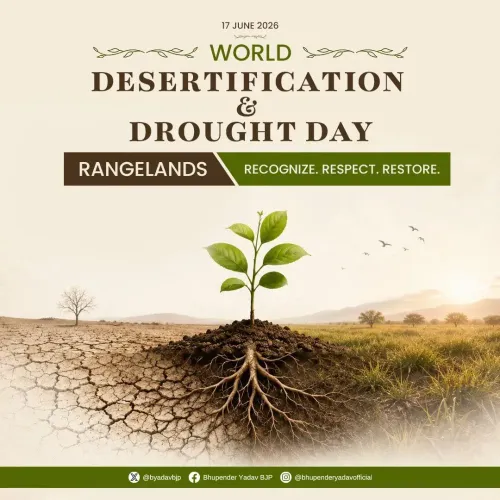
The World Day to Combat Desertification and Drought, observed every year on 17 June, is a United Nations observance that draws attention to land degradation and the communities most vulnerable to it. India has been a party to the United Nations Convention to Combat Desertification (UNCCD) since 1994.
Policy Backdrop
India committed to restoring 26 million hectares of degraded land by 2030 under the Bonn Challenge, a global voluntary initiative launched in 2011. Yadav stated that India has already brought 21.76 million hectares under restoration efforts — a significant share of that target — under the leadership of Prime Minister Narendra Modi.
Key programmes driving this progress include Ek Ped Ma Ke Naam, a nationwide citizen plantation campaign launched in 2024 encouraging people to plant trees in honour of their mothers, and CAMPA (Compensatory Afforestation Fund Management and Planning Authority), established under the 2016 Act to channel afforestation funds into ecological restoration.
The minister also highlighted the Aravalli Green Wall Initiative, a landscape-level restoration programme spanning the Aravalli hill range across Haryana, Rajasthan, Gujarat, and Delhi. Formally announced in 2023, the project aims to restore 1.35 million hectares over five years. Yadav noted that the initiative has surpassed its annual targets in financial year 2025–26.
Stakeholders and Impact
The communities most directly affected by land degradation in India include smallholder farmers dependent on rain-fed agriculture, pastoralists whose grazing lands are shrinking, and rural households in arid and semi-arid zones facing acute water stress. The Aravalli corridor, historically a natural barrier against desert encroachment from the Thar Desert, has faced decades of mining, encroachment, and vegetation loss.
Programmes like CAMPA and the Aravalli Green Wall attempt to address these pressures through a combination of state-level implementation and central funding, integrating biodiversity goals with drought resilience and rural livelihood support — an approach aligned with the 'whole-of-society' framework promoted under India's LiFE (Lifestyle for Environment) mission.
What's Next
India faces a mid-term review of its land restoration targets ahead of UNCCD COP17, where it will be expected to report on voluntary land degradation neutrality commitments. The performance of the Aravalli Green Wall in FY 2025–26 and the aggregate restoration figure of 21.76 million hectares will likely form the core of India's submission.
With 4.26 million hectares still to be brought under restoration to meet the 2030 Bonn Challenge pledge, the pace and quality of ongoing programmes will be closely watched by both domestic stakeholders and international bodies over the next four years.
Point of View
Where India's voluntary commitments will face international scrutiny. Framing desertification as a livelihood crisis — not just an ecological one — reflects a deliberate political choice to connect a global environmental agenda with the concerns of rural and agrarian constituencies. The emphasis on the Aravalli Green Wall, a multi-state initiative, also underscores the Centre's effort to present cooperative federalism as a vehicle for climate action. The remaining gap of roughly 4.26 million hectares to the 2030 target will test whether the current programme momentum can be sustained.
NationPress
17 Sept 2026
Frequently Asked Questions
What is India's target for land restoration under the Bonn Challenge?
India has pledged to restore 26 million hectares of degraded land by 2030 under the Bonn Challenge , a global voluntary initiative. As of June 2026, the country has brought 21.76 million hectares under restoration efforts, according to Environment Minister Bhupender Yadav.
What is the Aravalli Green Wall Initiative?
The Aravalli Green Wall Initiative is a landscape-level restoration programme covering the Aravalli hill range across Haryana, Rajasthan, Gujarat , and Delhi . Announced in 2023 , it aims to restore 1.35 million hectares over five years and has surpassed its annual targets in FY 2025–26 .
What is Ek Ped Ma Ke Naam?
Ek Ped Ma Ke Naam ('One Tree in Mother's Name') is a nationwide plantation campaign launched in 2024 by the Indian government, encouraging citizens to plant a tree in honour of their mothers as part of the broader LiFE (Lifestyle for Environment) mission.
What is CAMPA and how does it help land restoration in India?
CAMPA — the Compensatory Afforestation Fund Management and Planning Authority — was established under the 2016 Compensatory Afforestation Fund Act to collect and deploy funds for afforestation and ecological restoration, compensating for forest land diverted for development projects.
When is World Day to Combat Desertification and Drought observed?
World Day to Combat Desertification and Drought is observed every year on 17 June , as designated by the United Nations . In 2026 , India marked the day with a national event at Paryavaran Bhavan in New Delhi , addressed by Environment Minister Bhupender Yadav .