Yadav Marks World Day to Combat Desertification, Urges Land Restoration
Synopsis
On World Day to Combat Desertification and Drought, Union Environment Minister Bhupender Yadav called land the foundation of all ecosystems and urged collective restoration of degraded lands. India has pledged to restore 26 million hectares by 2030 under UNCCD commitments made at the 2019 New Delhi COP-14.
Key Takeaways
Union Environment Minister Bhupender Yadav posted on 17 June 2026 — World Day to Combat Desertification and Drought — calling for collective land restoration.
The day is observed annually on 17 June under the UNCCD framework established by the UN General Assembly in 1994 .
India pledged to restore 26 million hectares of degraded land by 2030 under the Bonn Challenge and UNCCD targets, announced at COP-14 in New Delhi (September 2019) .
The Delhi Declaration , adopted at COP-14, reaffirmed India's commitment to land degradation neutrality .
India's progress on restoration targets will be reviewed at the next UNCCD COP ahead of the 2030 deadline.
Farmers in semi-arid regions and rural communities are the primary stakeholders in land restoration outcomes.
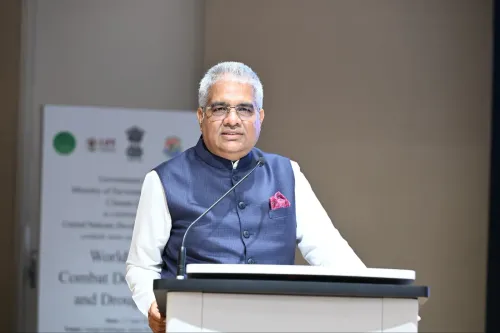
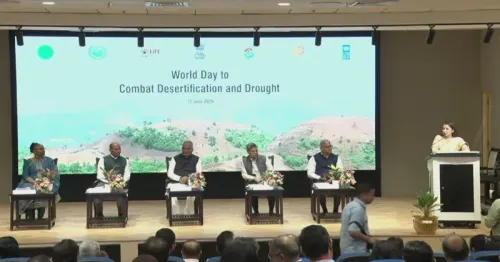
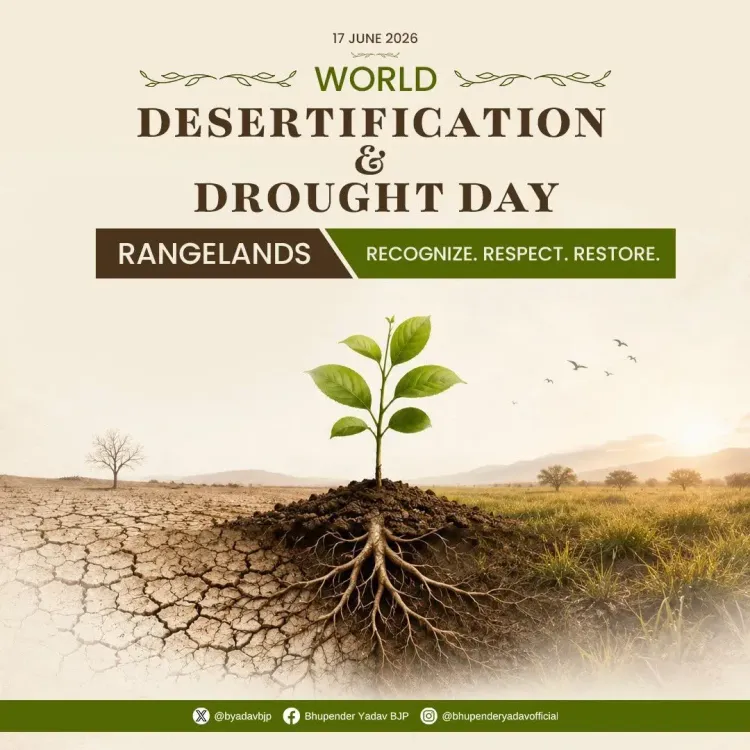
Union Environment Minister Bhupender Yadav on Wednesday, 17 June 2026 marked the World Day to Combat Desertification and Drought, calling land 'the foundation of all ecosystems and the source of our nutrition and energy cycles,' and urging collective action to restore degraded lands for future generations.
Context
The World Day to Combat Desertification and Drought is observed every year on 17 June, a date established by the UN General Assembly in 1994 under the framework of the United Nations Convention to Combat Desertification (UNCCD). The day draws global attention to the accelerating loss of productive land and the cascading effects on food security, biodiversity, and climate resilience. Minister Yadav's message underscored the foundational role of land in sustaining both ecosystems and human livelihoods.
In his post, Yadav wrote: 'Together, let's restore degraded lands and build a more resilient future for generations to come.' The appeal aligns with the UNCCD's broader mission of achieving land degradation neutrality — ensuring that land degradation is halted and reversed through restoration efforts worldwide.
Policy Backdrop
India has been a committed signatory to the UNCCD since 1994, the same year the convention was adopted — part of the three landmark Rio Conventions alongside the UN Framework Convention on Climate Change (UNFCCC) and the Convention on Biological Diversity (CBD). The country hosted the 14th Conference of Parties (COP-14) to the UNCCD in New Delhi in September 2019, where the Delhi Declaration was adopted, reaffirming commitments to land degradation neutrality.
At that summit, India pledged to restore 26 million hectares of degraded land by 2030 under the Bonn Challenge and UNCCD targets — one of the most ambitious national commitments in the Asia-Pacific region. Successive governments have pursued this goal through programmes such as the Green India Mission and national watershed development schemes, integrating land restoration into the broader climate and food security agenda.
Stakeholders and Impact
Land degradation disproportionately affects farmers in semi-arid regions and rural communities who depend directly on soil productivity for their livelihoods. In a country where agriculture remains the primary occupation for a large share of the population, the health of land is inseparable from economic security and nutritional outcomes. Restoration efforts, when effective, can reverse soil erosion, improve water retention, and revive local biodiversity.
The Ministry of Environment, Forest and Climate Change, under Yadav's stewardship since July 2021, coordinates India's reporting obligations to the UNCCD and oversees domestic programmes aligned with the 2030 land restoration pledge. The ministry's role spans policy design, inter-ministerial coordination, and international negotiations on land and climate issues.
What's Next
India's progress on its 26-million-hectare land restoration pledge will face scrutiny at the next UNCCD COP, where nations are expected to submit updated national reports ahead of the 2030 deadline. With less than four years remaining, the pace and scale of restoration activity across degraded landscapes — particularly in Rajasthan, the Deccan Plateau, and other semi-arid zones — will be closely watched by civil society and international partners alike.
Minister Yadav's statement on 17 June signals continued political commitment at the ministerial level, reinforcing India's position as a significant voice in global land governance discussions as the 2030 targets draw nearer.
Point of View
But it arrives at a moment when India's 26-million-hectare restoration pledge faces a tightening 2030 deadline and growing international scrutiny. By framing land as the 'foundation of all ecosystems,' the minister is reinforcing a whole-of-environment narrative that links soil health to food security and climate resilience — consistent with the BJP government's broader positioning on multilateral environmental commitments. The statement also keeps India's UNCCD leadership credentials — built around the 2019 New Delhi COP-14 — visible in the international discourse. Whether the political messaging translates into accelerated on-ground restoration will be the harder question civil society and UNCCD reviewers will ask ahead of the next COP.
NationPress
20 Sept 2026
Frequently Asked Questions
What is World Day to Combat Desertification and Drought?
World Day to Combat Desertification and Drought is observed every year on 17 June . It was established by the UN General Assembly in 1994 under the UNCCD framework to raise awareness about land degradation and promote sustainable land management globally.
What has India pledged under the UNCCD?
India pledged at the UNCCD COP-14 in New Delhi in September 2019 to restore 26 million hectares of degraded land by 2030 under the Bonn Challenge and UNCCD land degradation neutrality targets.
What did Bhupender Yadav say on World Desertification Day 2026?
Union Environment Minister Bhupender Yadav called land 'the foundation of all ecosystems and the source of our nutrition and energy cycles' and urged collective action to 'restore degraded lands and build a more resilient future for generations to come.'
What is the Delhi Declaration on land degradation?
The Delhi Declaration was adopted at the 14th UNCCD Conference of Parties (COP-14) hosted by India in New Delhi in September 2019 . It reaffirmed signatory nations' commitment to achieving land degradation neutrality — halting and reversing land degradation through restoration.
What is India's role in the UNCCD?
India ratified the UNCCD in 1994 as part of the three Rio Conventions . It hosted COP-14 in New Delhi in 2019 and has made one of the region's largest restoration pledges — 26 million hectares by 2030 — coordinated through the Ministry of Environment, Forest and Climate Change .