PM Modi shares Sanskrit shloka on truth, learning and conduct
Synopsis
Prime Minister Narendra Modi posted a Sanskrit shloka on 5 November 2026 stating that dharma is guarded by truth, knowledge by practice, appearance by cleanliness, and lineage by righteous conduct — continuing his periodic tradition of sharing classical Indian verses on social media.
Key Takeaways
Prime Minister Narendra Modi posted a Sanskrit shloka on 5 November 2026 .
The verse states: dharma is protected by truth ; knowledge by practice ; appearance by cleanliness ; lineage by righteous conduct .
The post was accompanied by a video, the contents of which were not independently reviewed.
Modi has a recurring practice of sharing classical Sanskrit and ethical verses on his social media platforms.
The post carries no explicit political context and functions as a stand-alone cultural statement.
A four-line Sanskrit verse on the timeless pillars of a virtuous life — truth, learning, appearance and lineage — arrived on Prime Minister Narendra Modi's X feed in the early hours of Thursday, 5 November 2026, drawing attention to classical Indian wisdom in the middle of a busy political week.
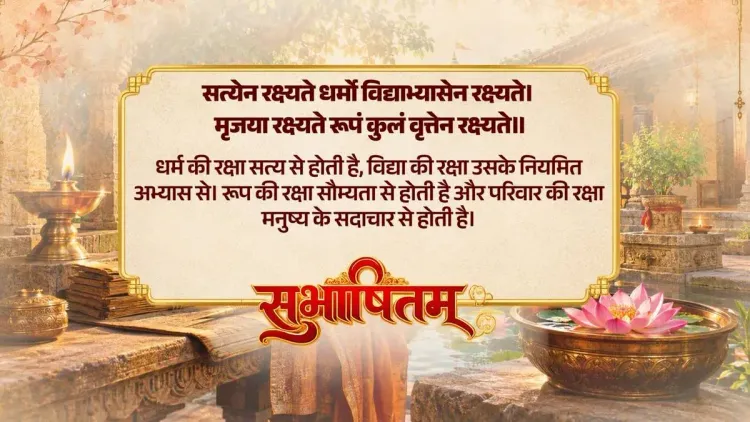
The shloka, rendered in classical Sanskrit, reads: 'सत्येन रक्ष्यते धर्मो विद्याभ्यासेन रक्ष्यते। मृजया रक्ष्यते रूपं कुलं वृत्तेन रक्ष्यते॥' — which translates as: 'Dharma is protected by truth; knowledge is protected by practice; beauty is protected by cleanliness; and lineage is protected by righteous conduct.' Each of the four couplets pairs a cherished value with the single discipline that guards it — a compact ethical map drawn from India's ancient textual tradition.
Four values, one governing idea
The verse is structured around the verb rakshyate — 'is protected' — repeated four times, giving the shloka a rhythmic, almost chant-like insistence. The sequence moves from the cosmic (dharma upheld by truth) to the personal (one's family name upheld by right conduct), suggesting that individual virtue and civilisational order are two ends of the same thread. It is the kind of formulation that appears in several classical Indic compilations on ethics and statecraft, though its precise attribution in this instance is not independently verified.
Modi's recurring turn to Sanskrit on social media
Prime Minister Modi has made the periodic sharing of Sanskrit verses and classical proverbs a recognisable feature of his digital presence. These posts typically carry no accompanying political context — they function as stand-alone cultural statements, inviting followers to reflect rather than respond to a news peg. The practice echoes his broader public emphasis on reviving pride in India's classical heritage, a theme that has surfaced in his speeches, in the government's promotion of Sanskrit education, and in ceremonial choices across his tenure. The attached video in this post, whose contents could not be independently reviewed, may carry a visual or musical rendering of the verse.
What the verse does, stripped of any political reading, is remind a mass audience of more than 100 million followers that the oldest prescription for a well-ordered life — be truthful, keep learning, stay clean, act with integrity — fits on four lines.
Point of View
These posts have served to normalise Sanskrit as a living public language for a smartphone-era audience. The pattern also aligns with broader BJP cultural politics, which position India's pre-colonial textual heritage as a source of contemporary national identity. Taken together, such posts accumulate into a consistent civilisational messaging thread, even when each individual post appears simply devotional or philosophical.
NationPress
5 Nov 2026
Frequently Asked Questions
What is the Sanskrit shloka PM Modi posted on 5 November 2026?
PM Modi posted the verse 'Satyen rakshyate dharmo vidyabhyasena rakshyate; Mrjaya rakshyate rupam kulam vrttena rakshyate' — meaning dharma is protected by truth, knowledge by practice, appearance by cleanliness, and lineage by righteous conduct.
What does the shloka Modi shared mean in English?
The shloka means: 'Dharma is protected by truth; knowledge is protected by practice; beauty is protected by cleanliness; and lineage is protected by righteous conduct.'
Why does PM Modi post Sanskrit verses on X?
PM Modi periodically shares Sanskrit shlokas and classical proverbs on social media as stand-alone cultural statements, reflecting his broader emphasis on India's classical heritage. These posts typically carry no direct political context.
What language did Modi use in his 5 November 2026 post?
The post was written entirely in classical Sanskrit, making it one of the relatively rare instances of a head of government posting in Sanskrit on a major social media platform.
What is the significance of the word 'rakshyate' in the shloka?
'Rakshyate' means 'is protected' in Sanskrit. Its fourfold repetition in the verse gives it a rhythmic structure and underscores that every core value — from dharma to family honour — requires a specific, active discipline to sustain it.