PM Modi Shares Sanskrit Shloka on Righteous Conduct
Synopsis
Prime Minister Narendra Modi on 24 July 2026 posted a Sanskrit verse on X urging followers to practise righteousness in deed, thought and word. The shloka reflects his consistent practice of sharing classical Indian wisdom on social media as part of a broader cultural messaging approach.
Key Takeaways
PM Modi posted a Sanskrit shloka on X on 24 July 2026 , continuing a well-established social media practice.
The verse teaches that repeated action, thought and word shape one's character, and calls for the pursuit of what is righteous.
The Sanskrit triad karmana, manasa, vacha is a classical ethical formulation found across major Indian philosophical texts.
The post was accompanied by a video , shared alongside the verse on the Prime Minister's official handle.
Such posts form part of a broader pattern of invoking ancient Indian wisdom in contemporary public communication by the Prime Minister.
Prime Minister Narendra Modi on Friday, 24 July 2026, shared a classical Sanskrit verse on X, continuing his practice of invoking ancient Indian wisdom to encourage ethical living among his followers.
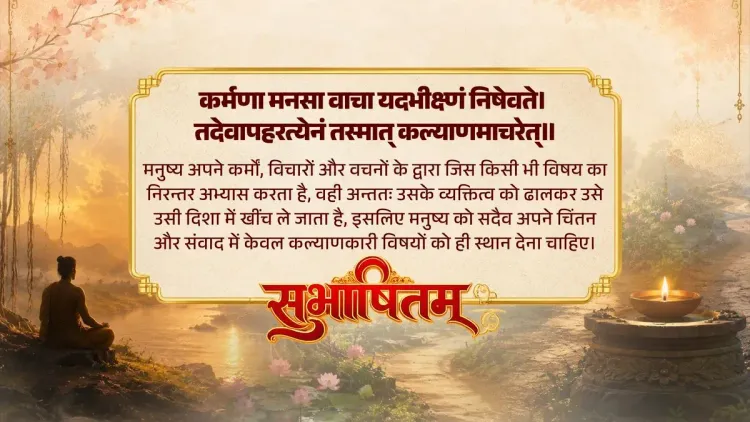
The shloka, drawn from classical Sanskrit literature, reads: 'कर्मणा मनसा वाचा यदभीक्ष्णं निषेवते। तदेवापहरत्येनं तस्मात्कल्याणमाचरेत्॥' — which translates to: 'That which one repeatedly practises through deed, thought and word, that alone shapes one's being; therefore, one must always pursue what is righteous and good.'
Context
The verse encapsulates a core principle found across classical Indian philosophical traditions: that repeated action, thought and speech collectively define a person's character. The Sanskrit triad karmana, manasa, vacha — deed, mind and word — is a recurring ethical formulation in texts ranging from the Mahabharata to the Manusmriti and various Puranic works. The concluding injunction, 'tasmaat kalyaanam aacharet' (therefore, practise what is auspicious), frames the verse as a direct call to virtuous conduct.
The post was accompanied by a video, which the Prime Minister's handle shared alongside the verse, though the specific content of the video was not independently detailed in the post text.
Policy Backdrop
Prime Minister Modi has maintained a consistent and deliberate practice of sharing Sanskrit shlokas and classical verses on social media. These posts are a recognisable feature of his public communication style, reinforcing themes of cultural continuity, self-improvement and ethical governance. The practice aligns with the broader emphasis his administration has placed on integrating India's classical heritage into contemporary public life — visible in initiatives spanning education, language policy and cultural programming.
Such posts typically attract wide engagement, functioning both as personal expressions of cultural affiliation and as soft-power messaging directed at a domestic audience attentive to India's civilisational identity.
Stakeholders and Impact
The primary audience for such posts is the general public, particularly those who engage with the Prime Minister's social media presence for cultural and motivational content. Sanskrit scholars, educators and cultural organisations often amplify such verses, using them as entry points for broader discussion of classical Indian thought.
For younger audiences, these posts serve as accessible introductions to Sanskrit literature, with translations and commentary frequently circulating in response threads and cultural forums across the country.
What's Next
Observers of the Prime Minister's communication patterns will watch for any follow-up references to this verse — or its themes of righteous conduct — in official addresses, policy announcements or cultural events. Historically, shlokas shared on social media have occasionally foreshadowed thematic emphases in subsequent public speeches. Whether this post signals a broader cultural messaging push or stands as a standalone reflection remains to be seen.
Point of View
Signalling civilisational continuity to a domestic base that values India's classical heritage. The choice of a verse centred on the unity of deed, thought and word carries implicit resonance in a political climate where questions of alignment between rhetoric and governance are perennially debated. By anchoring public communication in texts that predate partisan politics, the Prime Minister positions himself as a custodian of shared cultural inheritance rather than a purely ideological actor. The consistency of this practice across years of tenure suggests it is a core element of his personal brand, as much as any policy announcement.
NationPress
22 Oct 2026
Frequently Asked Questions
What Sanskrit shloka did PM Modi post on 24 July 2026?
PM Modi posted the verse 'Karmana manasa vacha yadabheekshnam nisevate, tadeva apaharatyenam tasmaat kalyaanam aacharet,' which means that what one repeatedly does, thinks and says shapes one's being, and therefore one must always pursue righteousness.
What is the meaning of 'karmana manasa vacha'?
'Karmana manasa vacha' is a classical Sanskrit phrase meaning 'by deed, by mind and by word.' It is a recurring ethical triad in Indian philosophical literature, emphasising that all three dimensions of human expression together define character.
Why does PM Modi post Sanskrit shlokas on social media?
PM Modi has consistently shared Sanskrit verses as part of his public communication to highlight classical Indian ethical teachings, promote cultural continuity and connect with followers interested in India's civilisational heritage.
Which texts does the shloka shared by PM Modi come from?
The verse draws on classical Sanskrit literature, with similar formulations found across major Indian texts including the Mahabharata, Puranic works and other classical philosophical sources.
What does PM Modi's shloka post mean for his followers?
For followers, the post serves as a motivational and cultural message encouraging righteous conduct. It also functions as an introduction to classical Sanskrit thought, often prompting wider discussion and commentary in public forums.