PM Modi Shares Sanskrit Shloka on Focus and Discipline
Synopsis
Prime Minister Narendra Modi posted a Sanskrit verse on 21 July 2026 likening concentration and resolve to sinews that grow stronger through daily practice. The post aligns with his consistent use of classical Sanskrit on social media and the government's broader push for Sanskrit education under the National Education Policy.
Key Takeaways
PM Modi posted a Sanskrit shloka on 21 July 2026 on X, with no additional text beyond the verse itself.
The verse compares concentration and resolve to sinews, stating both grow stronger through consistent daily practice.
The post is part of a recurring pattern of the Prime Minister sharing Sanskrit verses on themes of self-discipline and self-cultivation.
The National Education Policy 2020 includes Sanskrit promotion as a formal policy priority, providing institutional context for such communication.
No specific policy announcement accompanied the post; it stands as a standalone cultural communication to the general public.
Prime Minister Narendra Modi on Tuesday, 21 July 2026, shared a Sanskrit verse on X emphasising the power of concentration, resolve, and consistent practice as instruments of personal growth. The post, carrying no accompanying text beyond the verse itself, is consistent with the Prime Minister's periodic use of classical Sanskrit to communicate themes of self-discipline and cultural heritage.
The Verse and Its Meaning
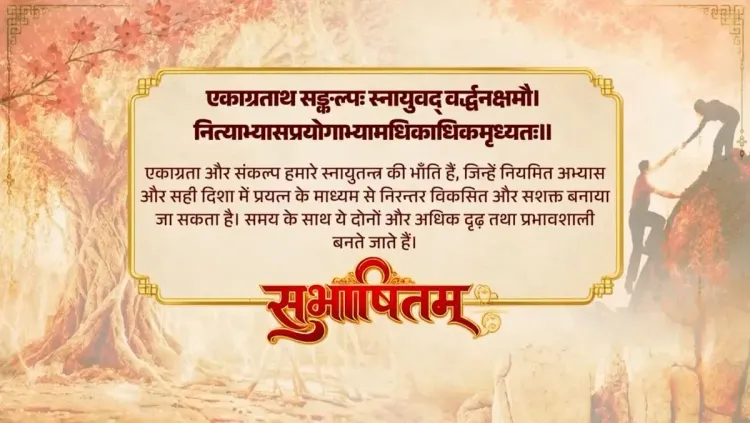
The shloka posted by Prime Minister Modi reads: एकाग्रताथ सङ्कल्पः स्नायुवद् वर्द्धनक्षमौ। नित्याभ्यासप्रयोगाभ्यामधिकाधिकमृध्यतः॥ Rendered in English, the verse conveys: 'Concentration and resolve are like sinews — capable of growth. Through daily practice and application, they expand more and more.' The imagery of sinews, or tendons, underscores the idea that mental faculties, like muscles, strengthen through sustained effort.
The verse is composed in classical Sanskrit metre and draws on a tradition of didactic poetry that has long been used in Indian philosophical and educational contexts to distil principles of self-improvement into memorable couplets.
Context
Prime Minister Modi has made Sanskrit verse a recurring feature of his public communication on X, often posting shlokas that align with broader government messaging around yoga, mindfulness, and traditional Indian knowledge systems. These posts typically attract wide engagement from followers interested in Indian classical culture and philosophy.
The 21 July 2026 post arrives in a period when the government's National Education Policy (NEP) implementation is ongoing, with Sanskrit education forming a stated component of the policy's emphasis on Indian languages and classical studies. The timing also follows the annual International Day of Yoga in June, a period during which themes of mental discipline and self-cultivation receive heightened public attention.
Policy Backdrop
The National Education Policy 2020 explicitly encourages the teaching of Sanskrit and other classical Indian languages at the school level, framing them as repositories of scientific, literary, and philosophical knowledge. The government has also expanded the Rashtriya Sanskrit Sansthan and related institutions to promote Sanskrit scholarship and accessibility.
Posts of this nature from the Prime Minister serve a dual function: they reinforce the cultural identity component of the ruling party's broader governance narrative while simultaneously lending informal endorsement to policy priorities around classical language promotion without making any formal policy announcement.
Stakeholders and Impact
The primary audience for such communication is the general public, particularly those engaged with Indian classical traditions, yoga practitioners, students of Sanskrit, and followers who look to the Prime Minister's social media for motivational content. Educators and institutions working under the NEP framework may also read the post as an informal signal of continued political support for classical language initiatives.
Sanskrit scholars and cultural organisations have historically welcomed the Prime Minister's use of the language on public platforms, arguing it raises the profile of a language that, while constitutionally recognised, has limited everyday speakers. Critics have occasionally noted that such posts, while culturally resonant, do not substitute for concrete funding or curriculum reform.
What's Next
Observers will watch whether this post is followed by a formal communication — such as an address, a scheme announcement, or an NEP progress update — that gives the verse a specific policy anchor. The pattern of PM Modi's Sanskrit posts suggests they sometimes precede or accompany larger cultural or educational announcements, though they also frequently stand alone as standalone expressions of personal and philosophical conviction. The verse's emphasis on daily practice and incremental growth may resonate in the lead-up to any forthcoming government messaging around education outcomes or skill development.
Point of View
Lending it a gravitas that explanatory prose would diminish. This approach is consistent with his broader strategy of using cultural signalling to reinforce a governance identity rooted in Indian classical tradition, without requiring a formal policy hook. The timing, in the post-Yoga Day window and amid ongoing NEP rollout, means the post lands in fertile ground even if no direct connection is stated. For political analysts, such posts are worth tracking cumulatively: they map the ideological texture of the administration as much as any White Paper does.
NationPress
20 Oct 2026
Frequently Asked Questions
What Sanskrit shloka did PM Modi post on 21 July 2026?
PM Modi posted a verse that translates to: 'Concentration and resolve are like sinews — capable of growth. Through daily practice and application, they expand more and more.' The original Sanskrit reads: एकाग्रताथ सङ्कल्पः स्नायुवद् वर्द्धनक्षमौ। नित्याभ्यासप्रयोगाभ्यामधिकाधिकमृध्यतः॥
Why does PM Modi post Sanskrit verses on social media?
PM Modi regularly shares Sanskrit shlokas on X as part of his public emphasis on Indian classical culture, yoga, and traditional knowledge systems. These posts also align with the government's policy priority of promoting Sanskrit education under the National Education Policy 2020.
What does the Sanskrit verse posted by Modi mean in English?
The verse means that concentration and resolve, like sinews or tendons in the body, have the capacity to grow. Through daily practice and consistent application, they strengthen progressively without limit.
Is PM Modi's Sanskrit post related to any government scheme?
No specific scheme or policy announcement accompanied this post. However, it is broadly consistent with the government's promotion of Sanskrit under the National Education Policy and its wider cultural heritage messaging.
How often does PM Modi post Sanskrit shlokas on X?
PM Modi posts Sanskrit verses periodically, often around culturally significant periods such as International Yoga Day in June or during government campaigns highlighting Indian classical traditions. The frequency varies and the posts do not always carry explicit policy context.