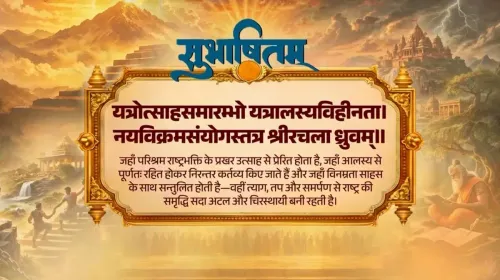
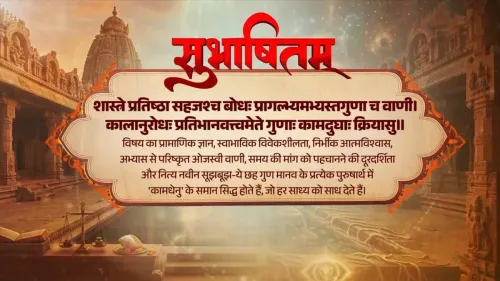
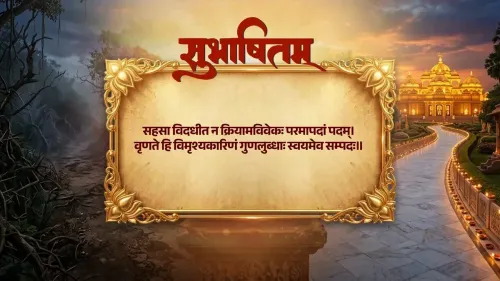
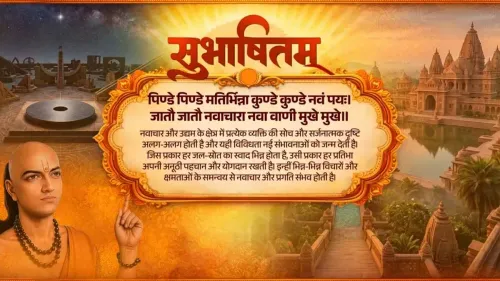
PM Modi shares Sanskrit shloka on courage and enterprise
Synopsis
Prime Minister Narendra Modi posted a classical Sanskrit shloka on X on 29 September 2026, citing six virtues — enterprise, courage, patience, wisdom, strength, and valour — as the conditions under which fortune becomes an ally, continuing his pattern of invoking ancient Indian thought in public communication.
Key Takeaways
Prime Minister Narendra Modi posted a Sanskrit shloka on X on 29 September 2026 .
The verse lists six virtues — enterprise, courage, patience, wisdom, strength, and valour — as prerequisites for fortune's favour.
The shloka is widely associated with the classical tradition linked to Chanakya , the 4th-century BCE statesman and author of the Arthashastra .
The post included an attached video whose content was not independently verifiable at publication time.
This continues Modi's long-standing practice of sharing Sanskrit verses on X to frame themes of self-reliance and purposeful action.
A Sanskrit verse on enterprise, courage, and wisdom — posted by Prime Minister Narendra Modi on Tuesday, 29 September 2026 — landed on his X timeline in the early hours, carrying a message that has echoed through Indian classical thought for centuries.
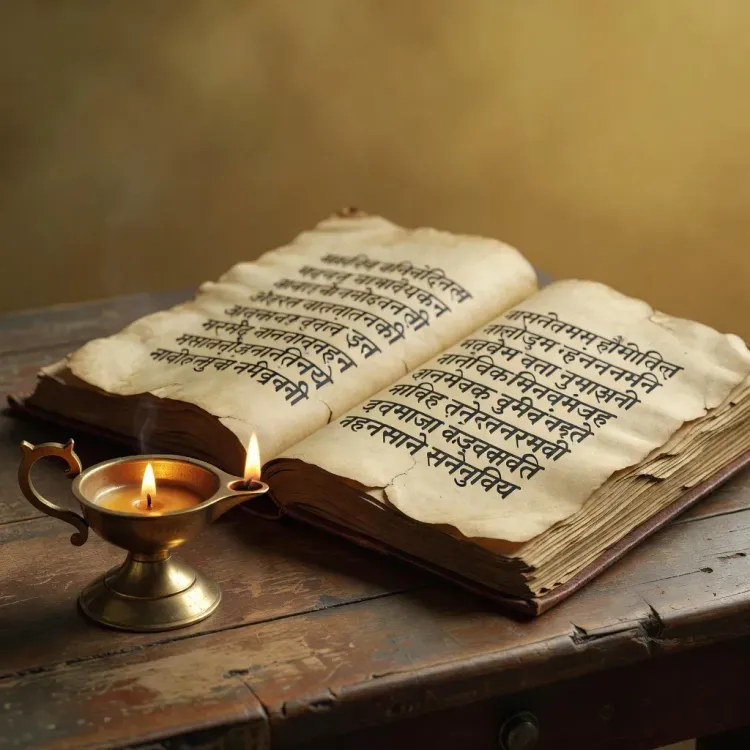
The shloka, rendered in Devanagari, translates broadly as: 'Udyamah sahsam dhairyam buddhih shaktih parakramah / Shadete yatra vartante tatra daivam sahayakrit' — 'Where enterprise, courage, patience, wisdom, strength, and valour reside together, there fortune itself becomes an ally.' The verse is widely attributed to the tradition of classical Indian ethical and governance literature, with scholars often linking it to the corpus associated with the ancient polymath Chanakya.
A verse that travels from ancient courts to modern timelines
The shloka is no ornamental flourish. It enumerates six specific qualities — udyama (enterprise), sahas (courage), dhairya (patience or steadfastness), buddhi (intellect), shakti (strength), and parakrama (valour) — and argues that when all six converge in a person or a people, divine favour follows. It is a verse about human agency, not divine dependence: fortune rewards those who do the work.
Chanakya, the 4th-century BCE statesman and scholar credited with authoring the Arthashastra and the Chanakya Niti, built a philosophy of governance around exactly these virtues. His writings have shaped Indian administrative and ethical thinking for over two millennia and remain a touchstone in contemporary leadership discourse.
Modi's pattern of invoking classical Indian thought
This post fits a well-established pattern. Prime Minister Modi has periodically shared Sanskrit shlokas on X, using classical verse to frame themes of self-reliance, national character, and purposeful action — themes that also run through flagship policy frameworks like Atmanirbhar Bharat. The practice is a deliberate choice: classical Sanskrit carries authority, universality, and a sense of civilisational continuity that transcends the news cycle.
The attached video in the post — whose content could not be independently verified at the time of publication — likely provides additional visual context for the verse.
Six qualities. One promise. The oldest productivity advice in the subcontinent's recorded memory — and it still holds.
Point of View
Not incidental culture-sharing. By anchoring public messaging in classical Indian thought, he signals civilisational continuity and reinforces the self-reliance narrative central to his governance philosophy. A verse that places human agency — enterprise, courage, wisdom — above passive dependence on fate aligns neatly with the Atmanirbhar Bharat framing. Watch whether subsequent speeches or policy announcements draw explicitly on these six virtues as a rhetorical scaffolding.
NationPress
29 Sept 2026
Frequently Asked Questions
What does the Sanskrit shloka posted by PM Modi mean in English?
The shloka translates as: 'Where enterprise, courage, patience, wisdom, strength, and valour reside together, there fortune itself becomes an ally.' It emphasises that human virtues, not fate alone, attract success.
Who wrote the shloka PM Modi posted on 29 September 2026?
The verse is widely attributed to the classical Indian tradition associated with Chanakya, the 4th-century BCE statesman and author of the Arthashastra, though exact attribution across ancient texts can vary.
Why does PM Modi post Sanskrit shlokas on X?
PM Modi has followed a long-standing pattern of sharing Sanskrit verses to invoke classical Indian ethical thought, often linking themes of self-reliance, courage, and wisdom to contemporary governance narratives.
What are the six virtues mentioned in the shloka?
The six virtues are udyama (enterprise), sahas (courage), dhairya (patience or steadfastness), buddhi (intellect or wisdom), shakti (strength), and parakrama (valour).
What is Chanakya's Arthashastra?
The Arthashastra is an ancient Indian treatise on statecraft, economic policy, and military strategy attributed to Chanakya, dating to approximately the 4th century BCE, and considered one of the foundational texts of Indian governance philosophy.