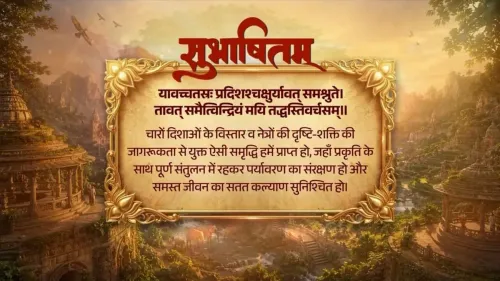
PM Modi shares Sanskrit shloka linking good governance to nature

Synopsis
Prime Minister Narendra Modi posted a Sanskrit couplet on 28 October 2026 asserting that a ruler who protects nature finds happiness and fulfilment — framing ecological stewardship as a core duty of just governance rooted in classical Indian statecraft.
Key Takeaways
Prime Minister Narendra Modi shared a Sanskrit shloka on X on 28 October 2026 linking a ruler's protection of nature to prosperity and happiness.
The verse translates as: 'A king who protects nature becomes happy; in no other way does he.
He whose conduct is beneficial to all fulfils every desire.' The couplet draws from the rajadharma tradition of classical Indian statecraft, found in texts such as the Mahabharata and the Shanti Parva.
Modi has periodically shared similar Sanskrit verses connecting ancient governance ethics with contemporary environmental themes.
The framing positions ecological responsibility as an indigenous Indian imperative predating modern international climate frameworks.
A king who honours nature finds happiness — those who do not, find none at all. With that ancient axiom, Prime Minister Narendra Modi opened Wednesday, 28 October 2026 by posting a Sanskrit couplet on X that ties the dharma of rulership directly to ecological stewardship.
The verse reads: 'Pālayan prakṛtiṃ rājā sukhī bhavati nānyathā / Prakṛtiśca hitā yasya sa rājā sarvakāmadhuk' — 'A king who protects and nurtures nature becomes happy; in no other way does he. He whose nature is beneficial to all, that king fulfils every desire.' The couplet frames ecological responsibility not as a policy option but as a precondition for just and prosperous governance.
What the Sanskrit verse actually says
The shloka belongs to the classical tradition of rajadharma — the duties and ethics of kingship — found across texts such as the Mahabharata, the Arthashastra, and the Shanti Parva. In that tradition, prakṛti carries a dual weight: it means both 'nature' in the ecological sense and 'the natural order of things,' including the well-being of subjects. A ruler who respects that order is likened to a kāmadhuk — a wish-fulfilling cow — capable of providing for all needs.
Modi's choice to surface this verse positions ancient Indian statecraft as an early articulation of what modern environmental governance calls the 'duty of care' toward the natural world.
A recurring pattern: ancient texts, contemporary stakes
This is not an isolated post. The Prime Minister has periodically shared Sanskrit verses on social media that weave classical concepts of rajadharma with modern themes of sustainability — a rhetorical strategy that simultaneously asserts civilisational continuity and frames India's green commitments in indigenous, rather than purely Western, terms.
The timing is notable. Global climate diplomacy remains in a state of heightened activity, with COP-cycle negotiations and domestic conservation programme reviews forming a persistent backdrop. While no specific event can be pinned to this post, the pattern of such verses appearing around periods of environmental salience is consistent with Modi's broader communications approach.
Why the framing matters
By grounding environmental responsibility in Sanskritic statecraft rather than international treaty language, the Prime Minister signals to a domestic audience that ecological care is not an imported obligation but a home-grown imperative — one that predates modern multilateralism by millennia. It is a soft but deliberate act of ideological framing: India as an ancient ecological civilisation, not merely a developing economy navigating carbon commitments.
The verse also carries a pointed moral edge. It does not merely praise conservation — it warns that a ruler who ignores nature cannot be happy. In 2026, with climate consequences becoming impossible to ignore, that warning lands differently than it might have in a classroom Sanskrit lesson.
Ancient wisdom, modern urgency — the Prime Minister is betting the two are the same argument.
Point of View
Strengthening the government's hand in global climate negotiations by asserting moral authority from within rather than conceding it from without. The timing — amid ongoing COP-cycle diplomacy — suggests the post is unlikely to be purely philosophical. Watch for whether this verse resurfaces as a rhetorical anchor in Modi's formal speeches on conservation or climate.
NationPress
28 Oct 2026
Frequently Asked Questions
What Sanskrit shloka did PM Modi post on 28 October 2026?
PM Modi posted: 'Pālayan prakṛtiṃ rājā sukhī bhavati nānyathā / Prakṛtiśca hitā yasya sa rājā sarvakāmadhuk,' which translates as 'A king who protects and nurtures nature becomes happy; in no other way does he. He whose conduct is beneficial to all fulfils every desire.'
What does 'rajadharma' mean in the context of this shloka?
Rajadharma refers to the ethical duties and responsibilities of a ruler in classical Indian statecraft. In this verse, protecting nature — 'prakṛti' — is framed as a core duty, the fulfilment of which determines whether a king rules with happiness and prosperity.
Why does PM Modi post Sanskrit shlokas about the environment?
Modi has followed a consistent pattern of invoking ancient Indian texts to frame environmental responsibilities in indigenous terms, presenting ecological stewardship as a civilisational value rooted in Indian tradition rather than an externally imposed obligation.
What does 'prakṛti' mean in this Sanskrit verse?
'Prakṛti' in classical Sanskrit carries a dual meaning: it refers to nature in the ecological sense as well as the natural or inherent order of things, including the well-being of a ruler's subjects. The verse uses both senses simultaneously.
Is this shloka connected to any specific Indian government policy or event?
No specific policy announcement or event has been confirmed in connection with this post. It forms part of a broader pattern of Modi sharing such verses during periods of environmental and policy salience, including global climate diplomacy cycles.