PM Modi shares Sanskrit verse on rajadharma and sanatana order
Synopsis
Prime Minister Narendra Modi shared a classical Sanskrit couplet on June 11, 2026, invoking the ruler's eternal duty to protect dharmic order. The verse, drawn from ancient Indian statecraft tradition, continues his consistent digital outreach on India's civilizational heritage and sanatana dharma.
Key Takeaways
Prime Minister Narendra Modi posted a classical Sanskrit verse on X on June 11, 2026 .
The verse states that protecting the duties of the fourfold social order is the eternal dharma of kings — a concept known as rajadharma .
The post was accompanied by a video; its specific contents were not independently verified at publication.
This is part of a consistent pattern of the Prime Minister invoking Sanskrit texts and civilizational concepts on social media.
Religious scholars and cultural organisations are the primary engaged audiences for such posts.
The post may precede or accompany future addresses or policy communications referencing classical Indian governance frameworks.
Prime Minister Narendra Modi posted a classical Sanskrit verse on X on Thursday, June 11, 2026, invoking the ancient concept of a king's duty to protect social and dharmic order — part of his recurring digital outreach on India's civilizational heritage.
The verse and its meaning
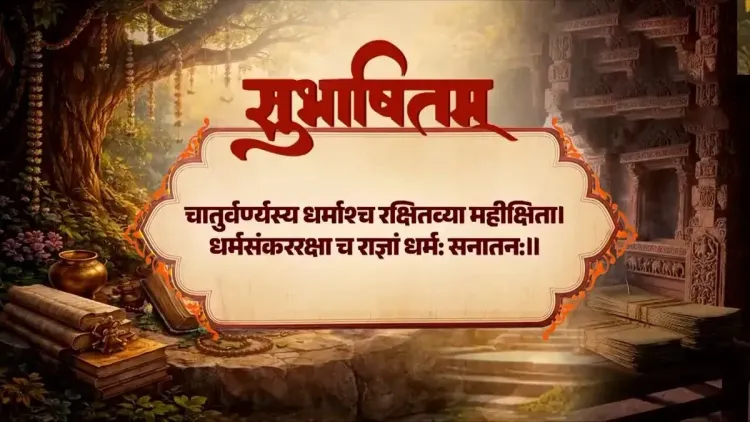
The two-line Sanskrit couplet shared by the Prime Minister reads: 'चातुर्वर्ण्यस्य धर्माश्च रक्षितव्या महीक्षिता। धर्मसंकररक्षा च राज्ञां धर्म: सनातन:॥' Translated, it conveys: 'The duties of the fourfold social order must be protected by the ruler of the earth; the protection against the mixing of dharma is the eternal duty of kings.' The verse frames governance as inseparable from the preservation of a timeless moral and social code.
The post was accompanied by a video, though its specific contents could not be independently verified at the time of publication. The verse is composed in classical Sanskrit and draws on the tradition of rajadharma — the dharma, or righteous duty, of a ruler.
Context
Prime Minister Modi has made the invocation of classical Indian texts a recurring feature of his public communication. Sanskrit verses touching on statecraft, duty, and civilizational identity appear periodically on his social media, particularly around cultural and religious occasions. This post continues that pattern, framing the responsibilities of governance in the language of ancient Indian political philosophy.
The concept of sanatana dharma — often rendered as the 'eternal order' or 'eternal duty' — has been a central motif in the Prime Minister's cultural messaging. His government has consistently positioned India's ancient civilizational texts as living frameworks relevant to modern governance and national identity.
Policy backdrop
The verse's emphasis on rajadharma — the ruler's obligation to uphold order and protect the social fabric — resonates with the BJP-led government's broader cultural agenda, which has included initiatives in Sanskrit promotion, classical arts, and the integration of ancient knowledge systems into education policy. The National Education Policy 2020 explicitly encourages the study of classical languages including Sanskrit.
Posts of this nature from the Prime Minister are watched closely by religious scholars, cultural organisations, and opposition commentators alike. Supporters read them as affirmations of India's civilizational continuity; critics periodically question the political implications of invoking varna-related frameworks in public discourse.
Stakeholders and impact
Religious scholars and Sanskrit academics are among the most engaged audiences for such posts, often offering textual commentary and source identification in responses. Cultural and Hindu religious organisations affiliated with the broader Sangh Parivar ecosystem typically amplify these messages as validation of their civilizational worldview.
For the wider public, the post reinforces the Prime Minister's personal brand as a leader rooted in classical Indian tradition — a positioning that has been consistent across his tenure. The verse's reference to protecting social order may draw varied interpretations depending on the reader's ideological lens.
What's next
Such posts from Prime Minister Modi have in the past preceded or accompanied larger addresses, cultural policy announcements, or ceremonial events where classical texts are cited. Observers will watch for any elaboration in upcoming speeches or government communications that draw on similar classical sources to articulate a vision of governance rooted in sanatana dharma.
Point of View
The post reinforces the BJP's broader cultural nationalism project without making an explicit policy announcement. The verse's invocation of protecting social order will inevitably draw divergent readings — affirmation from cultural conservatives and scrutiny from those who view varna-linked discourse as politically charged. Analysts will note that such posts often serve as ideological anchors ahead of larger policy or cultural moments.
NationPress
29 Jul 2026
Frequently Asked Questions
What Sanskrit verse did PM Modi post on June 11 2026?
PM Modi posted a verse that translates to: 'The duties of the fourfold social order must be protected by the ruler of the earth; the protection against the mixing of dharma is the eternal duty of kings.' The verse is in classical Sanskrit and draws on the tradition of rajadharma.
What is rajadharma in Indian tradition?
Rajadharma refers to the righteous duty or moral code of a king or ruler in ancient Indian political philosophy. It encompasses the obligation to uphold order, protect subjects, and maintain the social and dharmic fabric of society.
Why does PM Modi post Sanskrit verses on X?
Prime Minister Modi has made posting classical Sanskrit verses a recurring part of his digital outreach, using them to highlight India's civilizational heritage and reinforce themes of sanatana dharma, statecraft, and cultural identity that are central to his government's broader messaging.
What is sanatana dharma?
Sanatana dharma, often translated as 'eternal order' or 'eternal duty,' is a classical Indian concept referring to a timeless, universal moral and cosmic order. It is frequently invoked in Hindu philosophical and political discourse to describe enduring civilizational values.
What does the BJP government's cultural agenda include?
The BJP-led government's cultural agenda has included promotion of Sanskrit, support for classical arts, integration of ancient knowledge systems into education under the National Education Policy 2020, and consistent public messaging that frames India's governance in the context of its ancient civilizational traditions.