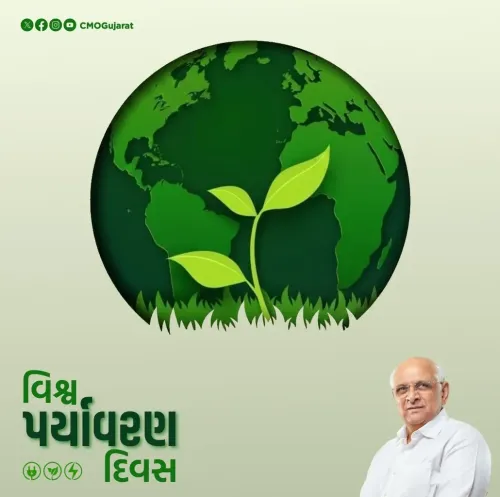
Env Minister Yadav Marks World Environment Day 2026

Synopsis
Union Environment Minister Bhupender Yadav marked World Environment Day on 5 June 2026 by renewing India's climate pledge under the theme 'Inspired by Nature,' linking tree planting and ecosystem restoration to India's net-zero and NDC commitments ahead of COP31.
Key Takeaways
Union Environment Minister Bhupender Yadav posted a World Environment Day message on 5 June 2026 under the theme 'Inspired by Nature.
For Our Future.' Yadav called nature 'our greatest ally in the fight against climate change' and urged citizens to plant trees and restore ecosystems.
India updated its Nationally Determined Contributions in August 2022 , targeting 50 per cent non-fossil fuel power capacity by 2030 .
India's net-zero emissions target is set for 2070 , announced at COP26 in Glasgow.
The Green India Mission under the National Action Plan on Climate Change remains the primary domestic vehicle for nature-based climate solutions.
India's next Biennial Update Report to the UNFCCC and state-level Green India Mission targets are key near-term deliverables to watch.
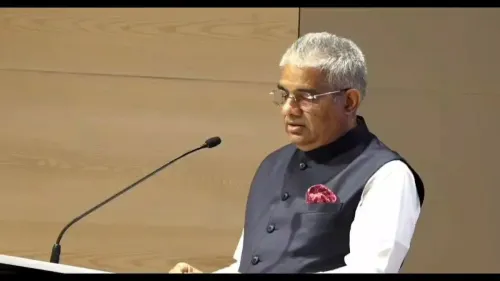
Union Environment Minister Bhupender Yadav on Friday, 5 June 2026 marked World Environment Day with a public pledge to advance climate action, calling nature 'our greatest ally in the fight against climate change' and urging collective effort to build 'a greener, cleaner and more resilient India for generations to come.'
Context
World Environment Day is the United Nations' principal vehicle for encouraging global awareness and action for the protection of the environment, observed every year on 5 June. This year's theme, 'Inspired by Nature. For Climate. For Our Future.', frames nature-based solutions as central to the global climate response. Minister Yadav anchored his message to that theme, calling on citizens to renew their commitment to the planet.
In his post on X, Yadav wrote: 'Every tree we plant, every ecosystem we restore, and every sustainable choice we make strengthens our collective future.' The message was accompanied by a video and carried the hashtags #EnvironmentDay and #NowForClimate, the latter a globally circulated mobilisation tag linked to UNFCCC campaigns.
Policy Backdrop
India's climate commitments provide the policy scaffolding behind such ministerial statements. At COP26 in Glasgow in November 2021, India announced a net-zero emissions target by 2070 — one of the 'Panchamrit' goals presented by Prime Minister Narendra Modi. In August 2022, India updated its Nationally Determined Contributions (NDCs) under the Paris Agreement, committing to sourcing 50 per cent of cumulative electric power from non-fossil fuel sources by 2030.
The National Action Plan on Climate Change (NAPCC), launched in June 2008, remains the overarching domestic framework, with its Green India Mission specifically targeting afforestation and ecosystem restoration — precisely the nature-based solutions Yadav highlighted. The Ministry of Environment, Forest and Climate Change, which Yadav has headed since July 2021, is the nodal body for implementing these commitments and reporting India's progress to the UNFCCC.
Stakeholders and Impact
The call to action is directed at a broad base: Indian citizens, state forest departments, environmental non-governmental organisations, and local communities involved in afforestation drives. India's climate strategy explicitly combines large-scale nature-based solutions — tree planting, wetland restoration, mangrove conservation — with renewable energy expansion, making public mobilisation on Environment Day a recurring instrument of policy communication.
Environmental groups and civil society observers have consistently noted that the success of programmes such as the Green India Mission depends heavily on grassroots participation and state-level implementation, both of which ministerial messaging on high-visibility days is designed to reinforce.
What's Next
Attention now turns to India's upcoming Biennial Update Report to the UNFCCC, which will document progress against the updated NDCs, and to state-level delivery of Green India Mission targets. With COP31 on the horizon, Environment Day 2026 statements from senior ministers are likely to set the tone for India's international climate diplomacy posture in the months ahead. The emphasis on nature-based solutions in Yadav's message signals continued alignment with the global push to integrate ecosystem restoration into nationally determined climate strategies.
Point of View
Giving New Delhi a strong narrative at COP31. For a senior BJP leader who also holds the Labour portfolio, framing environmental stewardship as a collective national duty rather than a regulatory burden reflects the government's long-standing effort to present growth and green goals as compatible. The post's reach will be measured less by its content than by whether it translates into renewed state-level momentum on Green India Mission targets.
NationPress
20 Oct 2026
Frequently Asked Questions
What did Bhupender Yadav say on World Environment Day 2026?
Union Environment Minister Bhupender Yadav called nature 'our greatest ally in the fight against climate change' and urged Indians to plant trees, restore ecosystems and make sustainable choices to build a greener and more resilient India.
What is the theme of World Environment Day 2026?
The theme of World Environment Day 2026 is 'Inspired by Nature. For Climate. For Our Future,' which focuses on nature-based solutions as a central pillar of climate action.
What is India's climate target under the Paris Agreement?
India updated its Nationally Determined Contributions in August 2022, committing to 50 per cent non-fossil fuel electric power capacity by 2030 and a net-zero emissions target by 2070, announced at COP26 in Glasgow.
What is the Green India Mission?
The Green India Mission is one of eight national missions under India's National Action Plan on Climate Change, launched in 2008, focused on afforestation, ecosystem restoration and biodiversity conservation.
When is World Environment Day observed?
World Environment Day is observed every year on 5 June as the United Nations' principal global platform for environmental awareness and action.