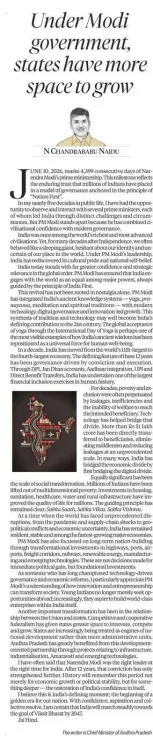
Bhupender Yadav shares Chandrababu Naidu's column on federalism
Synopsis
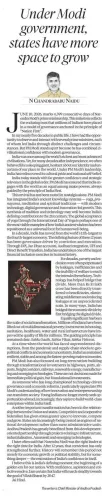
Union Environment Minister Bhupender Yadav amplified Andhra Pradesh Chief Minister Chandrababu Naidu's column arguing that states enjoy greater autonomy under PM Modi's government, sharing it as part of the BJP's #12YearsOfSeva campaign marking twelve years of Modi's tenure at the Centre.
Key Takeaways
Bhupender Yadav shared Chandrababu Naidu 's opinion column on June 9, 2026 , under the #12YearsOfSeva hashtag.
Naidu argues that states have 'more space to grow' under PM Narendra Modi 's government.
The 14th Finance Commission in 2015 raised states' share in central taxes from 32% to 42% , the largest devolution in India's fiscal history.
The Planning Commission was replaced by NITI Aayog in 2015 to institutionalise cooperative federalism.
GST , implemented in 2017 , restructured Centre-state fiscal relations with a built-in state compensation mechanism.
The post fits a pattern of NDA-aligned regional leaders endorsing the Centre's federal record during BJP anniversary campaigns.
Union Environment Minister Bhupender Yadav on Tuesday, June 9, 2026, shared an opinion piece by Andhra Pradesh Chief Minister N. Chandrababu Naidu, highlighting Naidu's argument that states have greater space to grow under the central government led by Prime Minister Narendra Modi. The post, shared under the campaign hashtag #12YearsOfSeva, amplifies a regional NDA ally's endorsement of the Union government's cooperative federalism approach.
Context
Yadav's post quotes Naidu's column directly: 'Under the government led by PM Shri Narendra Modi ji, states have more space to grow.' The share is part of the broader #12YearsOfSeva campaign marking twelve years of Prime Minister Modi's tenure at the Centre, during which NDA-aligned leaders have been amplifying narratives of federal cooperation and state-level development gains.
Chandrababu Naidu, who leads the Telugu Desam Party (TDP) and is a key NDA partner, has been among the more vocal regional leaders on the subject of state autonomy. His column argues that the current dispensation has meaningfully expanded the operational and fiscal latitude available to state governments.
Policy Backdrop
The cooperative federalism narrative has concrete policy anchors. In 2015, the Planning Commission was dissolved and replaced by NITI Aayog, repositioning states as active partners in development planning rather than passive recipients of centrally dictated schemes. In the same year, the 14th Finance Commission's recommendations were accepted, raising states' share in central taxes from 32% to 42% — the single largest devolution in India's fiscal history.
The rollout of the Goods and Services Tax (GST) in 2017 further restructured Centre-state financial relations, creating a unified indirect tax regime with a built-in compensation mechanism for states facing revenue shortfalls during the transition period. Together, these measures form the policy lineage that leaders like Naidu invoke when speaking about enhanced state autonomy.
Stakeholders and Impact
The audience for this messaging is primarily state governments and chief ministers across the NDA coalition, for whom the cooperative federalism framework translates into greater flexibility in designing and implementing centrally-sponsored schemes. For Andhra Pradesh specifically, the relationship with the Centre has carried particular weight given the state's post-bifurcation development priorities and infrastructure financing needs.
Opposition-governed states have at times contested the cooperative federalism characterisation, arguing that fiscal transfers and scheme conditions still leave limited room for independent policy choices. The debate over Centre-state relations therefore remains live, making endorsements like Naidu's politically significant within the NDA's anniversary messaging cycle.
What's Next
Attention will turn to upcoming meetings of the GST Council and the Inter-State Council, where the practical dimensions of Centre-state cooperation are negotiated. Any new guidelines increasing state flexibility in centrally-sponsored schemes would add substantive weight to the political narrative being advanced through the #12YearsOfSeva campaign. How non-NDA chief ministers respond to this framing is also likely to shape the federalism debate in the months ahead.
Point of View
Lending it cross-party credibility within the NDA tent. The #12YearsOfSeva campaign is systematically collecting such endorsements to construct a mosaic of governance validation ahead of future electoral cycles. For Chandrababu Naidu, the column also serves a local purpose — signalling continued alignment with New Delhi at a time when Andhra Pradesh's infrastructure and special-status demands require sustained central support. The episode illustrates how anniversary campaigns have evolved into structured political communications exercises, blending policy narrative with coalition management.
NationPress
20 Sept 2026
Frequently Asked Questions
What did Chandrababu Naidu write about PM Modi and state autonomy?
Naidu argued in his column that states have 'more space to grow' under the central government led by Prime Minister Narendra Modi, citing the cooperative federalism approach pursued since 2014.
What is the #12YearsOfSeva campaign?
#12YearsOfSeva is a BJP-led campaign marking twelve years of Prime Minister Narendra Modi's governance, during which NDA leaders and allies share endorsements of his tenure's policy record.
How has India's cooperative federalism policy changed since 2014?
Key changes include replacing the Planning Commission with NITI Aayog in 2015, raising states' share in central taxes from 32% to 42% following the 14th Finance Commission, and implementing GST in 2017 with a state revenue compensation mechanism.
Why did Bhupender Yadav share Chandrababu Naidu's article?
Yadav shared the article as part of the #12YearsOfSeva campaign to amplify an NDA ally's endorsement of PM Modi's governance record on cooperative federalism.
What is NITI Aayog and how does it differ from the Planning Commission?
NITI Aayog, established in 2015, replaced the Planning Commission to give states a greater voice in national development planning, treating them as partners rather than implementers of centrally dictated schemes.