Yadav Highlights Modhera as India's First Solar Village

Synopsis
Union Environment Minister Bhupender Yadav, speaking during Mann Ki Baat, spotlighted Modhera in Gujarat as India's first round-the-clock solar village — powered by a 6 MW plant with battery storage since 2022 — as a national sustainability model.
Key Takeaways
Modhera in Mehsana district, Gujarat is declared India's first fully solar-powered village, running 24 hours on renewable energy.
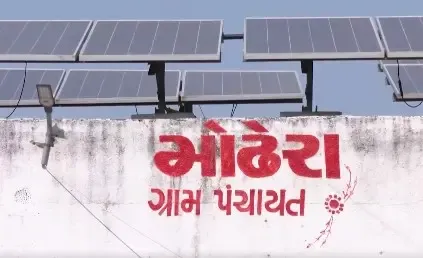
The village was equipped with a 6 MW solar plant backed by battery storage, inaugurated in October 2022 under a Gujarat government project.
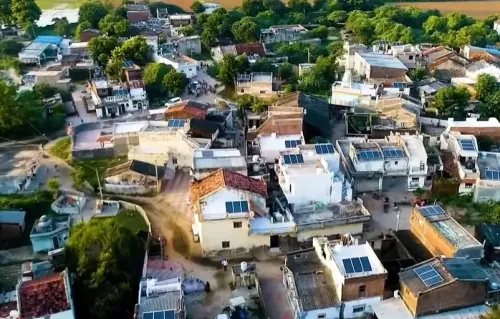
Every Modhera household has rooftop solar panels; surplus power feeds back into the local grid.
Union Environment Minister Bhupender Yadav cited Modhera during the Mann Ki Baat broadcast as a national sustainability example.
New tourist facilities have been launched at Modhera alongside the solar infrastructure, boosting its profile as a sustainable heritage destination.
The Modhera model is being watched as a potential blueprint for scaling solar microgrids to villages across India under the broader 500 GW non-fossil target by 2030 .
Long before the solar panels arrived, Modhera was a place of sun worship — its 11th-century Sun Temple drawing pilgrims and archaeologists alike. Now, Union Environment Minister Bhupender Yadav has underscored that this Mehsana district village in Gujarat has taken that ancient reverence for the sun and turned it into something India's entire energy transition can learn from.
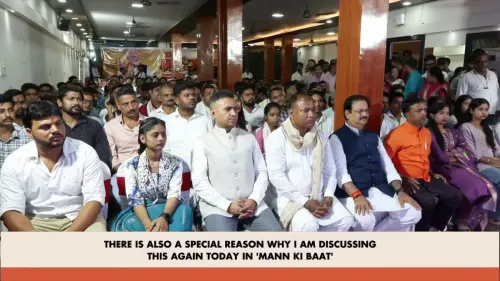
Writing on Sunday, September 27, during the broadcast of Prime Minister Narendra Modi's Mann Ki Baat, Yadav noted: 'Modhera is now known not only for the Sun Temple, but this village in Gujarat has become the country's first Solar Village — Modhera today runs entirely on solar energy and has presented a model of sustainability before the nation.'
From Ancient Sun Shrine to Round-the-Clock Solar Grid
The transformation of Modhera is rooted in a Gujarat government project inaugurated in October 2022, which equipped the village with a 6 MW solar plant backed by battery storage — enabling 24-hour solar power supply independent of the conventional grid. Every household received rooftop solar panels; the excess power they generate feeds back into the system. The village essentially became a live demonstration of what a decentralised, storage-backed renewable microgrid can deliver at the community scale.
It was a deliberate pairing of heritage and innovation. The Sun Temple, managed by the Archaeological Survey of India, was already one of Gujarat's most visited monuments. Layering a solar-village model on top of that existing tourism draw gave the initiative both symbolic weight and practical footfall.
Why Modhera Matters to India's 500 GW Ambition
India has committed to reaching 500 GW of non-fossil fuel capacity by 2030 under its National Solar Mission targets. Most of that headline number is pursued through large utility-scale parks — but Modhera represents the village-scale end of the same strategy. Gujarat has been at the forefront of that diversified push, with canal-top solar projects, solar parks, and now solar microgrids for entire communities.
The Modhera model carries a replication question that policymakers are already watching: can a state-funded microgrid-plus-storage approach be rolled out across hundreds of energy-deficient villages nationally, and what would central funding frameworks need to look like to make that happen?
Tourism Infrastructure Added Alongside the Solar Rollout
Yadav's post also flags that new tourist attractions and facilities have been launched in Modhera — a detail that points to the village being positioned not just as a renewable energy showcase but as a sustainable tourism destination. The combination of a world-class archaeological monument, a functioning solar ecosystem, and upgraded visitor infrastructure gives Modhera a rare multi-layered draw. Exact details of the new facilities announced remain to be officially documented.
For a government that has consistently tied its environmental credentials to visible, ground-level outcomes, Modhera is a useful proof point: sustainability not as an abstraction, but as a living, lit-up village that you can visit, photograph, and take home as a story.
Modhera once told India what its ancestors thought about the sun. It is now telling the country what its future could look like — and the lights are already on.
Point of View
Gujarat's governance success story, and India's green energy ambition. By framing a state-level initiative as a national model, the Centre shares the halo of a project it did not fund directly. The real policy question Modhera raises is whether the solar-village microgrid model can be replicated at scale with central financing, or whether it remains an impressive but isolated showcase — that answer will determine whether Modhera is a milestone or merely a monument to good intentions.
NationPress
27 Sept 2026
Frequently Asked Questions
What makes Modhera India's first solar village?
Modhera in Gujarat's Mehsana district was equipped with a 6 MW solar plant and battery storage system in October 2022, enabling round-the-clock solar power for every household — making it India's first village fully powered by solar energy.
Who inaugurated the Modhera solar village project?
The Modhera solar village project was inaugurated by the Gujarat state government in October 2022; Prime Minister Narendra Modi highlighted it as part of India's renewable energy push.
What is the Modhera Sun Temple?
The Modhera Sun Temple is an 11th-century temple dedicated to the sun god Surya, located in Mehsana district, Gujarat, and managed by the Archaeological Survey of India as a protected heritage monument.
Why did Bhupender Yadav mention Modhera on Mann Ki Baat?
Union Environment Minister Bhupender Yadav cited Modhera as a model of sustainability, noting that the village runs entirely on solar energy and has set an example for the rest of the country on green living.
Can the Modhera solar village model be replicated elsewhere in India?
Policymakers and the renewable energy sector are watching whether the Modhera microgrid-plus-storage approach can be scaled to other energy-deficient villages, potentially through central government solar village funding programmes.