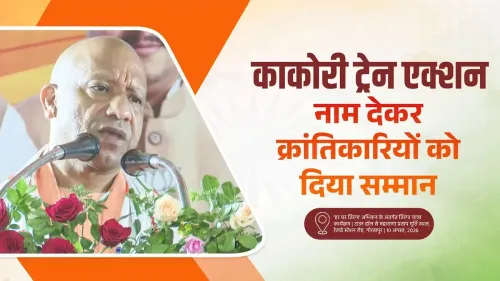
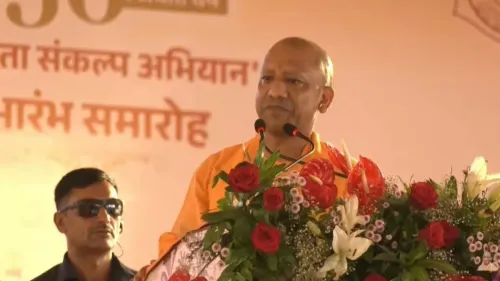
CM Yogi Warns: Foreign Profits Fund Terror, Urges Swadeshi
Synopsis
Uttar Pradesh Chief Minister Yogi Adityanath warned on 17 August 2026 that profits flowing abroad can fund terrorism and Naxalism against India, urging citizens to stay alert and prioritise swadeshi goods as a matter of national security.
Key Takeaways
CM Yogi Adityanath posted the warning on 17 August 2026 , reaching his large social-media audience.
He argued that a portion of profits sent to foreign entities can be redirected to fund terrorism and Naxalism targeting India.
He explicitly called on Indians to prioritise swadeshi (indigenous) products and services.
The message aligns with national campaigns such as 'Vocal for Local' and 'Make in India' , but adds a direct counter-terror framing.
No specific countries, companies, or organisations were named in the post.
Every rupee that leaves India's borders, Uttar Pradesh Chief Minister Yogi Adityanath warned on Monday, 17 August 2026, carries a hidden cost — one that can return as a bullet or a bomb. In a sharp message posted on X, the Chief Minister urged Indians to stay alert and put swadeshi (indigenous goods and enterprise) first.
The post, in Hindi, states: 'When our profits go abroad, a part of that money is spent against us — on terrorism, Naxalism, and destabilising India. Always stay aware and prioritise swadeshi.' The argument is direct: consumer choices have a national-security dimension, and ignoring that link is a risk the country cannot afford.
The security logic behind a shopping choice
The Chief Minister's framing draws a straight line from economic leakage to armed threat. The logic runs like this: profits flowing to certain foreign entities or intermediaries can, in part, finance networks that sponsor terrorism or Naxal insurgency on Indian soil. By choosing domestic products and services, citizens effectively starve those funding pipelines.
It is a nationalist-economic argument with a long lineage in Indian political thought — rooted in the original swadeshi movement of the independence era, now recast in the language of counter-terrorism and internal security. CM Yogi, as head of India's most populous state and a senior BJP leader, carries significant reach when he frames consumer behaviour as a patriotic and security imperative.
Swadeshi as a political and policy posture
The call for swadeshi preference sits within a broader national push — visible in the 'Vocal for Local' and 'Make in India' campaigns — to redirect Indian spending toward domestic manufacturers. What Yogi Adityanath adds here is an explicit security overlay: this is not merely about jobs or GDP, but about cutting off money that, he argues, loops back as violence.
The post does not name specific countries, companies, or organisations. It is a broad-brush awareness call, and its power lies precisely in that generality — it asks every Indian consumer to pause before each purchase and ask who ultimately benefits.
In a state where both Naxal-affected districts in the eastern belt and cross-border terror threats remain live concerns, the message lands with particular weight. Whether it translates into policy — procurement rules, import curbs, consumer campaigns — or remains a motivational appeal is the question that follows every such statement.
The Chief Minister of India's largest state just told its citizens that where they spend their money is a matter of national survival. That is a hard argument to scroll past.
Point of View
He elevates a cultural-economic preference into a civic duty, making dissent or indifference seem unpatriotic. The framing also allows the ruling party to connect grassroots consumer behaviour to high-stakes national-security narratives without announcing a specific policy, giving the message maximum reach at minimum political risk. Watch for whether this becomes a campaign plank ahead of any upcoming state or national electoral cycle.
NationPress
1 Oct 2026
Frequently Asked Questions
What did CM Yogi Adityanath say about foreign profits and terrorism?
CM Yogi Adityanath stated on 17 August 2026 that when Indian profits go abroad, a portion of that money can be used to fund terrorism, Naxalism, and efforts to destabilise India, urging citizens to always prioritise swadeshi products.
What does swadeshi mean and why is CM Yogi promoting it?
Swadeshi means 'of one's own country' — preferring goods and services produced domestically. CM Yogi is promoting it as both an economic and national-security measure, arguing that keeping money within India prevents it from financing hostile networks.
Did Yogi Adityanath name any country or organisation in his warning?
No. The post did not name any specific country, company, or organisation. It was a broad awareness appeal directed at Indian consumers in general.
How does this relate to 'Vocal for Local' and 'Make in India'?
The swadeshi call echoes those campaigns' goal of boosting domestic production and consumption, but Yogi Adityanath's post adds an explicit national-security argument — that foreign spending can indirectly fund threats to India — which goes beyond the economic rationale of those programmes.
Is Naxalism still a concern in Uttar Pradesh?
Parts of eastern Uttar Pradesh have historically been affected by Naxal influence, though the intensity has varied over the years. CM Yogi's reference to Naxalism alongside terrorism signals that he views both as live threats relevant to his state and the country.