30kg drone could collapse China's suspension bridges, study warns
Synopsis
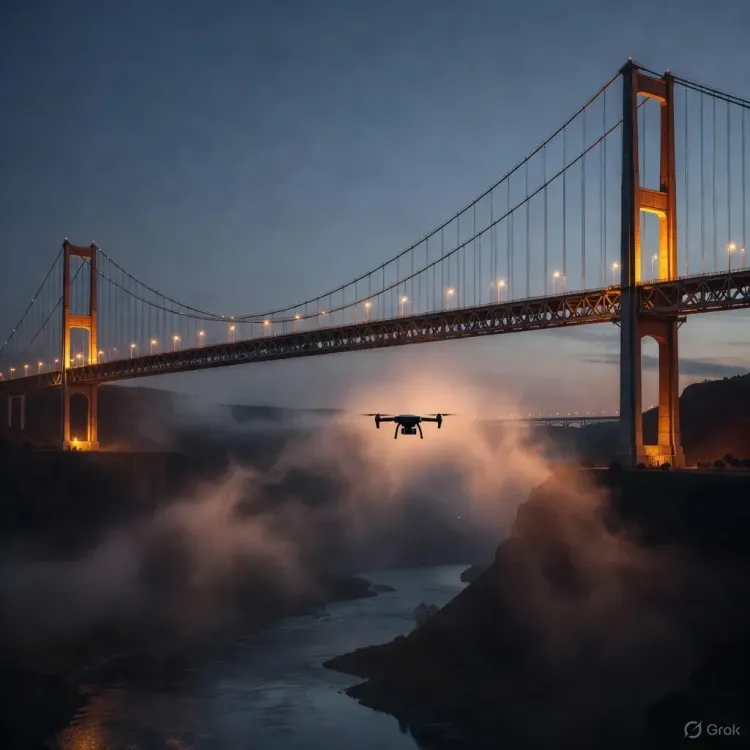
A peer-reviewed Chinese study reveals a drone carrying just 30kg of TNT could collapse a major suspension bridge by targeting the cable-tower junction — a finding with stark implications for China's 11,000-plus mega bridges amid the precision-strike lessons of the Ukraine war.
Key Takeaways
Chinese researchers simulated a drone strike on a major suspension bridge, finding that 30kg (66 lbs) of TNT detonated at the cable-tower junction is sufficient to trigger collapse.
The study was published in the September 2026 issue of the Journal of Railway Science and Engineering .
China has more than 11,000 mega bridges , many of which are critical economic and transport links in remote regions.
Researchers cited real-world precedents including attacks on the Antonovsky Bridge near Kherson and the Crimean Bridge during Russia's war on Ukraine .
The findings highlight a global shift from mass firepower to low-cost precision strikes against hard infrastructure, lowering the threshold for strategic disruption.
Chinese researchers have published a simulation study warning that a small drone carrying just 30 kilograms (66 lbs) of TNT could trigger the collapse of a major suspension bridge if detonated at a precise structural weak point — findings with direct implications for China's network of more than 11,000 mega bridges. The paper appeared in the September 2026 issue of the Journal of Railway Science and Engineering.
What the simulation found
Researchers modelled a drone strike on one of China's large suspension bridges and identified a critical vulnerability: detonating a 30kg TNT payload within inches of the main suspension cable at the junction with a support tower is sufficient to initiate structural failure. The finding underscores how little explosive force — delivered with precision — is needed to compromise infrastructure that was designed to withstand far larger conventional threats. The team noted that the scenario is no longer theoretical. Russia's war on Ukraine has produced documented cases of targeted bridge strikes, including attacks on the Antonovsky Bridge over the Dnieper River near Kherson and damage to the Crimean Bridge, demonstrating that precision drone and missile strikes can neutralise strategic crossings that were once considered difficult targets.Why it matters
'These events starkly reveal the extreme vulnerability of modern bridges to unconventional explosive attacks,' the research team wrote in the published paper. The shift from mass firepower to precision strikes, they argued, has fundamentally changed the threat calculus for civil infrastructure planners and defence strategists alike. China hosts some of the world's most ambitious bridge engineering, including the Zhangjinggao Yangtze River Bridge, the Dimuhe River Bridge, and structures spanning the dramatic gorges of Guizhou province such as the Huajiang Canyon Bridge. Many of these crossings are not merely transport links but economic lifelines connecting remote regions to national supply chains.The competitive backdrop
The study arrives as militaries worldwide accelerate investment in loitering munitions and commercial-drone-derived weapons platforms. The low cost and wide availability of drone technology means that the barrier to executing a precision infrastructure strike has dropped sharply — a concern that extends well beyond China to bridge-dense nations across Asia-Pacific, Europe, and beyond. Infrastructure vulnerability research of this kind is increasingly being published openly, reflecting a broader academic push to force policy responses before adversaries exploit known weaknesses rather than after.What's next
The researchers did not publicly specify countermeasures in the published abstract, but the study is expected to inform ongoing discussions within China's transport and defence ministries about hardening critical crossings. The question now is whether findings like these accelerate the deployment of anti-drone systems — such as electronic jamming arrays and kinetic interceptors — at high-value bridge sites across the country, and how quickly peer nations will follow suit.Point of View
And China's bridge-heavy geography — spanning deep river gorges and seismic zones — makes hardening these assets both urgent and extraordinarily expensive. Watch for whether this study accelerates procurement of counter-drone systems at strategic crossings, or whether it quietly shapes classified engineering standards for future bridge construction.
NationPress
23 Sept 2026
Frequently Asked Questions
What did the Chinese drone-bridge study find?
Chinese researchers found that a drone carrying just 30kg (66 lbs) of TNT could collapse a major suspension bridge if the payload is detonated within inches of the main suspension cable at its junction with a support tower. The simulation was published in the September 2026 issue of the Journal of Railway Science and Engineering .
Which bridges in China are considered at risk?
China's more than 11,000 mega bridges are broadly implicated, with the study referencing major structures such as the Zhangjinggao Yangtze River Bridge , the Dimuhe River Bridge , and the Huajiang Canyon Bridge in Guizhou province. These crossings are critical transport and economic links, making them high-value targets under the study's threat model.
How does the Ukraine war relate to China's bridge vulnerability concerns?
Researchers pointed to documented strikes on the Antonovsky Bridge over the Dnieper River near Kherson and the Crimean Bridge as real-world evidence that precision drone and missile attacks can neutralise strategic infrastructure. These events, the team wrote, 'starkly reveal the extreme vulnerability of modern bridges to unconventional explosive attacks.'
Why is a small drone considered such a serious threat to large bridges?
The study shows that structural vulnerability is concentrated at specific points — particularly where suspension cables meet support towers — meaning a small, precisely delivered payload can cause disproportionate damage. The low cost and increasing availability of drone technology have dramatically lowered the barrier to executing such a strike compared with conventional military hardware.
What countermeasures are being considered for Chinese bridges?
The published study did not detail specific countermeasures, but the research is expected to inform discussions within China's transport and defence sectors about deploying anti-drone systems — including electronic jamming and kinetic interceptors — at high-value bridge sites. The findings may also influence engineering standards for future bridge construction across the country.