How Are Indian Researchers Utilizing AI to Reveal H5N1's Transition to Humans?

Synopsis
A groundbreaking study from Indian researchers unveils how the bird flu virus H5N1 could potentially leap to humans using an AI model. With the virus evolving, understanding these mechanisms is crucial for public health safety.
Key Takeaways
The study utilized an AI model to analyze H5N1 transmission.
It highlights the importance of early intervention in outbreaks.
Culling birds is effective if no primary infection has occurred.
Isolation and quarantine can limit further infections.
Stricter measures may be necessary once community transmission occurs.
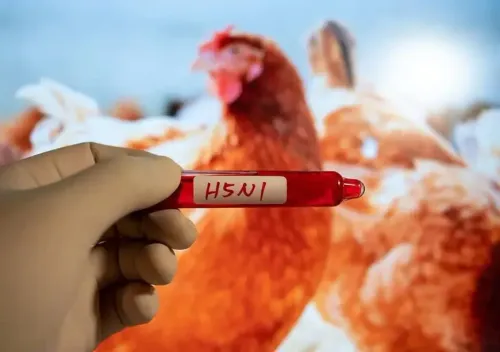
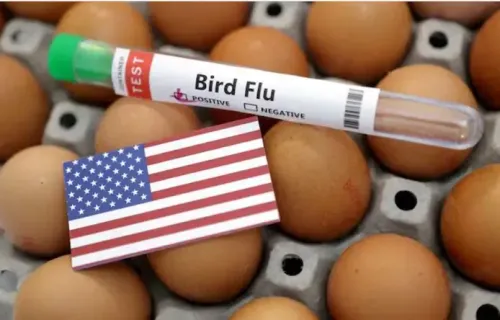
New Delhi, Dec 18 (NationPress) As the bird flu virus H5N1 undergoes rapid evolution, posing a considerable danger to human health, a group of Indian researchers has employed an Artificial Intelligence (AI)-driven model to uncover the mechanisms by which this lethal virus can transfer to humans.
Published in the BMC Public Health journal, their study utilized BharatSim—an expansive agent-based simulation framework initially designed for Covid-19 modeling—to illustrate the various stages of a zoonotic spillover.
“We examined the potential for initial spillover events of H5N1 from birds to humans, followed by sustained transmission between humans,” stated Philip Cherian and Gautam I. Menon from the Department of Physics at Ashoka University in Haryana.
“Our model outlines the two-step process of how an outbreak begins, highlighting how crucial epidemiological parameters influencing transmission can be adjusted based on early data regarding primary and secondary cases,” they explained.
First emerging in China during the late 1990s, avian flu has intermittently infected humans.
Given that South and Southeast Asia host some of the world's fastest-growing poultry markets, this region is anticipated to be the most likely site for an initial outbreak.
The World Health Organization (WHO) has documented 990 human cases of H5N1 across 25 countries, leading to 475 fatalities with a fatality rate of 48% from 2003 until August 2025.
The computational model indicated that culling birds is the most effective strategy to mitigate H5N1 outbreaks, whether at a farm or in a wet market, but this measure is only effective if no primary infections have occurred.
“In our analysis of tertiary attack risk, we discovered that even if a primary case becomes infected, further infections are contained if those cases are isolated and their household contacts quarantined. However, once tertiary contacts get infected, controlling the situation becomes nearly impossible unless significantly stricter measures, including a complete lockdown, are enforced,” the researchers noted.
They emphasized that effective control measures are most impactful during the initial stages of an outbreak.
“Once community transmission begins, more drastic public health interventions such as lockdowns, mandatory masking, and widespread vaccination campaigns become the only viable options,” the researchers added.
This study demonstrates how such models facilitate the systematic, real-time assessment of policy measures that can limit disease spread while enhancing our understanding of disease epidemiology for emerging infectious threats.
Point of View
It is essential to highlight the significance of this research uncovering the potential pathways for H5N1 transmission to humans. This study not only emphasizes the importance of early intervention but also showcases the innovative use of AI in understanding complex health threats. With the growing poultry markets in Asia, vigilance and proactive measures are critical.
NationPress
3 Oct 2026
Frequently Asked Questions
How does AI help in understanding H5N1's transmission?
AI models can simulate potential spillover events and assess epidemiological parameters, providing insights into how the virus might jump from birds to humans.
What are the risks of H5N1 outbreaks?
H5N1 outbreaks pose significant risks to human health, with a high fatality rate among infected individuals.
Why are control measures crucial during early stages of an outbreak?
Implementing control measures early can drastically reduce transmission rates and prevent widespread outbreaks.
What are the implications of this research for public health?
Understanding the transmission pathways of H5N1 can help inform public health strategies and prevent future outbreaks.