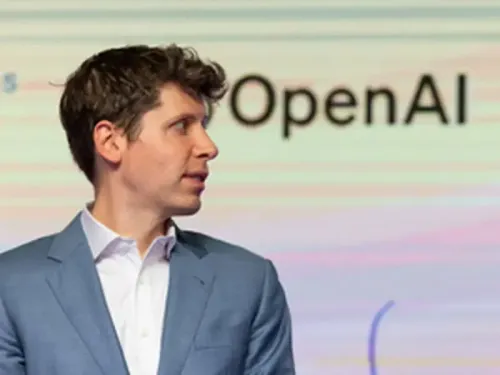
Sam Altman backs new US AI executive order, urges leadership

Synopsis
OpenAI chief executive Sam Altman has backed a newly issued United States executive order on artificial intelligence, arguing Washington should lead by building the best models, ensuring safety and equipping trusted cyber defenders. His endorsement aligns the largest US AI developer with the administration's latest framework as Congress weighs broader legislation.
Key Takeaways
OpenAI chief executive Sam Altman endorsed a new US executive order on artificial intelligence on June 3, 2026.
Altman framed US AI leadership around three pillars: best-in-class models, safety, and cyber tools for trusted defenders.
The order follows the Biden administration's Executive Order 14110 of October 2023 and the 2022 Blueprint for an AI Bill of Rights.
Key stakeholders include frontier AI developers, cloud providers, federal cybersecurity agencies and national laboratories.
Next steps include possible Congressional AI legislation and fresh NIST guidance on cybersecurity for advanced models.
OpenAI chief executive Sam Altman on Wednesday, June 3, 2026, publicly endorsed a newly issued United States executive order on artificial intelligence, arguing that Washington must continue to lead the global AI race through frontier model development, safety assurances and stronger cyber-defence capacity.
In his post on X, Altman wrote that 'the US should lead on AI by continuing to develop the very best models, making sure they're safe, and getting cyber tools into the hands of trusted defenders', adding that 'the new EO gets the balance right'. The intervention from one of the industry's most influential voices signals broad backing from the country's largest AI developer for the administration's latest policy framework.
Context
Altman co-founded OpenAI, the San Francisco-based research and deployment company behind the GPT series of large language models. He has emerged as a central interlocutor between Silicon Valley and Washington on questions of AI safety, compute access and national competitiveness.
His three-pronged framing — frontier capability, safety, and cyber defence — tracks closely with positions OpenAI has articulated in past Congressional testimony and white papers, where the company has argued that responsible scaling and government partnership are complementary rather than opposed.
Policy backdrop
US AI policy has evolved through a sequence of executive actions. In October 2022, the White House released a Blueprint for an AI Bill of Rights, setting out voluntary principles for algorithmic systems. A year later, in October 2023, the Biden administration issued Executive Order 14110 on the Safe, Secure, and Trustworthy Development and Use of Artificial Intelligence, directing federal agencies to establish standards across testing, reporting and procurement of advanced models.
Successive administrations have paired domestic executive measures with export controls on advanced semiconductors and diplomatic outreach to shape global norms, particularly amid strategic competition with China. The new order Altman references is the latest entry in that arc, although its full text and operative provisions remain to be parsed by industry and civil society.
Stakeholders and impact
The cohort most directly affected includes frontier AI developers, cloud infrastructure providers, federal cybersecurity agencies and the national laboratories that increasingly host model evaluations. Altman's emphasis on placing 'cyber tools' with 'trusted defenders' echoes a growing policy consensus that advanced models are dual-use — capable of both enabling and blunting offensive cyber operations.
For Indian stakeholders, the order matters on three counts. First, Indian information technology services firms and start-ups building on US foundation models will operate within whatever compliance perimeter the order establishes. Second, New Delhi's own evolving approach, anchored in the IndiaAI Mission and the Digital India Act drafting process, is being shaped in dialogue with US frameworks. Third, Indian cybersecurity vendors are increasingly embedded in transatlantic supply chains for managed detection and response.
What's next
Attention now turns to two tracks in Washington. The first is Congressional consideration of comprehensive AI legislation, which has stalled across multiple sessions despite bipartisan interest. The second is fresh guidance expected from the National Institute of Standards and Technology on cybersecurity practices for advanced models, including red-teaming protocols and incident reporting.
Altman's endorsement gives the administration political cover from a key constituency, but it also raises the bar for follow-through. Implementation choices — on compute thresholds, evaluation regimes and information-sharing with allies — will determine whether the 'balance' he praises holds up under scrutiny from researchers, civil liberties groups and competing AI labs. For governments in India, the European Union and the United Kingdom, the new order will function as both reference point and pressure test for their own frameworks.
Point of View
Unqualified endorsement is as much political signalling as policy commentary. By framing the order as striking the right balance, he positions OpenAI alongside the administration at a moment when scrutiny of frontier labs is intensifying from both progressive and national-security camps. The statement also reinforces a broader pattern in which leading US AI firms trade visible cooperation on safety and cyber defence for a permissive environment to keep scaling. The harder test will be whether the order's implementation details satisfy critics who argue voluntary commitments have not kept pace with model capability.
NationPress
18 Oct 2026
Frequently Asked Questions
What did Sam Altman say about the new US AI executive order?
Sam Altman said the United States should lead on AI by developing the best models, ensuring they are safe, and getting cyber tools into the hands of trusted defenders, adding that the new executive order 'gets the balance right'.
When did Sam Altman post about the AI executive order?
He posted the statement on X on Wednesday, June 3, 2026.
What is OpenAI and who leads it?
OpenAI is a San Francisco-based artificial intelligence research and deployment company best known for the GPT series of large language models. It is led by co-founder and chief executive Sam Altman.
What was the earlier Biden AI executive order?
In October 2023, the Biden administration issued Executive Order 14110 on the Safe, Secure, and Trustworthy Development and Use of Artificial Intelligence, directing federal agencies to set standards for advanced AI systems.
How does US AI policy affect India?
It shapes the compliance environment for Indian IT services firms and start-ups built on US foundation models, informs New Delhi's own IndiaAI Mission and Digital India Act drafting, and influences cybersecurity supply chains involving Indian vendors.