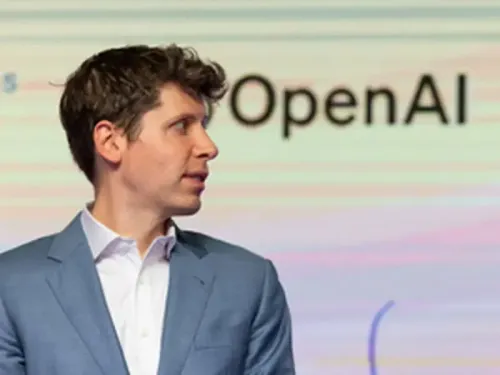
Sam Altman on OpenAI: 'Magic Intelligence' Must Work for Everyone

Synopsis
OpenAI CEO Sam Altman praised his team not just for building frontier AI but for doing so with a focus on business privacy, low prices, and predictable policies — framing broad accessibility as central to the company's mission.
Key Takeaways
OpenAI chief executive Sam Altman posted on X on 9 August 2026 praising his team's dual focus on frontier AI capability and broad accessibility.
Altman cited business privacy, low prices, and predictable policies as the pillars of OpenAI's 'everyone wins' approach.
The statement reflects a wider industry pattern where AI labs pair raw capability with governance and pricing commitments to win enterprise and regulatory trust.
Predictable AI policies are increasingly seen as a competitive moat , not merely a compliance checkbox, in a crowded model-provider market.
For India's AI-native startups and enterprises, Altman's framing signals OpenAI's intent to prioritise broad, affordable access alongside technical performance.
It is one thing to build what OpenAI chief executive Sam Altman calls 'magic intelligence in the sky.' It is another to build it in a way that every business, developer, and everyday user can actually trust and afford. On Sunday, 9 August 2026, Altman made clear he considers the second part just as impressive as the first.
Responding on X, Altman wrote that while frontier AI capability alone would be remarkable, what genuinely impresses him is that his team pursues it 'with such a focus on making sure everyone wins' — citing business privacy, low prices, and predictable policies as the pillars of that commitment.
Why 'everyone wins' is harder than it sounds
The phrase sounds warm, but the engineering and policy challenge behind it is immense. Enterprises will not embed an AI system they cannot trust with sensitive data. Developers will not build on a platform whose pricing can shift overnight. Governments will not greenlight deep integration without some assurance of regulatory stability. OpenAI is signalling that it is designing for all three audiences simultaneously — not as an afterthought, but as a core product discipline.
Across the AI industry, the pattern is now familiar: frontier capability alone no longer wins the room. Labs that pair raw model performance with privacy guarantees, transparent pricing tiers, and long-term policy commitments are the ones landing enterprise contracts and surviving regulatory scrutiny. Altman's post, brief as it is, reads as a public restatement of that philosophy from the top.
The competitive stakes behind the sentiment
OpenAI operates in a market crowded with capable rivals, each pitching their own version of trustworthy, affordable AI. In that context, Altman's emphasis on 'predictable policies' is not incidental — predictability is a moat. Businesses making multi-year technology bets need confidence that the platform they choose today will not reprice, restrict, or pivot away from their use case tomorrow. By naming it explicitly, Altman is positioning it as a deliberate competitive differentiator, not a regulatory concession.
For India's fast-growing base of AI-native startups and large enterprises exploring OpenAI integrations, the signal is direct: the company is thinking about broad accessibility, not just frontier benchmarks.
The real test, of course, is whether product updates on privacy controls and pricing structures follow the rhetoric — and on that, the industry will be watching closely.
Point of View
Not a moat. By naming privacy, pricing, and policy predictability in the same breath, he is signalling that OpenAI's competitive strategy is as much about trust architecture as it is about model benchmarks. This mirrors a broader shift where enterprise adoption — not just research prestige — determines which AI platforms endure. The statement also functions as a pre-emptive answer to regulators and procurement officers who ask not 'how powerful is it?' but 'can we rely on it?'
NationPress
24 Sept 2026
Frequently Asked Questions
What did Sam Altman say about OpenAI on X?
Sam Altman said he is impressed not just by OpenAI building advanced AI but by the team's focus on ensuring everyone benefits — through business privacy, low prices, and predictable policies.
What does OpenAI mean by 'predictable policies'?
Predictable policies refer to stable, consistent rules around how OpenAI's platforms operate, price, and handle data — giving businesses and developers confidence to build long-term on OpenAI's infrastructure.
Why is business privacy important for AI companies like OpenAI?
Enterprises share sensitive data with AI systems; without strong privacy guarantees, they will not integrate AI into core workflows. Business privacy is a foundational requirement for enterprise adoption.
How does OpenAI's pricing strategy affect Indian startups?
Low and predictable pricing lowers the barrier for Indian startups to access frontier AI, making it viable to build AI-native products without prohibitive infrastructure costs.
What is OpenAI competing against in the AI industry?
OpenAI competes with multiple large AI model providers globally, all vying for enterprise contracts and developer ecosystems — making trust, affordability, and policy stability key differentiators beyond raw model performance.