Sam Altman: GPT-5.6 Outperforms Physicians in Response Quality
Synopsis
OpenAI CEO Sam Altman posted on 12 July 2026 that physicians found fewer flaws in GPT-5.6 responses than in physician-written ones, reigniting debate over AI's role in clinical medicine and its implications for healthcare systems globally.
Key Takeaways
Sam Altman posted on 12 July 2026 that physicians rated GPT-5.6 responses as having fewer flaws than physician-written responses.
The specific study cited in the post has not been independently verified at the time of publication.
A 2023 peer-reviewed study had already found ChatGPT responses to patient queries rated higher in quality and empathy than doctor-written answers.
Since GPT-4's release in 2023 , successive AI models have been benchmarked against clinicians on medical question answering and diagnostic reasoning.
Regulators in the US , EU , and India are examining liability, accuracy, and oversight frameworks for AI in clinical settings.
Medical associations caution that benchmark results do not automatically qualify AI tools for real-world patient-facing deployment.
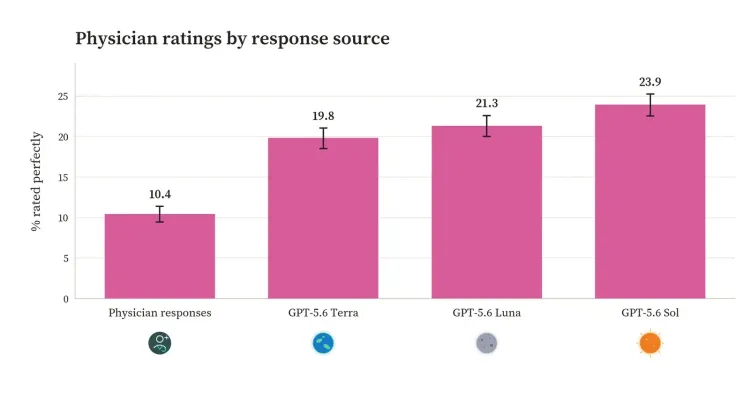
OpenAI chief executive Sam Altman posted on X on Saturday, 12 July 2026, citing findings that physicians identified fewer flaws in responses generated by GPT-5.6 than in responses written by physicians themselves — a claim that reignites debate over AI's role in clinical medicine.
Context
Altman's post quoted a striking benchmark result: 'physicians found fewer flaws in GPT-5.6 responses than physician-written responses.' The statement implies that independent physician evaluators, when assessing answer quality, rated the AI model's output above that of their own peers. The specific study underpinning this claim has not been independently verified at the time of publication.
The assertion follows a well-established pattern of head-to-head comparisons between large language models and clinicians. A 2023 study published in a leading US medical journal found that ChatGPT-generated answers to patient questions were rated higher in both quality and empathy than physician-written answers — an early signal that AI-generated medical communication could meet or exceed human standards on certain metrics.
Policy Backdrop
Since the release of GPT-4 in 2023, OpenAI and independent researchers have repeatedly benchmarked successive model versions against clinicians on tasks ranging from medical question answering to diagnostic reasoning. Each new generation has generally narrowed — and in several cases closed — the gap with specialist physicians on standardised tests.
Regulators in the United States, European Union, and India are actively examining how AI tools can be integrated into clinical workflows while managing concerns around accuracy, liability, and the need for human oversight. India's National Medical Commission has flagged AI-assisted diagnosis as an area requiring clear guidelines, even as hospitals in metro cities pilot AI triage and documentation tools.
Stakeholders and Impact
The implications of Altman's post are significant for physicians, patients, and healthcare systems worldwide. If peer-reviewed research consistently shows that AI-generated responses contain fewer clinical errors than those written by doctors, health systems face pressure to integrate such tools into patient communication and decision-support pipelines.
For patients — particularly in under-served regions of India where physician-to-patient ratios remain low — AI-assisted medical responses could democratise access to quality health information. However, medical associations have cautioned that benchmark performance does not automatically translate to safe, real-world clinical deployment, where context, ethics, and accountability remain paramount.
For OpenAI, the post is also a product signal. GPT-5.6 has not been publicly detailed in full, and Altman's framing of the result as a headline fact — rather than a caveat-laden research finding — is characteristic of the company's practice of using social media to shape the narrative around model capability milestones.
What's Next
Attention will now turn to whether the underlying study is published in a peer-reviewed journal, and what methodology was used to select physician evaluators, craft prompts, and score responses. Medical bodies including the Indian Medical Association are expected to weigh in on what standards AI responses must meet before being used in patient-facing settings.
Additional benchmarks comparing newer GPT iterations on clinical tasks are anticipated, alongside potential guidance from health ministries on AI-assisted patient communication. The trajectory suggests that the question is no longer whether AI can match clinicians on structured tasks, but how regulators and institutions will govern its use when it does.
Point of View
Liability, and patient safety that regulators are actively wrestling with. The trajectory of AI medical benchmarks has moved consistently in one direction since 2023, and each milestone post from OpenAI's leadership accelerates pressure on medical institutions and governments to formalise governance frameworks before deployment outpaces regulation. For India, where the physician shortage is acute, the stakes of getting that governance right are especially high. Altman's framing reflects a broader industry pattern of using social media to set the terms of the AI capability debate ahead of formal peer review.
NationPress
10 Oct 2026
Frequently Asked Questions
What did Sam Altman say about GPT-5.6 and doctors?
Sam Altman posted on X on 12 July 2026 that physicians found fewer flaws in GPT-5.6 responses than in responses written by physicians themselves, suggesting the AI model outperformed human doctors on a response-quality benchmark.
Is GPT-5.6 better than doctors at answering medical questions?
According to the claim cited by Altman, physician evaluators found fewer errors in GPT-5.6 responses than in physician-written ones, but the specific study has not been independently verified and medical associations caution that benchmark results do not equal safe clinical deployment.
What was the 2023 study that found AI better than doctors?
A 2023 study found that ChatGPT-generated responses to patient questions were rated higher in quality and empathy than physician-written answers, an early benchmark that prefigured the more recent GPT-5.6 claims.
Can AI replace doctors in India?
AI tools are being piloted in Indian hospitals for triage and documentation, but regulators and the Indian Medical Association have not approved AI as a replacement for physicians; current guidance focuses on AI as a decision-support tool under human oversight.
What is OpenAI GPT-5.6?
GPT-5.6 is referenced by Sam Altman as a newer iteration of OpenAI's GPT model series; full technical details of this specific version have not been publicly disclosed by OpenAI at the time of publication.