Amazon's custom AI chips start winning over Anthropic, OpenAI

Synopsis
Amazon's homegrown AI chips are reportedly winning commitments from both Anthropic and OpenAI — two of the world's most compute-hungry AI labs — marking the first serious sign that Nvidia's grip on frontier AI infrastructure may be loosening.
Key Takeaways
Amazon 's custom AI chips are gaining traction among frontier AI developers, according to reports.
Anthropic and OpenAI have both committed to renting large amounts of current and future Amazon silicon capacity.
Both companies have existing multibillion-dollar investment and infrastructure deals with Amazon Web Services .
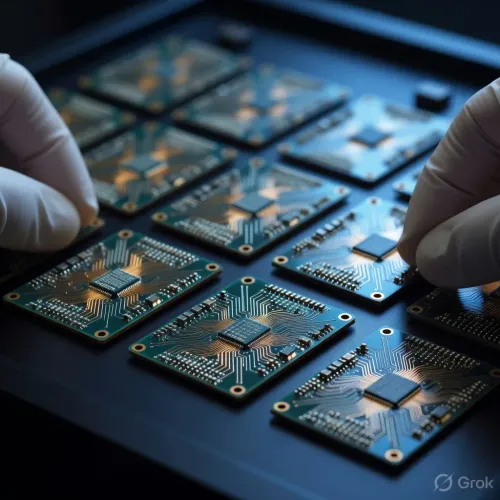
Amazon has developed the Inferentia chip for inference and the Trainium chip for training workloads as Nvidia alternatives.
Amazon announced a multibillion-dollar strategic investment in Anthropic in 2023 , tied to expanded AWS infrastructure use.
The development represents a potential shift in the AI compute supply chain, where Nvidia has held near-total dominance.
Amazon's years-long effort to build a credible alternative to Nvidia's dominant AI chips is beginning to gain meaningful traction, according to reports. Anthropic and OpenAI — both of which have struck multibillion-dollar investment and infrastructure deals with Amazon — have already committed to renting large amounts of current and future Amazon custom silicon capacity, signalling a potential shift in the AI compute landscape.
The commitment taking shape
Amazon Web Services (AWS) has spent years developing custom AI accelerators, including its Inferentia chip for inference workloads and Trainium chip for training workloads, as part of a broader push to reduce the AI industry's near-total dependence on Nvidia hardware. The reported commitments from Anthropic and OpenAI represent a significant vote of confidence in that programme. Both companies operate at the frontier of large language model development and require massive, sustained compute capacity to train and serve their models.
Why it matters
For years, Nvidia's CUDA software ecosystem and GPU hardware have been the default infrastructure choice for AI training and inference at scale. Any meaningful adoption of Amazon's custom chips by top-tier AI labs would mark the first credible crack in that dominance. Hyperscale cloud providers including Amazon, Google, and Microsoft have all pursued custom silicon programmes precisely to gain cost control and supply-chain independence from Nvidia, whose chips have faced persistent shortages amid surging demand.
The competitive backdrop
Amazon announced a multibillion-dollar strategic investment in Anthropic in 2023, tied to expanded use of AWS infrastructure — a deal that reportedly included commitments to use Amazon's custom AI chips alongside standard cloud services. Anthropic, founded in 2021 by former OpenAI researchers including Dario and Daniela Amodei, develops the Claude series of large language models and has positioned AWS as a primary cloud partner. OpenAI, meanwhile, has maintained its primary infrastructure relationship with Microsoft Azure but has separately established cloud commitments with Amazon as well.
What's next
The broader industry will be watching whether Amazon's chip programme can scale to meet the demands of frontier AI workloads — not just in inference, where custom silicon has historically been more competitive, but in the computationally intensive training runs that define the capabilities of next-generation models. If Anthropic and OpenAI expand their reliance on Amazon's custom silicon, other AI developers and cloud customers could follow, accelerating the diversification of the AI chip supply chain. Nvidia's stock and long-term pricing power remain the most exposed variable to watch as these commitments mature.
Point of View
And Amazon is using investment capital to lock in that diversification. What mainstream coverage underplays is that these commitments likely began as contractual obligations embedded in the multibillion-dollar cloud deals — meaning 'winning over' developers may partly reflect negotiated minimums rather than pure technical preference. The deeper signal is structural: as training runs grow larger and more expensive, AI labs have a direct financial incentive to develop Nvidia alternatives, and hyperscalers have the balance-sheet capacity to subsidise that transition. Nvidia's real risk is not losing today's contracts but losing the default status that drives developer tooling, hiring, and ecosystem lock-in over the next hardware generation.
NationPress
5 Oct 2026
Frequently Asked Questions
What are Amazon's custom AI chips and how do they differ from Nvidia GPUs?
Amazon has developed two custom AI accelerators under its AWS platform: Inferentia , designed for machine learning inference workloads, and Trainium , designed for model training. Unlike Nvidia 's general-purpose GPUs backed by the widely adopted CUDA software ecosystem, Amazon's chips are purpose-built for specific AI workload types and are offered exclusively through AWS cloud services.
Why are Anthropic and OpenAI committing to Amazon's chips?
Both Anthropic and OpenAI have existing multibillion-dollar investment and infrastructure deals with Amazon , which include commitments to use AWS infrastructure and custom silicon. Diversifying away from Nvidia also gives frontier AI labs greater supply-chain resilience and potential cost advantages at the scale they operate.
Does this mean Nvidia is losing its dominance in AI chips?
Nvidia remains the dominant supplier of AI chips, and its CUDA ecosystem retains deep developer adoption. However, the reported commitments from Anthropic and OpenAI to Amazon 's custom silicon represent the most significant sign yet that hyperscaler alternatives are gaining credibility at the frontier of AI development.
What is Amazon's relationship with Anthropic?
Amazon announced a multibillion-dollar strategic investment in Anthropic in 2023 , tied to expanded use of AWS infrastructure. Anthropic , founded in 2021 by former OpenAI researchers, develops the Claude series of large language models and has designated AWS as a primary cloud partner.
Which other cloud providers are building Nvidia alternatives?
Beyond Amazon , both Google (with its TPU series) and Microsoft (with its Maia chip programme) have developed custom AI silicon as part of broader strategies to reduce dependence on Nvidia and gain greater cost control over AI infrastructure at hyperscale.