Can At-home Blood Tests Effectively Identify Key Alzheimer's Biomarkers?
Click to start listening
Synopsis
A groundbreaking study reveals that simple finger-prick blood tests conducted at home can accurately detect biomarkers for Alzheimer's disease, revolutionizing research accessibility and paving the way for early diagnosis. This innovative approach eliminates barriers in healthcare access and opens doors for wider community participation in Alzheimer's research.
Key Takeaways
- At-home blood tests can accurately detect Alzheimer's biomarkers.
- The method eliminates the need for specialized healthcare facilities.
- It enables wider participation in Alzheimer's research.
- The approach shows a high accuracy of 86% in identifying changes related to Alzheimer's.
- This breakthrough holds promise for early diagnosis and intervention.
New Delhi, Jan 6 (NationPress) Simple finger-prick blood samples that can be obtained at home and sent to laboratories without the need for refrigeration or special processing can accurately identify biomarkers associated with Alzheimer's disease, according to a comprehensive international study.
This research, featured in the journal Nature Medicine, marks the first extensive validation of this accessible testing approach, eliminating geographic limitations and making brain disease research available to global populations without necessitating specialized healthcare infrastructure.
Typically, Alzheimer's disease is diagnosed through brain scans or spinal fluid examinations, which can be invasive and costly. Emerging blood tests that analyze biomarkers such as p-tau217 are proving to be reliable and accessible tools for Alzheimer's detection.
Professor Nicholas Ashton, senior director of US-based Banner Health, commented, "This breakthrough could fundamentally alter the landscape of Alzheimer's research by demonstrating that the same biomarkers used by physicians to detect Alzheimer's pathology can be assessed from a simple home-collected finger prick or in remote community settings.”
“Ultimately, we are progressing towards a method of treating individuals for Alzheimer's disease before symptoms arise. If this trend continues, innovative strategies will be essential to identify eligible individuals who are not routinely presenting in clinical environments. This work represents one such approach, although further validation is necessary,” he added.
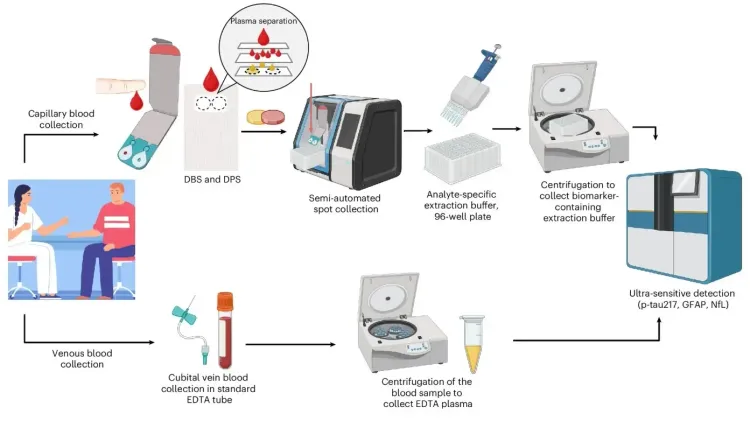
The researchers employed this new method using a few drops of blood collected from the fingertip and subsequently dried on a card. This technique was utilized to identify proteins associated with Alzheimer's disease and other neurological changes in 337 participants across seven European medical centers.
The findings revealed that levels of p-tau217 in finger-prick samples closely corresponded with results from standard blood tests, achieving an accuracy of 86% in identifying Alzheimer’s disease-related changes in spinal fluid.
Additionally, two other markers, GFAP and NfL, were successfully measured, showing strong alignment with traditional test results.
While still not ready for clinical application, this breakthrough tackles significant barriers in Alzheimer's research by facilitating remote participation in studies, enabling clinical trial recruitment and monitoring, and expanding population sampling for epidemiological research, thereby including underrepresented communities and regions with limited healthcare access.
Point of View
I believe this groundbreaking research signifies a pivotal moment in Alzheimer's diagnostics. The ability to conduct blood tests at home not only enhances accessibility but also empowers individuals to take control of their health. This innovative approach to Alzheimer's research aligns with our mission to bridge the gap between healthcare advancements and community needs.
NationPress
08/01/2026
Frequently Asked Questions
How does the at-home blood test for Alzheimer's work?
The test involves collecting a simple finger-prick blood sample, which is then dried on a card and mailed to a laboratory for analysis of biomarkers like p-tau217 associated with Alzheimer's.
What is the accuracy of these blood tests?
The study found that levels of p-tau217 in finger-prick samples matched standard blood tests with an accuracy of 86% in identifying Alzheimer's disease-related changes.
Are these blood tests available for clinical use?
Currently, the blood tests are not yet ready for clinical application, but they represent a significant step toward more accessible Alzheimer's research.
What impact does this research have on Alzheimer's detection?
This research could significantly reduce geographic barriers in Alzheimer's detection, enabling broader participation in studies and early intervention strategies.
What other biomarkers were measured in the study?
In addition to p-tau217, two other markers, GFAP and NfL, were also successfully measured and showed strong agreement with traditional testing methods.