China's Economic Imbalance: The Dilemma of Consumer Neglect

Synopsis
Explore how China's relentless pursuit of industrial growth, prioritizing production over consumer needs, could lead to a dangerously unbalanced economy. This article highlights the potential consequences of ignoring household consumption in favor of technological advancement.
Key Takeaways
China's economic strategy is heavily focused on industrial production.
The Five-Year Plan emphasizes domestic demand but prioritizes technology over welfare.
Overproduction could lead to a vicious cycle of economic decline.
Emerging sectors are critical for future growth, including electric vehicles and biomedicine .
Consumer needs must align with state priorities to achieve balance.
New Delhi, April 13 (NationPress) If China maintains its focus on productive grandeur without considering consumers' needs, the leading industrial powerhouse may become trapped in a lopsided economy that is increasingly challenging to rebalance, as stated in an article from The Wire, a global digital publication based in New York.
The article underscores that while China's Marxist developmentalist approach acknowledges the importance of demand, it prioritizes meeting the needs of modern science, technology, and production methods. Thus, the demand generated by establishing factories, acquiring machinery, constructing infrastructure, and expanding data centers takes precedence over household spending.
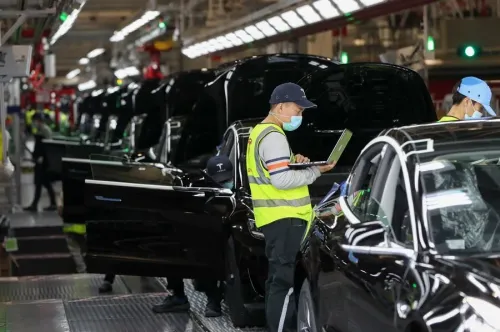
Furthermore, the new Five-Year Plan of China emphasizes boosting domestic demand as a strategic foundation. However, it predominantly directs the party-state to pursue a comprehensive techno-industrial transformation, enhancing traditional industries like metals, textiles, and appliances, while bolstering new sectors such as electric vehicles, batteries, and biomedicine, and fast-tracking the adoption of cutting-edge technologies like quantum computing, fusion energy, and embodied AI.
For a Marxist developmentalist, individuals are considered workers before being recognized as consumers. Their ability to spend is expected to depend on earned income rather than on fiscal redistribution. Consequently, the primary recommendation for increasing consumption in the Five-Year Plan is to elevate employment levels and wage compensation, rather than developing the welfare systems that economists outside China have long advocated.
China's substantial investments in supply-side capabilities have yielded remarkable results. Its industrial enterprises continue to ascend the value chain, its exports consistently capture global markets, and its technology firms are increasingly influencing global trends, as noted in the article.
However, despite these technological and industrial successes, the economic challenges that Xi highlighted five years ago have only deepened.
Chinese policymakers who adhere to a Marxist developmentalist ideology may hold the belief that their unwavering focus on enhancing the country's productive forces will eventually trigger a beneficial cycle of industrial evolution, skill enhancement, rising incomes, and greater consumption.
Yet, there is a significant risk that a vicious cycle may instead emerge, characterized by chronic overproduction that undermines corporate profits, suppresses wages, and deters consumer spending—prompting Chinese companies to increasingly rely on exports to markets that are becoming reluctant to absorb excess capacity. This obsession with production could solidify, rather than resolve, the economic obstacles that have troubled Xi, as the priorities of the state and consumers often diverge, the article elaborates.
It cites the instance of Chinese state media heralding 2026 as the inaugural year for commercial space travel. Following a central government action plan, over 600 space enterprises have been established, many focusing on developing space tourism.
Chinese officials envision a future of mass consumption of space travel. However, a populace facing job instability, stagnant wages, and diminishing wealth is unlikely to prioritize sightseeing in space, the article expresses dismay over.
Point of View
I see a complex landscape where China's robust industrial ambitions clash with the needs of its consumers. This divergence poses a significant challenge for policymakers as they navigate the fine line between growth and economic stability.
NationPress
16 Sept 2026
Frequently Asked Questions
What is the main concern regarding China's economy?
The primary concern is that China's focus on production and industrial growth is overshadowing consumer needs, leading to a lopsided economy that may become harder to rebalance.
How does China's Five-Year Plan aim to address domestic demand?
The Five-Year Plan emphasizes boosting domestic demand as a strategic cornerstone while prioritizing techno-industrial transformation over immediate consumer welfare.
What risks does China face with its current economic strategy?
China risks entering a vicious cycle of overproduction that can depress wages and consumer spending, ultimately impacting corporate profits and economic growth.
What are some emerging sectors highlighted in China's economic plans?
China's economic plans focus on enhancing sectors like electric vehicles, batteries, biomedicine, and frontier technologies such as quantum computing.
How does consumer sentiment affect China's economy?
Consumer sentiment is crucial; if households face job insecurity and stagnant incomes, they are unlikely to prioritize spending, impacting overall economic health.