Beijing surgeon solves 20-year-old Crouzeix conjecture using GPT-5.6-Sol
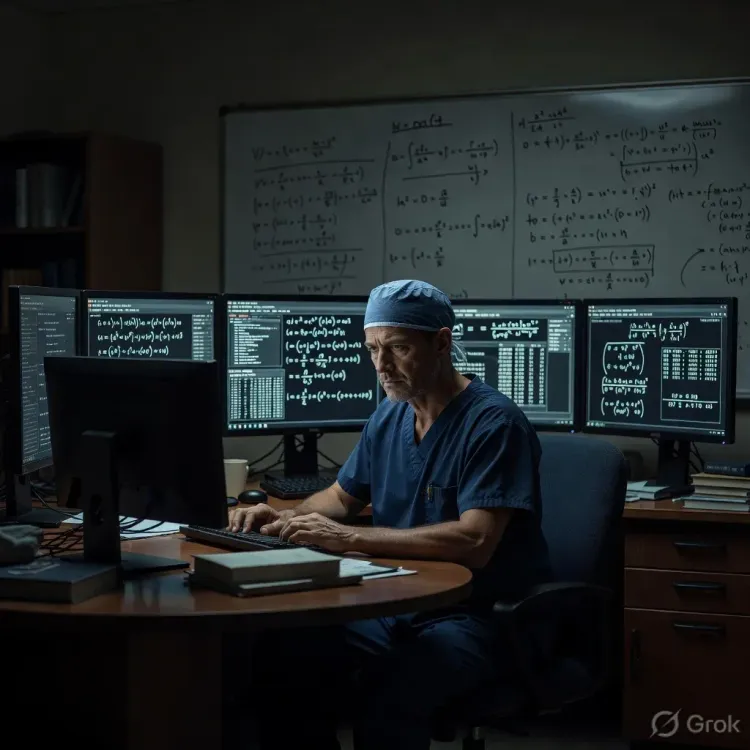
Synopsis
A Beijing neurosurgeon with no formal mathematics training reportedly proved Crouzeix's conjecture — unsolved since 2004 — using a 16-hour autonomous session on OpenAI's GPT-5.6-Sol. The result, if verified, would rank among the most significant AI-assisted breakthroughs in pure mathematics.
Key Takeaways
Jin Shanmu , a neurosurgeon and postdoctoral researcher at Peking Union Medical College Hospital, Beijing , reportedly proved Crouzeix's conjecture in August 2026 .
The conjecture, proposed by French mathematician Michel Crouzeix in 2004 , had remained unproven for over 20 years .
Jin used OpenAI 's GPT-5.6-Sol model running autonomously for 16 hours on the ChatGPT Work platform.
Jin's interest in the problem originated from his medical research into transcranial ultrasounds , not a mathematics background.
Independent peer verification by the global mathematics community — including researchers at institutions such as Cornell University — is still required before the proof is formally accepted.
The breakthrough intensifies competition among frontier AI labs, with Anthropic 's Claude and others racing to demonstrate comparable long-horizon reasoning capabilities.
Jin Shanmu, a postdoctoral researcher and resident neurosurgeon at Peking Union Medical College Hospital in Beijing, has reportedly proved Crouzeix's conjecture — a two-decade-old open problem in numerical linear algebra — using a 16-hour autonomous run on OpenAI's GPT-5.6-Sol model via the ChatGPT Work platform. The breakthrough, announced in August 2026, stunned the global mathematics community and reignited debate over AI's role in frontier research.
The conjecture, explained
First proposed by French mathematician Michel Crouzeix in 2004, Crouzeix's conjecture holds that the norm of applying any function to a matrix is no larger than twice the function's maximum value on that matrix's numerical range. Despite its abstract framing, the problem sits at the intersection of matrix analysis and functional analysis, and had resisted proof by specialists worldwide for over 20 years.
Jin, a self-taught mathematics enthusiast, stumbled into the field while conducting research on transcranial ultrasounds — a tool used in brain surgery. The conjecture's connection to signal processing in ultrasound analysis drew his attention before the scope of the problem became clear.
Why it matters
The proof, if independently verified, would mark one of the most significant AI-assisted breakthroughs in pure mathematics to date. It places GPT-5.6-Sol alongside a short list of AI systems — including Google DeepMind's AlphaProof — credited with advancing formal mathematical reasoning beyond the reach of conventional tools.
The result also underscores a widening pattern: domain experts outside mathematics, armed with frontier AI models, are increasingly capable of engaging with problems that once required years of specialised training. Jin's medical background, rather than being a disadvantage, appears to have provided the applied framing that motivated the research direction.
The competitive backdrop
OpenAI's GPT-5.6-Sol, deployed via the ChatGPT Work platform, was the instrument of record here — a notable data point as Anthropic's Claude and other frontier models compete aggressively on reasoning benchmarks. The autonomous, extended-session format — 16 hours of continuous operation — points to agentic AI workflows as a meaningful new surface for scientific discovery, distinct from single-prompt query interactions.
Researchers at institutions including Cornell University, where mathematician Alex Townsend has worked on related problems in numerical analysis, are expected to scrutinise the proof closely. The mathematics community typically requires independent verification before a conjecture is formally considered solved.
What's next
The immediate question is peer verification: whether the proof holds under formal mathematical scrutiny will determine whether this becomes a landmark moment in both AI capability and pure mathematics. If confirmed, it will intensify pressure on research institutions to integrate long-horizon agentic AI tools into their workflows — and raise fresh questions about attribution, authorship, and the future of human-led mathematical discovery. Observers will also watch whether this accelerates attempts to apply similar AI-assisted approaches to harder open problems, including the Riemann hypothesis.
Point of View
But by an iterative human-AI loop running for 16 uninterrupted hours, a workflow most academic institutions have no framework to evaluate. This fits a broader pattern where the most disruptive AI-assisted discoveries are coming from domain experts at the periphery of a field, not its centre — mirroring how AlphaFold's protein-structure breakthrough originated outside traditional structural biology. What mainstream coverage underplays is the platform dimension: OpenAI's ChatGPT Work is being stress-tested as a serious scientific instrument, and a verified proof here would be a commercial and reputational event for the company, not just an academic one. The harder question — whether agentic AI can now be systematically directed at Millennium Prize problems like the Riemann hypothesis — moves from thought experiment to live research agenda.
NationPress
14 Aug 2026
Frequently Asked Questions
What is Crouzeix's conjecture and has it been solved?
Crouzeix's conjecture is a problem in numerical linear algebra, proposed by French mathematician Michel Crouzeix in 2004, stating that the norm of applying any function to a matrix is no larger than twice the function's maximum value on that matrix's numerical range. Beijing neurosurgeon Jin Shanmu reportedly proved it in August 2026 using OpenAI's GPT-5.6-Sol, though the result still awaits formal peer verification.
What AI model was used to solve the conjecture?
Jin used GPT-5.6-Sol, OpenAI's latest flagship AI model, running autonomously for 16 hours on the ChatGPT Work platform. The extended autonomous session format is central to the result, distinguishing it from standard single-prompt AI interactions.
Why does this AI maths breakthrough matter?
If verified, the proof would be one of the most significant AI-assisted results in pure mathematics, demonstrating that frontier AI models can crack long-standing open problems when directed by domain experts. It raises immediate questions about peer review, authorship attribution, and whether similar approaches could be applied to harder unsolved problems such as the Riemann hypothesis.
What happens next — how will the proof be verified?
The global mathematics community, including researchers at institutions such as Cornell University, is expected to independently scrutinise the proof before it is formally accepted. Only after rigorous peer review will Crouzeix's conjecture be considered officially solved.