Chinese researcher flags 600g UFO acceleration in US military UAP files
Synopsis
A Beijing-based UAP researcher has flagged a declassified 2020 US military infrared video showing a humanoid-shaped object that AI analysis suggests may have accelerated at over 600g — roughly 50 times the tolerance of the toughest known drones — raising questions no existing physics framework can yet answer.
Key Takeaways
Zhang Nan , a Beijing -based UAP researcher, identified a five-minute infrared clip labelled 'NAG UAP 1 Jun 20' as the most compelling footage in the latest US Department of Defence disclosure batch.
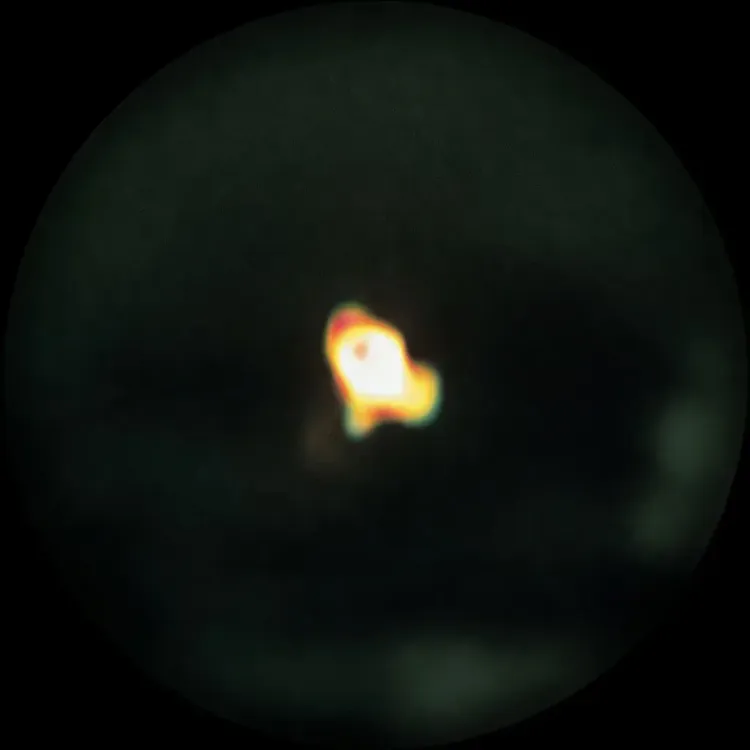
The video, recorded by a US military sky-facing sensor in Florida in 2020 , shows a humanoid-like object hovering before making an apparent instantaneous displacement.
AI-assisted analyses suggest the object's acceleration could have exceeded 600g — compared to a human pilot blackout threshold of roughly 12g and a maximum drone tolerance of around 30g .
The object displayed no visible propulsion system and reportedly changed shape during movement, complicating conventional explanations.
Zhang cautioned that a sensor malfunction cannot be excluded, and stressed that the absence of hard telemetry data remains the primary barrier to scientific conclusions.
Zhang Nan, a Beijing-based researcher into unidentified anomalous phenomena (UAP), has highlighted a nearly five-minute infrared video captured by a US military sky-facing sensor in Florida in 2020 as among the most compelling footage in the latest batch of declassified US Department of Defence UFO files. The clip, labelled 'NAG UAP 1 Jun 20', shows a humanoid-like shape that hovers at length before abruptly vanishing outside the frame — a movement that has drawn significant attention from the global UAP research community.
What the footage shows
In the video, a human-shaped object remains stationary for an extended period before executing what appears to be an instantaneous displacement to a distant location. The object reportedly lacked any visible propulsion system and appeared to change shape during its movement — two characteristics that set it apart from conventional aerial platforms.
AI-assisted analyses cited by Zhang suggest the object's acceleration, if genuine, could have exceeded 600g — or 600 times the force of gravity at Earth's surface. By comparison, human pilots typically lose consciousness at around 12g, and the most structurally robust drones are rated to withstand approximately 30g.
Why it matters
'A manoeuvre surpassing 600g is far beyond the limits of any known modern aircraft or living organism,' Zhang said. He added that, given the object's apparent lack of propulsion and its shape-shifting behaviour, an acceleration exceeding 600g 'cannot be completely ruled out.' The researcher was careful to note the caveat that the movement could still be attributable to a sensor glitch rather than a physical phenomenon.
The remarks underscore growing international scientific interest in UAP disclosures as the US government continues to release previously classified material. Zhang described the latest tranche of US Department of Defence files as 'far more intriguing' than older, lower-resolution imagery the Pentagon had previously made public.
The data gap problem
Despite the visual intrigue, Zhang pointed to a critical obstacle facing researchers: a near-total absence of hard sensor data accompanying the footage. Without corroborating telemetry — speed, altitude, radar cross-section — definitive scientific conclusions remain out of reach. This data deficit is a recurring frustration for the broader UAP scientific community, which has long argued that declassified visuals alone are insufficient for rigorous analysis.
What's next
The disclosure of the Florida infrared footage arrives amid a broader wave of UAP transparency from Washington, with researchers in China, the United States, and elsewhere now actively cross-referencing newly available files. Whether subsequent declassification tranches will include the raw sensor data scientists need to move beyond speculation remains the central question for the field going forward.
Point of View
While speculative, is structurally useful — it sets a performance benchmark that, if validated, would place the object entirely outside any known aerospace programme, including classified ones. What mainstream coverage tends to underplay is the data-access asymmetry: US researchers can petition for supplementary sensor logs under disclosure frameworks, while international scientists like Zhang are entirely dependent on whatever Washington chooses to release. Until raw telemetry accompanies the visuals, the scientific debate will remain hostage to image quality and algorithmic inference rather than physics.
NationPress
25 Oct 2026
Frequently Asked Questions
What is the US military UAP video that the Chinese researcher highlighted?
The video is a nearly five-minute infrared clip, labelled 'NAG UAP 1 Jun 20', captured by a US military sky-facing sensor in Florida in 2020. It shows a humanoid-shaped object hovering for an extended period before appearing to move instantaneously outside the camera frame.
What does 600g acceleration mean and why is it significant?
600g means 600 times the gravitational force at Earth's surface. Human pilots black out at around 12g, and the most durable drones max out near 30g, making a 600g manoeuvre physically impossible for any known aircraft or biological organism.
Who is Zhang Nan and what is his connection to UAP research?
Zhang Nan is a Beijing-based researcher specialising in unidentified anomalous phenomena. He analysed the latest batch of declassified US Department of Defence UFO files and described this particular infrared footage as far more intriguing than older Pentagon imagery previously made public.
Could the UAP footage be a sensor error?
Zhang explicitly acknowledged that a sensor glitch cannot be ruled out. Without corroborating telemetry data — such as radar returns or altitude logs — it is impossible to confirm whether the apparent displacement represents a real physical event.
Why can't scientists reach firm conclusions about UAP footage?
The core problem is a lack of hard sensor data accompanying declassified visuals. Researchers have only the imagery itself, with no speed, altitude, or radar cross-section data, making rigorous scientific analysis impossible at this stage.