How is CSIR Transforming India’s Scientific Ecosystem?
Synopsis
Discover how the Council of Scientific and Industrial Research (CSIR) is revolutionizing India’s scientific landscape with green road technology, indigenous diagnostic kits, and groundbreaking initiatives in healthcare and biodiversity. This transformative journey is set to redefine national development by 2025, showcasing the power of innovation in addressing pressing challenges.
Key Takeaways
CSIR's green technology is transforming road infrastructure.
Indigenous diagnostic kits are revolutionizing healthcare.
Innovations in agriculture are combating pest problems.
Biodiversity is being safeguarded through advanced testing.
CSIR's work supports sustainable development and national autonomy.
New Delhi, Jan 16 (NationPress) The Council of Scientific and Industrial Research (CSIR) is making strides to reshape India’s scientific landscape by innovating road construction through eco-friendly technology, safeguarding biodiversity, and enhancing healthcare with locally developed diagnostic kits, as reported.
Since 2015, CSIR laboratories nationwide have significantly contributed to advancements that bolster infrastructure, improve health outcomes, enhance climate resilience, and strengthen India's strategic independence, as highlighted by the Times of Oman.
According to the report, “The year 2025 will be recognized as a pivotal moment in India’s scientific evolution, marking a shift where research directly supports national development.”
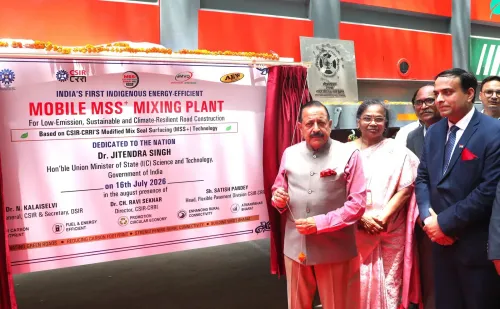
Under CSIR's initiative, green technology has been successfully implemented to upgrade over 200 kilometers of rural roads in Uttar Pradesh.
This innovation has decreased emissions and facilitated quicker and more resilient construction.
The world's first port road at Hazira, Gujarat, was constructed using steel slag technology, converting industrial waste into a sustainable and durable asset by CSIR-Central Road Research Institute (CRRI).
Moreover, approximately 30 tonnes of end-of-life plastic technical textiles were incorporated into expressway construction.
In agriculture, CSIR-National Botanical Research Institute (NBRI) developed the world’s first genetically modified cotton that is fully resistant to the pink bollworm, a pest causing significant crop failures.
Additionally, CSIR-Centre for Cellular and Molecular Biology (CCMB) has played a crucial role in biodiversity preservation by creating the world’s first DNA-based test designed to identify illegal shahtoosh in pashmina shawls, aiding in the protection of the endangered Tibetan antelope.
The lab also launched India’s inaugural Zoo Bio Bank at Darjeeling Zoo, aimed at preserving the genetic material of endangered species for future conservation efforts and research.
CSIR laboratories have also revolutionized healthcare through indigenous scientific advancements.
For instance, CSIR-CCMB developed a rapid, cost-effective molecular test for sickle cell anemia, allowing for early diagnosis using just a single drop of dried blood, while the CSIR-Institute of Genomics and Integrative Biology (IGIB) pioneered India’s first indigenous CRISPR-based gene therapy for sickle cell disease.
Furthermore, CSIR-Indian Institute of Chemical Biology and collaborating laboratories have progressed in creating innovative therapies for triple-negative breast cancer, including advanced anti-cancer agents and targeted nanoparticle drug delivery systems.
CSIR’s initiatives have also contributed to constructing climate-resilient homes and smarter waste management systems. The laboratories have fortified defense capabilities and fostered innovation through industry partnerships and startups.
Point of View
I affirm that the CSIR's initiatives represent a crucial leap forward in India's scientific endeavors. By harnessing indigenous technologies and prioritizing sustainability, CSIR is not only enhancing healthcare and infrastructure but also placing India on the global map as a leader in scientific innovation. This commitment to progress aligns with national interests and showcases the potential for local advancements to make a significant impact.
NationPress
19 Sept 2026
Frequently Asked Questions
What is the role of CSIR in India's scientific ecosystem?
CSIR plays a pivotal role in transforming India's scientific landscape by spearheading innovations in various sectors, including eco-friendly road technologies, healthcare advancements, and biodiversity conservation.
How has CSIR contributed to healthcare?
CSIR has enhanced healthcare through the development of indigenous diagnostic kits, including a rapid test for sickle cell anemia and pioneering CRISPR-based gene therapy for sickle cell disease.
What innovations has CSIR introduced in road construction?
CSIR has implemented green technologies to improve rural roads, significantly reducing emissions and enabling efficient construction. The world’s first port road built with steel slag technology is a prime example.
How is CSIR addressing biodiversity issues?
CSIR is actively protecting biodiversity by developing DNA-based tests to detect illegal wildlife products and establishing initiatives like the Zoo Bio Bank to preserve endangered species.
What are the future implications of CSIR's work?
CSIR's contributions are expected to play a defining role in India’s scientific journey, particularly by 2025, reinforcing the connection between research and national development.