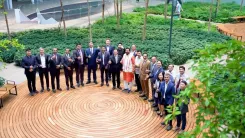
Google DeepMind director Cao Liangliang joins PolyU after 20-year gap

Synopsis
Google DeepMind director and IEEE Fellow Cao Liangliang — a key architect of Gemini, Apple Intelligence, and Vision Pro — has joined Hong Kong Polytechnic University as Chair Professor of AI after a 20-year absence, closing a career arc that began at CUHK's legendary MMLab under the late Tang Xiao'ou.
Key Takeaways
Cao Liangliang , former director at Google DeepMind and IEEE Fellow , has been appointed Chair Professor of Data Science and Artificial Intelligence at Hong Kong Polytechnic University (PolyU) .
The appointment was confirmed last week, marking his return to Hong Kong after more than 20 years .
Cao won the ImageNet competition in 2010 and later contributed to Gemini , Apple Intelligence , and Apple Vision Pro across roles at Google DeepMind , Apple , and IBM .
His academic roots trace to Tang Xiao'ou 's MMLab at CUHK , the laboratory that also spawned AI unicorn SenseTime .
Cao completed his PhD at the University of Illinois Urbana-Champaign (UIUC) under Thomas S.
Huang , who died in 2020 .
Cao Liangliang, former principal engineer and director at Google DeepMind, IEEE Fellow, and a key architect behind Gemini, Apple Intelligence, and Vision Pro, has returned to Hong Kong after a two-decade absence, taking up the role of Chair Professor of Data Science and Artificial Intelligence at Hong Kong Polytechnic University (PolyU) last week.
A full-circle homecoming
The appointment closes a remarkable intellectual arc that began when Cao arrived at the Chinese University of Hong Kong (CUHK) in 2003 under the mentorship of the late Tang Xiao'ou, the MIT-trained computer vision pioneer whose Multimedia Laboratory (MMLab) at CUHK seeded much of China's modern AI industry — including the AI unicorn SenseTime. Cao earned his master's degree from MMLab in 2005 and worked there as a research assistant until 2006. 'Returning to Hong Kong is a full-circle moment for me,' he wrote on his personal website.
From USTC to Silicon Valley's frontier
Born in Donggang, in the northeastern province of Liaoning, Cao was admitted to the University of Science and Technology of China (USTC) in 1998. After graduating in 2003, he was recruited by Tang Xiao'ou, who had returned to Hong Kong to lead the Department of Information Engineering at CUHK in 1998 and was actively scouting top USTC graduates. Cao subsequently moved to the United States in 2006 to pursue his PhD at the University of Illinois Urbana-Champaign (UIUC) under Thomas S. Huang, widely regarded as the 'father of Chinese computer vision', who passed away in 2020.
ImageNet win to industry leadership
In 2010, Cao placed first in the landmark ImageNet competition organised by Li Fei-Fei, now a tenured professor at Stanford University — a result that foreshadowed his ascent through IBM, Apple, and ultimately Google DeepMind. His contributions span foundational machine learning systems that underpin some of the most widely used AI products in the world, including Apple Intelligence and Apple Vision Pro.
Why it matters for Hong Kong's AI ecosystem
Hong Kong has been actively courting global AI talent as it seeks to position itself as a regional technology hub, competing with Singapore and mainland Chinese cities. Cao's appointment at PolyU brings rare dual credentials — elite academic pedigree and hands-on experience building production-scale AI at the world's largest technology companies. The move could attract further research collaboration and talent pipelines between Silicon Valley and Hong Kong.
What's next
With Tang Xiao'ou's passing in 2023, a generation of MMLab alumni now occupies senior roles across China's and the world's AI landscape. Cao's return to the city where his career began raises the prospect of PolyU emerging as a new node in that network. Observers will watch whether his appointment catalyses fresh industry-academia partnerships and draws additional diaspora researchers back to Hong Kong.
Point of View
Yet rarely achieves at this calibre. What mainstream coverage underplays is the lineage effect: MMLab alumni now hold senior positions at Baidu, ByteDance, SenseTime, and the major US hyperscalers, and Cao's return could activate that network in ways that formal policy cannot. His appointment also arrives as US export controls and visa friction push some Chinese-heritage researchers to reconsider their long-term base, making Hong Kong — with its common-law framework and proximity to mainland capital — a structurally attractive landing point. Whether PolyU can translate this hire into durable research output and industry spin-offs, rather than a prestige signal, will be the real test.
NationPress
6 Oct 2026
Frequently Asked Questions
Who is Cao Liangliang and what is his role at PolyU?
Cao Liangliang is a former principal engineer and director at Google DeepMind , an IEEE Fellow , and a contributor to Gemini , Apple Intelligence , and Vision Pro . He was appointed Chair Professor of Data Science and Artificial Intelligence at Hong Kong Polytechnic University (PolyU) last week.
Why is Cao Liangliang's return to Hong Kong significant?
Cao 's appointment is significant because it brings a researcher with direct experience building frontier AI systems at Google DeepMind , Apple , and IBM back to Hong Kong 's academic ecosystem. His roots in CUHK 's MMLab — the lab that spawned SenseTime — give him deep ties to both the city and China 's broader AI industry.
What is the connection between Cao Liangliang and SenseTime?
Cao trained at the Multimedia Laboratory (MMLab) at the Chinese University of Hong Kong under Tang Xiao'ou , the same laboratory from which the AI company SenseTime later emerged. He earned his master's degree from MMLab in 2005 and worked there as a research assistant until 2006 .
What did Cao Liangliang achieve at the ImageNet competition?
Cao Liangliang placed first in the ImageNet competition in 2010 , an event organised by Li Fei-Fei , now a tenured professor at Stanford University . The win was an early signal of his expertise in computer vision and machine learning.
How does this appointment affect Hong Kong's AI ambitions?
Hong Kong has been competing with Singapore and mainland Chinese cities to attract global AI talent, and Cao 's hire at PolyU represents one of the highest-profile such recruitments in recent years. His industry credentials and academic network could help PolyU forge stronger links between Silicon Valley research and Hong Kong 's technology sector.