Shenzhou-23 lifts off with Hong Kong's first astronaut Lai Ka-ying
Synopsis
Hong Kong police superintendent and tech specialist Lai Ka-ying became the city's first-ever astronaut on 24 May 2026, lifting off aboard Shenzhou-23 from the Jiuquan Satellite Launch Centre — a landmark moment for Hong Kong's integration into China's national space programme.
Key Takeaways
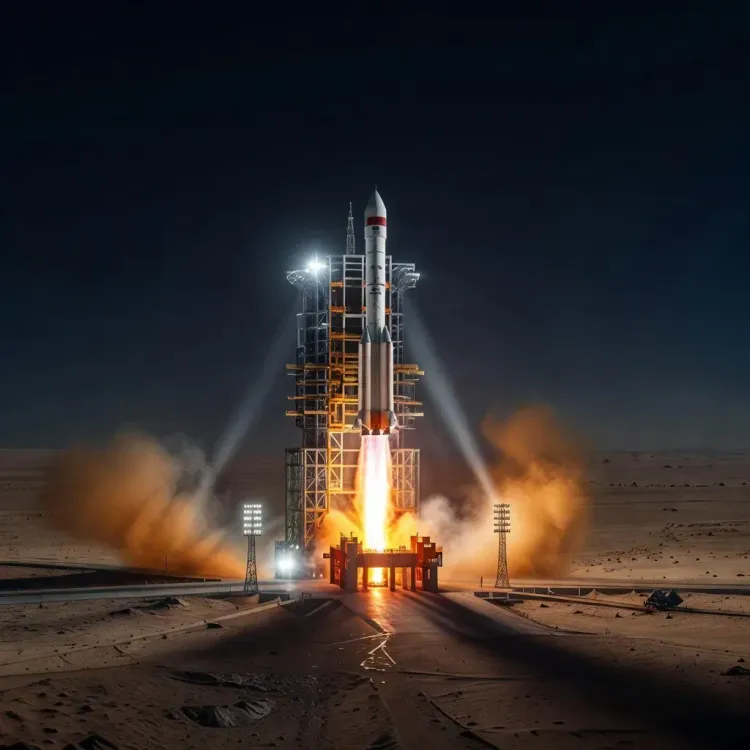
Shenzhou-23 launched at 11:08 pm local time on Sunday, 24 May 2026 , from the Jiuquan Satellite Launch Centre , Gansu province , China.
Lai Ka-ying , a Hong Kong police superintendent and tech specialist, became Hong Kong's first astronaut , serving as payload specialist.
The mission is commanded by Zhu Yangzhu , a Shenzhou-16 veteran, with Zhang Zhiyuan as pilot.
The crew was launched aboard a Long March-2F rocket , China's primary crewed launch vehicle.
A Hong Kong government delegation led by Secretary for Innovation, Technology and Industry Sun Dong attended the send-off ceremony at Wentian Pavilion, Dongfeng Aerospace City .
Hong Kong's first astronaut, Lai Ka-ying, lifted off into space aboard the Shenzhou-23 spacecraft on Sunday, 24 May 2026, marking a historic milestone for the city and for China's manned space programme. The mission launched from the Jiuquan Satellite Launch Centre in Gansu province, northwestern China, at 11:08 pm local time, according to the China Manned Space Agency.
The Crew and Their Roles
Lai Ka-ying, a Hong Kong police superintendent and tech specialist, joins the mission as payload specialist — the role typically assigned to scientists and engineers conducting experiments in orbit. The mission is commanded by Zhu Yangzhu, a veteran who previously served as flight engineer on the Shenzhou-16 mission, with Zhang Zhiyuan serving as pilot.
The three-person crew rode atop a Long March-2F rocket — China's primary crew-rated launch vehicle — on its latest crewed flight to the Chinese Space Station.
Send-Off Ceremony at Dongfeng Aerospace City
Before heading to the launch pad in the Gobi Desert, the crew was celebrated at a send-off ceremony at the Wentian Pavilion at Dongfeng Aerospace City, where they were met with cheers from well-wishers and officials. A Hong Kong government delegation attended the event, led by Secretary for Innovation, Technology and Industry Sun Dong.
The presence of a senior Hong Kong official underscores the political and symbolic weight the mission carries for the city, which has long sought a stronger identity within China's national space ambitions.
Why It Matters
Lai's selection represents the culmination of a broader push by Beijing to integrate Hong Kong's scientific and technological talent into national programmes. Her background as both a law-enforcement officer and a tech specialist reflects the interdisciplinary profile China's space agency has increasingly favoured for payload specialist roles.
The mission also signals China's continued cadence of crewed launches to its permanently inhabited space station, reinforcing the country's position as one of only three nations — alongside the United States and Russia — capable of independently launching humans into orbit.
What's Next
The Shenzhou-23 crew is expected to dock with the Chinese Space Station and conduct a rotation with the outgoing crew. Lai's payload specialist duties will likely involve scientific experiments during the orbital stay. All eyes will be on how Hong Kong leverages this moment to deepen its role in China's expanding space economy.
Point of View
A point often understated in Western coverage. The choice of a law-enforcement officer with a tech background also reflects how China blurs civilian, state, and security roles in its space programme — a structural distinction that matters for how other nations assess dual-use capabilities. For Hong Kong's innovation ecosystem, the mission offers a rare soft-power dividend that the city's government will almost certainly leverage for STEM recruitment and startup branding.
NationPress
9 Oct 2026
Frequently Asked Questions
Who is Lai Ka-ying and why is she significant?
Lai Ka-ying is a Hong Kong police superintendent and tech specialist who became Hong Kong's first astronaut when she launched aboard Shenzhou-23 on 24 May 2026 . Her selection marks the first time a Hong Kong resident has flown to space as part of China's national programme.
When and where did Shenzhou-23 launch?
Shenzhou-23 launched at 11:08 pm local time on Sunday, 24 May 2026 , from the Jiuquan Satellite Launch Centre in Gansu province , northwestern China, according to the China Manned Space Agency .
Who else is on the Shenzhou-23 crew?
The crew comprises three members: commander Zhu Yangzhu , a veteran of the Shenzhou-16 mission; pilot Zhang Zhiyuan ; and payload specialist Lai Ka-ying . Zhu Yangzhu previously served as flight engineer before being elevated to mission commander.
What will Lai Ka-ying do in space?
As payload specialist , Lai Ka-ying is expected to conduct scientific experiments aboard the Chinese Space Station during the crew's orbital stay. Payload specialists typically focus on research tasks rather than spacecraft operation.
Why did Hong Kong officials attend the Shenzhou-23 launch?
A Hong Kong government delegation led by Secretary for Innovation, Technology and Industry Sun Dong attended the send-off ceremony at Wentian Pavilion, Dongfeng Aerospace City , reflecting the political and symbolic importance of Lai Ka-ying 's historic flight for the city.