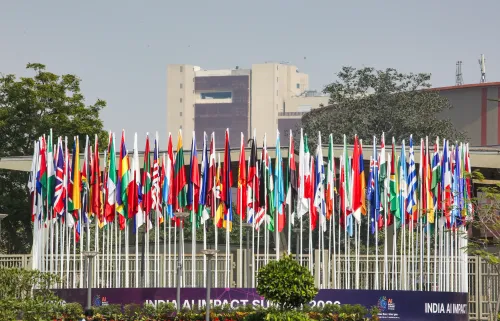
Will the 'India AI Impact Summit' Become the Largest Gathering on AI?

Synopsis
The upcoming 'India AI Impact Summit 2026' is generating buzz as it approaches, with over 35,000 registrations. Slated to host global leaders and hundreds of startups, this summit aims to drive impactful discussions around AI and its future.
Key Takeaways
The India AI Impact Summit 2026 is set for February 16-20 in New Delhi.
Over 35,000 registrations have already been received.
Participation from more than 100 countries, including heads of state and industry leaders.
Focus on responsible and inclusive AI development.
Showcasing 12 qualified Indian startups with potential for foreign investment.
New Delhi, Feb 2 (NationPress) The 'India AI Impact Summit 2026', taking place from February 16-20 in the capital, has garnered immense global attention, with over 35,000 registrations reported to date, according to a government announcement on Monday.
This significant event will see participation from over 100 countries, including 15-20 heads of government, more than 50 ministers, and around 40 CEOs of prominent global and Indian firms, as detailed in an official statement.
The India AI Impact Summit is expected to be the largest among the four global AI summits held thus far, underscoring the increasing international traction around responsible, inclusive, and impactful Artificial Intelligence.
According to the Ministry of Electronics and IT, the summit will host over 500 AI startups and feature around 500 sessions.
The framework of the summit includes seven flagship events, collectively engaging over 300,000 participants, illustrating the broad national and global interest in the AI Impact Summit initiative.
The engagement scale leading up to the summit has been remarkable, with over 1,300 proposals submitted for pre-summit events, and more than 500 pre-summit events already conducted across various sectors and regions in India and abroad.
The global AI summit process has transitioned from focusing on AI risks to fostering discussions on ethics and inclusion, moving towards operationalizing shared principles.
The ministry encourages interested parties to visit the official website to register and engage in this global dialogue aimed at promoting the responsible and impactful use of Artificial Intelligence.
This summit will also highlight 12 selected Indian startups in fields such as healthcare and multilingual technology. Such exposure could attract foreign investments and talent, propelling India toward its ambition of achieving a $1 trillion digital economy by 2030.
The India AI Mission, initiated in 2024 with funding of $1.2 billion, has democratized access to computing resources, datasets, and talent development. Additionally, the National AI Portal has made open-source datasets available, while partnerships with technology giants have ensured the establishment of high-performance computing infrastructure.
aar/na
Point of View
I firmly believe that the 'India AI Impact Summit 2026' represents a crucial milestone in the global discourse on Artificial Intelligence. With significant international participation, it reflects India's commitment to being at the forefront of AI development and governance. This event is not just about technology; it is about fostering responsible and inclusive innovation that can benefit humanity as a whole.
NationPress
16 Sept 2026
Frequently Asked Questions
What is the date of the India AI Impact Summit 2026?
The India AI Impact Summit 2026 is scheduled from February 16 to February 20.
How many registrations have been received so far?
Over 35,000 registrations have been reported to date.
Which countries will participate in the summit?
The event will feature participation from over 100 countries.
What is the significance of the summit?
The summit aims to drive discussions around responsible and impactful AI, showcasing innovations and addressing ethical considerations.
How can one register for the summit?
Interested individuals can visit the official website to register.