Are India and Portugal Paving the Way for AI-led Governance?

Synopsis
India and Portugal have established a collaborative framework for AI-led governance, highlighting their commitment to digital reforms in public services. This partnership aims to enhance administrative efficiencies and citizen services, reflecting a significant shift towards practical cooperation between the two nations.
Key Takeaways
India and Portugal have agreed to collaborate on AI-led governance.
A joint working group will focus on administrative reforms and digital services.
Key areas of collaboration include digital pensions and grievance redressal.
Both nations aim to enhance citizen services through innovative technologies.
This partnership marks a significant step towards practical cooperation.
New Delhi, Feb 17 (NationPress) India and Portugal have reached an agreement to establish a collaborative framework aimed at enhancing administrative reforms and digital governance, specifically targeting the implementation of artificial intelligence in public services. This decision reflects a move towards structured cooperation beyond mere dialogue.
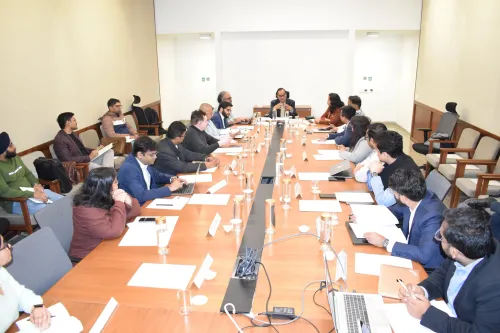
The agreement was made during discussions between Union Minister of State (Independent Charge) for Science and Technology, Dr. Jitendra Singh, and Portugal's Minister of State for Reform, Goncalo Matias, on the sidelines of the AI Impact Summit 2026 held in the national capital.
Dr. Singh introduced the idea of forming a working group to pinpoint priority areas for collaboration, including digital pension systems, grievance redressal platforms, and AI-enabled document processing. He stated, "We can identify areas of mutual benefit and begin with specific, scalable models," suggesting training exchanges and technical sharing between the two countries.
Highlighting India's reform journey over the past decade, he noted that nearly 2,000 outdated regulations, many of which were remnants of colonial rule, have been abolished, thus improving citizen services. He mentioned the removal of mandatory attestations by gazetted officers, the phasing out of interview-based recruitment for certain roles to lessen discretion, and the introduction of single-page digital forms replacing cumbersome, multi-copy paperwork.
India's grievance redressal system, which is now functioning on a "hybrid model" that combines AI-led sorting with human oversight, has achieved nearly 95% disposal rates, with final decisions still requiring human intervention. Additionally, the government has fully digitized the pension processing system and expanded the use of biometric and facial authentication for life certificates, benefiting millions annually.
Matias shared Portugal’s reform strategy focused on "simplification first, digitalization next." His administration is revising essential codes governing public procurement, construction, and licensing before integrating AI into administrative decision-making. He emphasized the importance of avoiding the digitalization of complexity, stating, "If we digitalize complexity, we create another layer of bureaucracy," and confirmed that AI will help speed up document processing, but with mandatory human approval for final decisions.
Furthermore, Portugal is allocating public funds to assist small and medium enterprises in adopting AI technologies, especially after extreme climate events recently impacted industrial units in the central region. Matias indicated that the goal is for affected SMEs to rebuild with enhanced technological infrastructure by the end of the year.
On the multilateral front, Dr. Singh mentioned that India has launched new anti-corruption initiatives within the G20, emphasizing women-centered corruption risks and building consensus on addressing economic fugitives who exploit jurisdictional differences. He also highlighted India's recent election to a leadership role at the International Institute of Administrative Sciences as a recognition of its governance reforms.
In addition to governance, both nations recognized the potential for increased collaboration in trade, technology, and education. The two ministers discussed accelerating the third meeting of the senior consultative body under the existing MoU regarding public administration and governance reforms, as well as exploring partnerships in science and technology, digital inclusion, and academic exchanges.
This meeting takes place in the context of strengthening political ties between the two democracies, which celebrated 50 years of re-established diplomatic relations in 2025. With both governments emphasizing administrative simplification and AI-led governance as central to their reform agendas, Tuesday’s discussions indicate a transition from ceremonial interactions to practical institutional alignment in India-Portugal cooperation.
Point of View
I believe that the collaboration between India and Portugal in establishing a joint working group on AI-led governance marks a pivotal moment in international cooperation. This initiative not only underscores the importance of technological advancement in public administration but also reinforces the shared commitment of both nations to improve citizen services. It is a step towards more efficient governance that other countries should consider emulating.
NationPress
20 Sept 2026
Frequently Asked Questions
What is the primary focus of the India-Portugal collaboration?
The collaboration primarily focuses on administrative reforms and digital governance, specifically through the deployment of artificial intelligence in public services.
Who are the key figures involved in this agreement?
The key figures involved in this agreement are Dr. Jitendra Singh, India's Union Minister of State for Science and Technology, and Goncalo Matias, Portugal's Minister of State for Reform.
What are some specific areas of collaboration mentioned?
Some specific areas of collaboration include digital pension systems, grievance redressal platforms, and AI-enabled document processing.
How has India modernized its grievance redressal system?
India has modernized its grievance redressal system by implementing a hybrid model that combines AI-led sorting with human oversight, achieving close to 95% disposal rates.
What is Portugal's approach to digital governance?
Portugal's approach to digital governance emphasizes simplification before digitalization, ensuring that complex processes are streamlined before integrating AI.