India's Trade with Australia Soars Post-Bilateral Pact
Synopsis
Discover how the India-Australia Economic Cooperation and Trade Agreement has transformed trade dynamics, more than doubling India's exports to Australia and creating new business opportunities over the past four years.
Key Takeaways
India’s exports to Australia have more than doubled since the ECTA.
The total bilateral trade reached $24.1 billion in FY 2024-25.
70.3% of India's tariff lines now have preferential access.
98.3% of tariff lines became duty-free immediately upon implementation.
The MRA enhances cooperation in organic products trade.
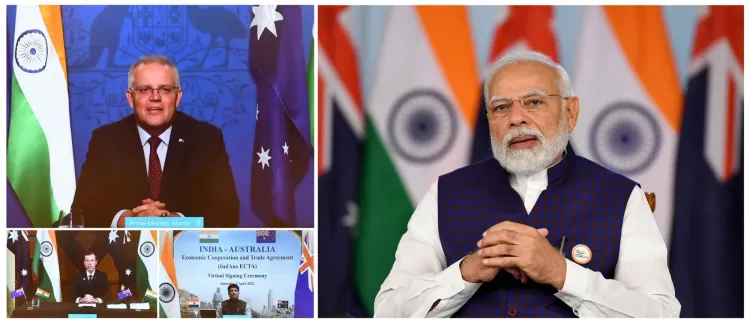
New Delhi, April 2 (NationPress) The Economic Cooperation and Trade Agreement between India and Australia (Ind-Aus ECTA) has marked its four-year milestone since its signing on April 2, 2022, significantly boosting India's export figures and trade relations between the two nations.
In the past four years, this agreement has opened up numerous avenues for businesses, entrepreneurs, and job creation across both countries. India’s exports to Australia have skyrocketed, climbing from $4 billion in FY 2020-21 to $8.5 billion in FY 2024-25. During this period, bilateral trade totaled $24.1 billion, with Indian exports to Australia achieving an 8% increase compared to the previous year. In FY 2025-26 (up to February), the total trade between India and Australia reached $19.3 billion, according to the latest data from the Commerce Ministry.
As part of the Ind-Aus ECTA, India has provided preferential market access on 70.3% of its tariff lines, which accounts for 90.6% of the trade value, while Australia has extended preferential access to 100% of its imports from India.
Notably, 98.3% of tariff lines became duty-free immediately upon the agreement's implementation, with the remaining 1.7% (113 tariff lines) set to be phased out over the next five years. From January 1, 2026, all Indian exports will qualify for zero-duty market access in Australia, as explained in the official statement.
The sectoral benefits under the ECTA are increasingly widespread, with significant growth in exports of textiles, pharmaceuticals, chemicals, and agricultural products. On the import side, the agreement continues to enhance access to crucial raw materials, such as base metals, raw cotton, chemicals, fertilizers, and pulses, vital for India’s manufacturing and industrial sectors. This complementary trade framework has bolstered supply chain resilience and fostered increased domestic value addition, as stated.
A major milestone in bilateral cooperation was reached with the signing of the Mutual Recognition Arrangement (MRA) on Organic Products between India and Australia on September 24, 2025. This MRA streamlines trade in organic products by mutually recognizing each other's certification systems, thereby minimizing duplication, costs, and time for exporters. This initiative has reinforced cooperation in the organic sector, promoting transparency and trust in organic trade practices.
The agreement has emerged as a fundamental component of bilateral relations, providing substantial benefits to businesses, MSMEs, workers, and consumers in both regions.
Point of View
I view the India-Australia Economic Cooperation and Trade Agreement as a pivotal development in strengthening bilateral trade and promoting economic growth. It reflects a commitment to mutually beneficial trade practices, enhancing opportunities for businesses and consumers alike.
NationPress
11 Oct 2026
Frequently Asked Questions
What is the Ind-Aus ECTA?
The India-Australia Economic Cooperation and Trade Agreement (Ind-Aus ECTA) is a trade pact that enhances economic relations, providing preferential market access and boosting exports between the two nations.
How much have India's exports to Australia increased?
India's exports to Australia have increased from $4 billion in FY 2020-21 to $8.5 billion in FY 2024-25.
What sectors are benefiting from the ECTA?
The ECTA has led to notable growth in sectors such as textiles, pharmaceuticals, chemicals, and agricultural products.
When will all Indian exports be eligible for zero-duty access to Australia?
From January 1, 2026, all Indian exports will qualify for zero-duty market access in Australia.
What is the Mutual Recognition Arrangement (MRA)?
The MRA on Organic Products facilitates seamless trade by recognizing each country's certification systems, reducing costs and time for exporters.