Are India-Australia Economic Ties at an All-Time High?
Synopsis
India and Australia are witnessing a remarkable surge in economic relations, with bilateral trade at an all-time high. Zoe Woodley from the Australian High Commission highlights the momentum of the Economic Cooperation and Trade Agreement (ECTA) and the potential for further collaboration. Discover how these developments reflect India's growing global economic importance.
Key Takeaways
Economic relations between India and Australia are thriving.
Bilateral trade has surged by nearly 200% since the ECTA's implementation.
Plans to enhance the ECTA into a SECA agreement are underway.
Australia's raw materials complement India's manufacturing capabilities.
India is recognized as the fastest-growing economy globally.
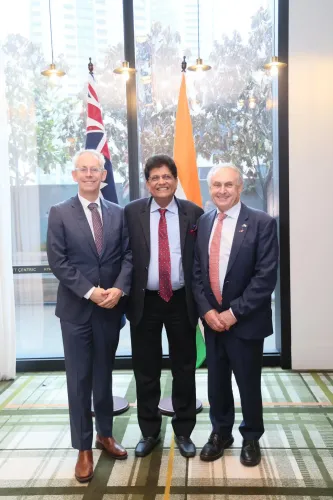
New Delhi, Feb 4 (NationPress) The economic relationship between India and Australia is currently at its peak, with bilateral trade experiencing significant growth and exciting opportunities on the horizon, according to Zoe Woodley, First Secretary for Economic, Energy and Climate Change at the Australian High Commission, during a recent discussion.
In her conversation with IANS, Woodley emphasized that the trade connections between the two nations are at an unprecedented level, propelled by the Economic Cooperation and Trade Agreement (ECTA).
"Australia and India are actively working on enhancing the existing ECTA into a more extensive SECA agreement to further strengthen economic collaboration," she remarked.
Woodley pointed out that since the ECTA was implemented, trade from India to Australia has surged by nearly 200 percent in a few short years.
She noted that this growth is merely the beginning, expressing optimism that both countries have much more to accomplish together.
"Australia's resources are abundant in raw materials, while India offers scale and manufacturing prowess," she explained to IANS.
"This partnership enables both countries to collaboratively produce goods and supply them to international markets," Woodley asserted.
Discussing India's broader economic perspective, Woodley stated that India is widely acknowledged as the fastest-growing economy in the world.
"This status clearly illustrates India's increasing significance in the global economic arena," she added.
Meanwhile, a recent article in an Australian publication pointed out that India's latest free trade agreements (FTAs) signify a strategic pivot from a defensive trade policy to a targeted, growth-oriented strategy, focusing on partners with already strong trade complementarities, efficient logistics, and aligned economic interests.
The article, authored by Anna Mahjar-Barducci in the Australian Institute of International Affairs, highlighted that India is increasingly selecting partners where bilateral trade is already flourishing and where agreements can build on existing momentum, rather than trying to forge new trade connections from the ground up.
Point of View
It is imperative to recognize that the strengthening economic ties between India and Australia not only highlight the potential for growth in both nations but also reflect broader trends in global trade. The collaboration offers invaluable opportunities for enhancing manufacturing and resource sharing, which could redefine their roles in the international market. The focus on strengthening existing trade relationships is a strategic approach that could yield significant benefits for both countries.
NationPress
7 Oct 2026
Frequently Asked Questions
What is the reason behind the growth in trade between India and Australia?
The growth in trade is primarily driven by the Economic Cooperation and Trade Agreement (ECTA) and the collaborative efforts to upgrade it into a more comprehensive SECA agreement.
How much has trade from India to Australia increased since the ECTA was implemented?
Trade from India to Australia has increased by nearly 200 percent since the ECTA came into effect.
What strengths do Australia and India bring to their economic partnership?
Australia's strength lies in its abundant raw materials, while India contributes scale and manufacturing capabilities, allowing for collaborative production and supply to global markets.
Why is India considered the fastest-growing economy?
India's rapid economic growth is recognized globally, reflecting its increasing importance in the international economic landscape.
What strategic shift is reflected in India's recent FTAs?
India's recent FTAs indicate a strategic shift from a defensive trade policy to a targeted, growth-driven approach focused on partners with established trade complementarities.