Is India the 2nd Country to Integrate Mobile Stroke Units with Emergency Medical Services?
Synopsis
India has made significant strides in healthcare by becoming the second country to integrate Mobile Stroke Units into its emergency medical services. This initiative promises to enhance stroke treatment accessibility in rural regions, ensuring timely care and improved patient outcomes.
Key Takeaways
India is the second country to implement Mobile Stroke Units.
The initiative aims to improve stroke treatment in rural areas .
MSUs are equipped with essential medical technology.
The model significantly reduces treatment time.
This approach enhances healthcare accessibility in the Northeast .
New Delhi, Jan 22 (NationPress) India has become the second nation worldwide to incorporate Mobile Stroke Units within its emergency medical services, enhancing treatment accessibility in rural regions, as stated by Dr. Rajiv Bahl, the Secretary of the Department of Health Research and Director General of ICMR.
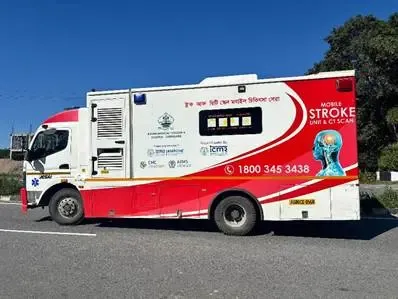
Dr. Bahl made this announcement during the handover of two Mobile Stroke Units (MSUs) to the Assam government, marking a significant transition from stroke patients in remote locations needing to travel to hospitals, to hospitals reaching out to patients.
This initiative is part of a project funded by ICMR to assess ‘Stroke Care Pathways’ in the area. Following the pilot phase, the ICMR donated these units to ensure that the people of Assam can receive swift treatment for cerebrovascular emergencies.
“Mobile Stroke Units were initially developed in Germany and subsequently assessed in major cities around the globe. India has tested such units in rural, isolated, and challenging terrains in Northeast India. We are also the second country worldwide to report successful integration of an MSU with emergency medical services for treating rural acute ischemic stroke patients,” Dr. Bahl noted.
Stroke remains a leading cause of death and long-term disability in India, necessitating prompt care within the golden hour.
“This handover fortifies Assam’s emergency response framework and guarantees the continuity of this critical service under state management,” remarked P. Ashok Babu, Secretary & Commissioner of Health in Assam.
He emphasized that the partnership with ICMR has led to quicker treatment, enhanced coordination, and improved outcomes for stroke patients, establishing a solid foundation for future expansion.
The Mobile Stroke Units function as mobile hospitals on wheels, equipped with a CT scanner, teleconsultation with specialists, point-of-care laboratory, and clot-busting medications, facilitating early diagnosis and treatment of strokes at or near the patient’s home.
The Northeast region bears a heavy burden of strokes. Challenging terrains, lengthy distances, and limited access to specialized care have historically hindered timely stroke treatment.
To combat this issue, ICMR set up a neurologist-led stroke unit at the Assam Medical College & Hospital in Dibrugarh, along with physician-led stroke units at the Tezpur Medical College Hospital and Baptist Christian Hospital in Tezpur.
The Mobile Stroke Units have been integrated into this pre-hospital stroke care pathway.
This model has cut treatment time from almost 24 hours to roughly 2 hours, reduced mortality rates by one-third, and decreased disability by eight times, according to the Ministry.
Point of View
I believe this initiative represents a remarkable advancement in public health, specifically in the realm of emergency medical responses. The integration of Mobile Stroke Units signifies a proactive approach to healthcare in India, ensuring that even the most underserved populations receive critical and timely medical attention. This is a vital step forward that aligns with our commitment to enhancing healthcare accessibility and effectiveness across the nation.
NationPress
24 Sept 2026
Frequently Asked Questions
What are Mobile Stroke Units?
Mobile Stroke Units are specialized vehicles equipped with medical technology, including CT scanners and teleconsultation capabilities, designed to provide immediate care and treatment for stroke patients at or near their homes.
Why is the integration of MSUs important?
The integration of Mobile Stroke Units into emergency medical services is crucial as it allows for rapid diagnosis and treatment of strokes, significantly improving patient outcomes and reducing mortality rates.
How has this initiative impacted Assam?
This initiative has strengthened Assam's emergency response system, ensuring that residents can access timely stroke care, which is particularly important in rural and remote areas.
How does this model compare to previous treatment methods?
The new model reduces treatment time from nearly 24 hours to about 2 hours, dramatically decreasing deaths and disability rates associated with strokes.
What challenges does the Northeast face regarding stroke treatment?
The Northeast region faces challenges such as difficult terrain, long distances, and limited access to specialized care, which have historically hindered timely stroke treatment.