India-Italy bilateral trade may hit €50 billion by 2035: ASSOCHAM report

Synopsis
India and Italy's bilateral trade could more than quintuple to €50 billion by 2035, according to an ASSOCHAM report presented to Italy's Deputy PM Antonio Tajani in Rome. With India's share in Italy's imports already rising and the India-EU FTA in the pipeline, the report argues both countries are sitting on an underexploited industrial partnership — from precision engineering to green hydrogen.
Key Takeaways
ASSOCHAM projects India-Italy bilateral trade reaching €50 billion by 2035 , up from current levels.
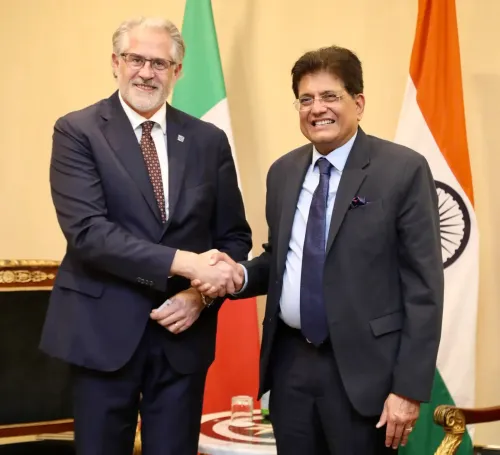
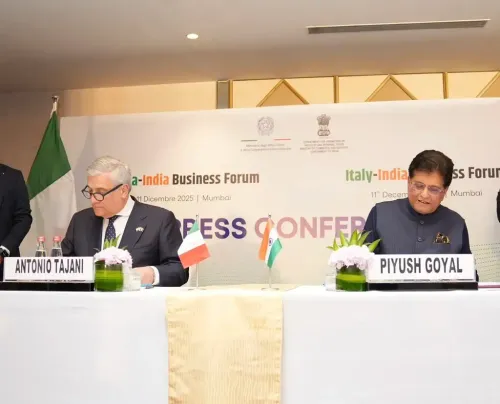
The report was presented to Antonio Tajani , Italy's Deputy PM, at the India-Italy Business Forum in Rome on 20 November 2026 .
Italy's imports from India stood at $9.7 billion in 2025 , with India's share in Italy's total imports rising from 1.2% (2019) to 1.5% (2025) .
Key cooperation sectors include advanced manufacturing , pharmaceuticals , textiles , semiconductors , green hydrogen and AI .
The anticipated India-EU Free Trade Agreement is identified as a primary structural driver for trade growth.
Bilateral trade between India and Italy could surge to €50 billion by 2035, according to a report released by the Associated Chambers of Commerce and Industry of India (ASSOCHAM), with the anticipated India-EU Free Trade Agreement, deeper industrial linkages and expanded business partnerships cited as the primary drivers. The report was unveiled at the India-Italy Business Forum in Rome on 20 November 2026.
Key Findings of the ASSOCHAM Report
The report was formally presented to Antonio Tajani, Deputy Prime Minister and Minister of Foreign Affairs and International Cooperation of Italy, by Saurabh Sanyal, Secretary General, ASSOCHAM. It identifies a clear complementarity between the two economies — India's manufacturing scale, skilled workforce and expanding domestic market on one side, and Italy's strengths in quality craftsmanship, design, precision engineering and advanced industrial technologies on the other.
Sanyal noted that combining these strengths could unlock significant trade, investment and value-chain opportunities. 'India and Italy have considerable potential to deepen their economic partnership,' he said, emphasising that stronger business connections and technology exchange can help enterprises in both countries access new markets and strengthen their global competitiveness.
Where the Two Economies Stand Today
Italy's total global imports stood at $669 billion in 2025, with imports from India reaching $9.7 billion during the same period. India's share in Italy's total imports has grown from approximately 1.2 per cent in 2019 to 1.5 per cent in 2025 — a modest but steady rise that underscores growing commercial ties even before a formal trade framework is in place. This trajectory, the report argues, provides a foundation on which a more ambitious bilateral relationship can be built.
Sectors with the Most Promising Cooperation Potential
The report identifies several established and emerging sectors where collaboration is particularly promising. On the conventional side, these include advanced manufacturing and industrial automation, automobiles and components, pharmaceuticals and medical technologies, textiles, fashion and technical textiles, and food processing and agricultural technology.
Emerging high-growth areas flagged by the report include artificial intelligence, semiconductors, fintech, quantum computing, renewable energy, green hydrogen and energy storage — sectors where joint research and commercial partnerships could yield significant returns. Additionally, the report highlights scope for strengthening cooperation in critical minerals, maritime infrastructure and logistics, areas that have gained strategic importance in the context of global supply-chain realignment.
The India-EU FTA as a Structural Catalyst
Central to the report's projections is the ongoing negotiation of the India-EU Free Trade Agreement, which could significantly lower tariff and non-tariff barriers and create a more predictable framework for bilateral commerce. ASSOCHAM believes that sustained institutional engagement, backed by active industry participation, can transform the India-Italy relationship from a conventional trade corridor into a dynamic, investment-led partnership. This comes amid a broader global push to diversify supply chains away from single-country dependencies, in which both India and Italy are actively repositioning themselves as manufacturing and technology hubs.
What Comes Next
The release of this report at the Rome forum signals a deliberate push by Indian industry bodies to deepen economic diplomacy with European partners at a moment when geopolitical realignments are reshaping trade flows. Whether the €50 billion target is achieved will hinge on the pace of the India-EU FTA negotiations and the ability of businesses in both countries to move from statements of intent to concrete joint ventures and investment commitments.
Point of View
Not a baseline — and it rests almost entirely on an India-EU FTA whose timeline remains uncertain. India's share of Italy's imports has grown by just 0.3 percentage points over six years, suggesting the relationship, while improving, is not yet accelerating at the pace the headline figure implies. The report's real value is in mapping the sectoral architecture — precision engineering, green hydrogen, critical minerals — where genuine complementarity exists. Without a concluded FTA and verifiable investment commitments, however, forum-level declarations risk becoming a familiar pattern of ambition without execution.
NationPress
20 Nov 2026
Frequently Asked Questions
What is the ASSOCHAM India-Italy trade projection for 2035?
ASSOCHAM projects bilateral trade between India and Italy could reach €50 billion by 2035, up from current levels, driven by the India-EU Free Trade Agreement, stronger industrial linkages and expanded business partnerships. The projection was outlined in a report released at the India-Italy Business Forum in Rome on 20 November 2026.
How much does India currently trade with Italy?
Italy's imports from India stood at $9.7 billion in 2025, against Italy's total global imports of $669 billion. India's share in Italy's total imports has grown from approximately 1.2 per cent in 2019 to 1.5 per cent in 2025.
Which sectors are highlighted for India-Italy cooperation?
The ASSOCHAM report identifies advanced manufacturing, industrial automation, automobiles, pharmaceuticals, textiles, food processing, artificial intelligence, semiconductors, fintech, green hydrogen, renewable energy and critical minerals as key areas for bilateral cooperation and joint investment.
What role does the India-EU FTA play in this projection?
The anticipated India-EU Free Trade Agreement is cited as a primary structural catalyst, as it would lower tariff and non-tariff barriers and create a more predictable framework for bilateral trade and investment between India and EU member states, including Italy.
Who presented the ASSOCHAM report and to whom?
The report was presented by Saurabh Sanyal, Secretary General of ASSOCHAM, to Antonio Tajani, Deputy Prime Minister and Minister of Foreign Affairs and International Cooperation of Italy, at the India-Italy Business Forum in Rome.