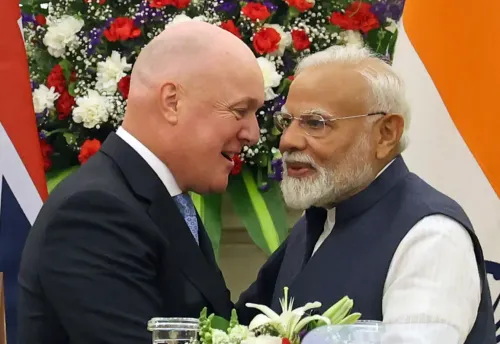
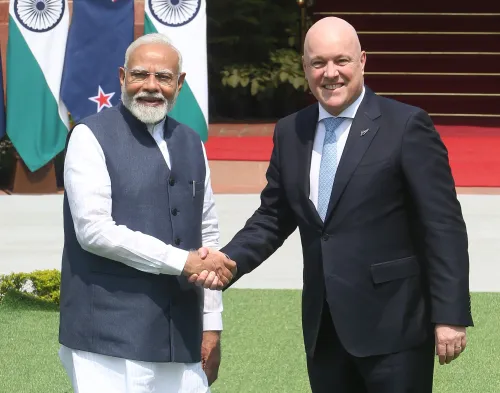
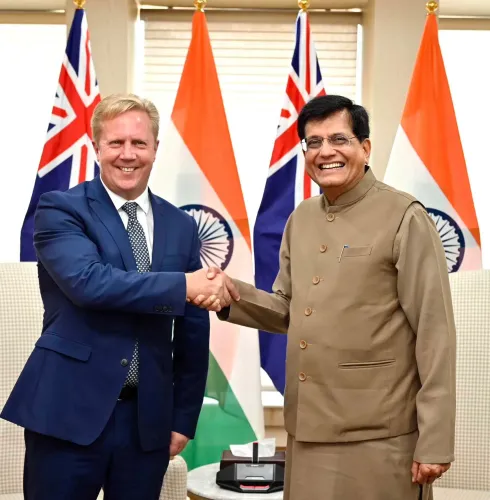
India-New Zealand FTA unlocks $20 billion investment pledge, targets $5 billion bilateral trade
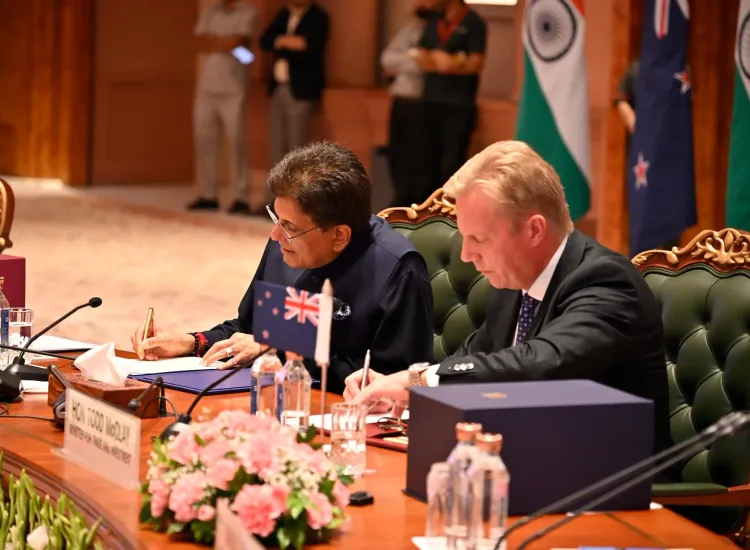
Synopsis
India and New Zealand just inked a trade pact with teeth: $20 billion in committed investment, 100% tariff-free access for Indian exports, and a $5 billion bilateral trade target. For India's textiles, autos, and pharma sectors, this is a gateway to scale; for New Zealand, it's a foothold in Asia's fastest-growing manufacturing ecosystem.
Key Takeaways
India–New Zealand FTA signed on 27 April , featuring 100 per cent duty-free access for Indian exports.
New Zealand commits $20 billion investment over 15 years to catalyse Indian industrial infrastructure and manufacturing.
Bilateral trade target: $5 billion within five years, double current levels.
Key beneficiary sectors: textiles, leather, ceramics, auto components, pharmaceuticals, and mechanical machinery.
CII Director General Chandrajit Banerjee highlighted productivity gains and MSME support through reduced trade costs.
Green and sustainable manufacturing partnerships aligned with global climate goals.
The Confederation of Indian Industry (CII) on 27 April hailed the signing of the India–New Zealand Free Trade Agreement (FTA), noting that New Zealand's commitment to facilitate $20 billion in investment over 15 years is expected to catalyse industrial infrastructure, manufacturing ecosystems, and innovation clusters across India. The pact aims to double bilateral trade to $5 billion within five years, marking a significant deepening of economic ties between the two nations.
What the FTA delivers
The agreement provides 100 per cent duty-free access for Indian exports across key sectors including textiles, leather, ceramics, and auto components. Chandrajit Banerjee, Director General of CII, said the accord would "substantially enhance the competitiveness of Indian exports" by eliminating tariffs and unlocking new avenues for scale and market diversification. The pact is particularly significant for transport and automotive, pharmaceuticals, plastics and rubber, electrical and electronic equipment, and mechanical machinery sectors, which are positioned to scale up exports and strengthen global market presence.
Investment and productivity gains
Beyond tariff elimination, the FTA's innovative trade-investment linkage is expected to enhance productivity, reduce trade costs, and provide substantial support to micro, small, and medium enterprises (MSMEs). Banerjee noted that the agreement would foster innovation, attract fresh capital, and strengthen global linkages while safeguarding key domestic sectors. The $20 billion investment pledge from New Zealand signals renewed momentum in bilateral economic engagement and underscores confidence in India's manufacturing and infrastructure potential.
Emerging collaboration opportunities
The agreement opens doors for partnership across high-growth sectors such as advanced manufacturing, agritech and food processing, digital technologies, and pharmaceuticals. By combining India's scale and digital capabilities with New Zealand's innovation strengths, both nations can co-create solutions and build globally competitive industries. Notably, partnerships in sustainable and green manufacturing are expected to align with global climate goals and support the transition to low-carbon growth pathways — a strategic priority for both economies amid rising ESG pressures.
What's next
CII indicated it would work closely with stakeholders in both nations to realise the agreement's full potential. Implementation timelines for sectoral guidelines and investment facilitation mechanisms are expected to be detailed in the coming months, with the first tranche of New Zealand-backed capital likely to flow into infrastructure and manufacturing clusters by the next financial year.
Point of View
Aligns incentives on sustainability, and targets sectors where India has genuine competitive advantage. But the real test is execution: $20 billion over 15 years is credible only if New Zealand's investment climate boards and India's infrastructure bottlenecks don't slow capital deployment. The $5 billion bilateral trade target assumes zero friction in customs clearance and logistics — an assumption that has unravelled in other recent FTAs. Watch whether CII's optimism translates into actual factory floor expansion or remains headline GDP arithmetic.
NationPress
16 Sept 2026
Frequently Asked Questions
What is the India-New Zealand Free Trade Agreement?
The FTA, signed on 27 April, is a bilateral trade pact between India and New Zealand that provides 100 per cent duty-free access for Indian exports across key sectors including textiles, leather, ceramics, and auto components. New Zealand has committed to facilitate $20 billion in investment over 15 years to support Indian manufacturing and infrastructure development.
How much investment will New Zealand contribute?
New Zealand has pledged to facilitate $20 billion in investment over 15 years to catalyse industrial infrastructure, manufacturing ecosystems, and innovation clusters across India. This capital is expected to flow into sectors such as advanced manufacturing, agritech, digital technologies, and pharmaceuticals.
What is the bilateral trade target under the FTA?
The agreement aims to double bilateral trade to $5 billion within five years. This represents a significant expansion from current trade levels and signals renewed momentum in India-New Zealand economic ties.
Which Indian sectors benefit most from the FTA?
Key beneficiary sectors include transport and automotive, pharmaceuticals, plastics and rubber, electrical and electronic equipment, mechanical machinery, textiles, leather, and ceramics. These sectors gain 100 per cent duty-free access to the New Zealand market, enabling scale-up and export growth.
How will the FTA support MSMEs?
The agreement reduces trade costs and enhances productivity for small and medium enterprises by eliminating tariffs, providing tariff-free market access, and attracting foreign investment. CII noted that the trade-investment linkage is designed to foster innovation and strengthen global linkages for MSME exporters.