Historic India-New Zealand FTA Signed April 27: $5B Trade, 5,000 Visas
Synopsis
India and New Zealand sign a landmark FTA on April 27 targeting $5 billion in bilateral trade and $20 billion in investment. The deal opens 5,000 annual work visas for Indian professionals — including yoga instructors and AYUSH practitioners — while shielding dairy and farm sectors from foreign competition.
Key Takeaways
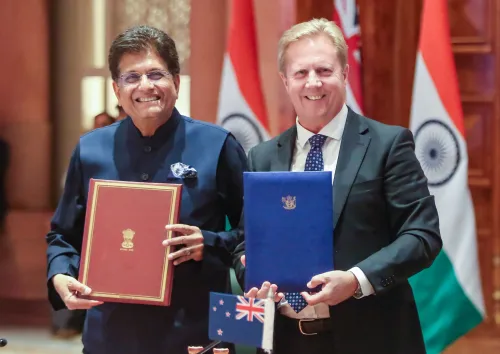
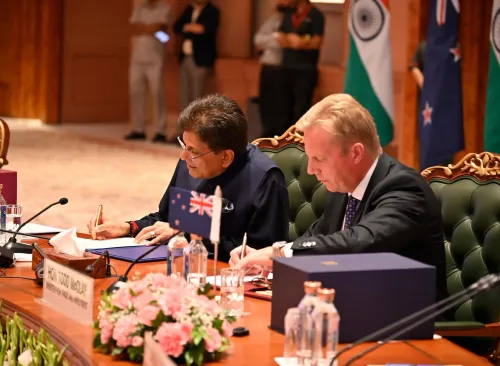
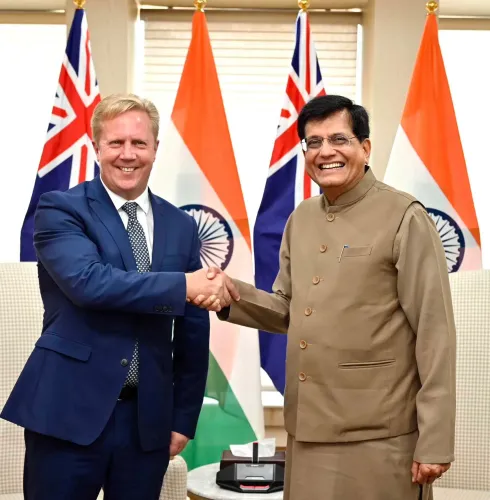
India and New Zealand will sign their landmark Free Trade Agreement on April 27, 2025 , at Bharat Mandapam, New Delhi , in the presence of ministers Piyush Goyal and Todd McClay .
The deal targets doubling bilateral trade to $5 billion within five years and attracting $20 billion in New Zealand investment into India over 15 years.
New Zealand will see tariffs eliminated or reduced on 95 per cent of its exports to India , including wool, wine, seafood and fruit, while India gains duty-free access to New Zealand markets.
India has excluded dairy, onions, sugar, spices, edible oils and rubber from tariff concessions to protect domestic agricultural sectors.
A 5,000 annual visa pathway for Indian professionals — covering IT, healthcare, engineering, yoga instructors and AYUSH practitioners — allows stays of up to three years in New Zealand.
New Zealand has committed to amending its laws to recognize Indian Geographical Indications , strengthening legal protection for iconic Indian products abroad.
India and New Zealand are set to ink a landmark Free Trade Agreement (FTA) on Monday, April 27, at Bharat Mandapam, New Delhi, in the presence of Union Commerce Minister Piyush Goyal and New Zealand Trade Minister Todd McClay. The long-awaited pact, concluded after more than four months of post-negotiation formalities, is designed to fundamentally reshape the economic relationship between the two nations — targeting doubled bilateral trade, massive investment inflows, and new mobility pathways for Indian professionals.
Deal at a Glance: Trade, Investment and Market Access
The agreement sets an ambitious target of doubling bilateral trade to $5 billion over the next five years, up from current levels that have remained modest relative to India's trade with other major partners. The timing is strategically significant — with global trade disruptions driven by West Asia tensions and shifting supply chains, India is actively diversifying its trade partnerships to reduce dependence on volatile corridors.
Beyond trade, the pact is projected to unlock an estimated $20 billion in New Zealand investment into India over 15 years, spanning sectors such as manufacturing, infrastructure, services, innovation and job creation. This positions the agreement not merely as a tariff deal, but as a long-term economic architecture between two democracies with complementary strengths.
Tariff Concessions: What Opens, What Stays Protected
Under the FTA, Indian companies will gain duty-free access to New Zealand markets, a significant win for Indian exporters eyeing the Pacific region. Simultaneously, New Zealand will see tariffs eliminated or reduced on approximately 95 per cent of its exports to India, covering products such as wool, coal, wood, wine, seafood, cherries, avocados and blueberries.
New Zealand will also receive quota-based tariff reductions for key agricultural exports including kiwifruit and apples, while enjoying duty-free access on sheep meat, wool and forestry products. Reduced duties will apply to Manuka honey, infant formula and select seafood items.
Critically, India has exercised strategic caution by excluding sensitive sectors — dairy, onions, sugar, spices, edible oils and rubber — from tariff concessions. This carve-out directly protects millions of Indian farmers and domestic agro-industries from competitive pressure, a politically and economically prudent safeguard that reflects lessons learned from the RCEP negotiations India walked away from in 2019, largely over dairy concerns.
Professional Mobility: 5,000 Visas Annually for Indian Workers
One of the most consequential provisions of the agreement is a dedicated temporary employment visa pathway that will allow up to 5,000 Indian professionals annually to work in New Zealand for up to three years. This covers high-demand sectors including IT, engineering, healthcare, education and construction.
Notably, the visa pathway also extends to traditional Indian professions such as yoga instructors, AYUSH practitioners, chefs and music teachers — a culturally significant inclusion that acknowledges India's soft power exports and the growing global demand for traditional Indian knowledge systems.
This mobility chapter could prove transformative for Indian professionals seeking international exposure in a stable, high-income economy, particularly as Canada and the UK have tightened immigration pathways in recent years, redirecting Indian talent flows toward newer destinations.
Agriculture, GI Tags and Non-Tariff Barriers
The FTA includes a dedicated Agri-Technology Action Plan focused on products like kiwifruit, apples and honey, supporting Indian farmers through improved planting materials, capacity building and technical assistance in orchard management, supply chains and food safety. This bilateral agricultural cooperation could introduce productivity gains for Indian horticulture — a sector that employs hundreds of millions.
In a notable diplomatic win, New Zealand has committed to amending its domestic laws to facilitate the registration of Indian Geographical Indications (GIs), particularly for wines and spirits. This strengthens the legal protection of iconic Indian products in foreign markets — a priority India has pursued across multiple trade negotiations.
The agreement also addresses non-tariff barriers through enhanced regulatory cooperation, streamlined customs procedures and improved sanitary and phytosanitary (SPS) measures — often the hidden obstacles that derail the practical benefits of FTAs even after they are signed.
Strategic Context: Why This FTA Matters Now
India's FTA push has accelerated in recent years, with deals already signed or under negotiation with the UAE, Australia, the UK and the Gulf Cooperation Council. The New Zealand agreement adds a Pacific anchor to this expanding trade architecture, at a time when India's merchandise exports face headwinds from global demand softness and geopolitical realignments.
Historically, India-New Zealand trade has punched well below its potential — bilateral trade stood at roughly $700 million to $800 million in recent years, a fraction of what two economies of their respective sizes typically achieve. The FTA is designed to change that trajectory structurally, not just incrementally.
With the formal signing scheduled for April 27 at Bharat Mandapam, both governments are expected to move swiftly toward ratification. The agreement's implementation timeline, sector-specific rules of origin, and the activation of the visa pathway will be closely watched by industry bodies and exporters in the coming months.
Point of View
Securing market access and investment while fiercely protecting its farmers, a balancing act it failed to execute during the RCEP negotiations. The inclusion of traditional professions like AYUSH practitioners and yoga instructors in the visa pathway is quietly revolutionary, institutionalizing India's soft power exports in international law for the first time. What mainstream coverage misses is the timing: as Canada and the UK shut doors on Indian migrants and the West Asia corridor faces turbulence, India is methodically building alternative economic highways. The real test, however, lies in implementation — India's FTA with Australia, signed in 2022, has yet to fully deliver on its promise, and the New Zealand deal must not repeat that pattern.
NationPress
16 Sept 2026
Frequently Asked Questions
When will India and New Zealand sign the Free Trade Agreement?
India and New Zealand are scheduled to sign the Free Trade Agreement on April 27, 2025 , at Bharat Mandapam in New Delhi . The signing will take place in the presence of Union Commerce Minister Piyush Goyal and New Zealand Trade Minister Todd McClay .
What are the key benefits of the India-New Zealand FTA for India?
The FTA gives Indian exporters duty-free access to New Zealand markets and is projected to attract $20 billion in New Zealand investment into India over 15 years . It also opens a 5,000-visa annual pathway for Indian professionals to work in New Zealand for up to three years.
Which sectors has India excluded from the India-New Zealand trade deal?
India has kept dairy, onions, sugar, spices, edible oils and rubber outside the scope of tariff concessions under the FTA. This exclusion is designed to protect domestic farmers and agro-industries from competitive imports.
How will the India-New Zealand FTA affect Indian professionals seeking jobs abroad?
New Zealand has agreed to provide a temporary employment visa for up to 5,000 Indian professionals annually , valid for up to three years. Eligible occupations include IT, engineering, healthcare, construction, yoga instructors, AYUSH practitioners, chefs and music teachers .
What is the bilateral trade target under the India-New Zealand FTA?
The agreement aims to double bilateral trade to $5 billion within five years of signing. Current India-New Zealand trade stands at an estimated $700–$800 million annually , making the target a significant scale-up.