Historic India-New Zealand FTA Signed: $5B Trade & 5,000 Visas Annually
Synopsis
India and New Zealand signed a historic Free Trade Agreement at Bharat Mandapam, targeting $5 billion in bilateral trade within five years and $20 billion in investments over 15 years. A landmark visa pathway will allow 5,000 Indian professionals annually into New Zealand — a deal that reshapes ties at a moment of global trade turbulence.
Key Takeaways
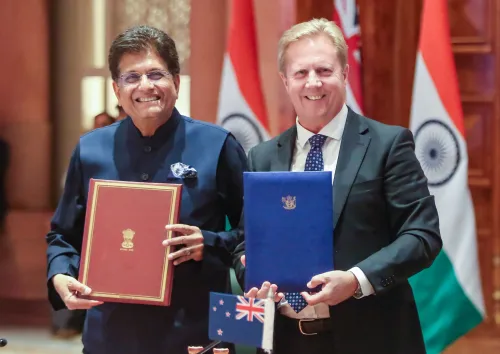
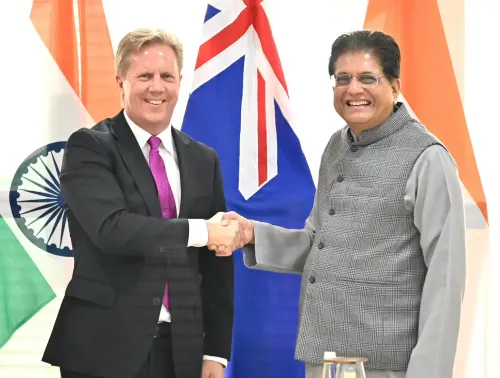
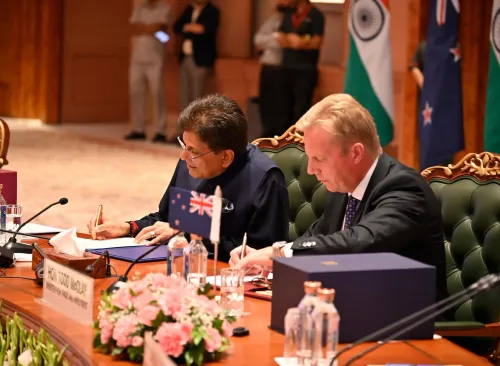
Historic FTA signed on April 28, 2025 , at Bharat Mandapam, New Delhi , between India and New Zealand in the presence of Commerce Minister Piyush Goyal and New Zealand's Trade Minister Todd McClay .
The agreement targets doubling bilateral trade from ~$2.5 billion to $5 billion within five years and attracting $20 billion in New Zealand investment into India over 15 years .
5,000 Indian professionals per year will be eligible for a temporary employment visa to work in New Zealand for up to three years under a dedicated pathway.
New Zealand will see tariffs eliminated or reduced on ~95% of its exports to India , covering wool, seafood, wine, timber, cherries, avocados, and more.
India has excluded dairy, onions, sugar, spices, edible oils, and rubber from tariff concessions to protect domestic farmers and industries.
Agra's leather footwear sector , which produces ~75% of India's leather footwear and holds a GI tag, was spotlighted as a key bilateral opportunity under the One District One Product scheme .
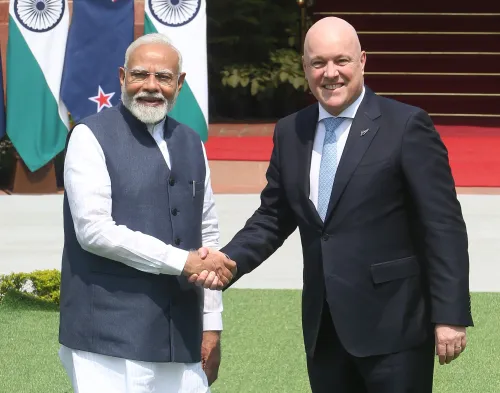
New Delhi, April 28: India and New Zealand formally signed a landmark Free Trade Agreement (FTA) at Bharat Mandapam, New Delhi, marking a pivotal shift in bilateral economic relations that have long operated below their potential. The agreement, inked in the presence of Union Commerce Minister Piyush Goyal and New Zealand's Trade Minister Todd McClay, is designed to double bilateral trade from approximately $2.5 billion to $5 billion within five years and catalyse an estimated $20 billion in New Zealand investment into India over 15 years.
What the India-New Zealand FTA Covers
The trade pact delivers sweeping market access reforms across goods, services, and professional mobility. Under the agreement, New Zealand will eliminate or reduce tariffs on approximately 95 per cent of its exports to India, covering commodities such as wool, coal, timber, wine, seafood, cherries, avocados, and blueberries. New Zealand exporters will additionally benefit from quota-based tariff reductions on kiwifruit and apples, and enjoy duty-free access for sheep meat, wool, and forestry products.
Products like Manuka honey, infant formula, and select seafood items will see reduced — though not fully eliminated — duties, reflecting the nuanced negotiation that characterises any major FTA. In return, Indian companies gain duty-free access to New Zealand's markets, opening significant opportunities for Indian exporters in manufacturing, textiles, pharmaceuticals, IT services, and agri-processed goods.
Sensitive Sectors Shielded: What India Protected
Critically, India has excluded several politically and economically sensitive sectors from tariff concessions. These include dairy products, onions, sugar, spices, edible oils, and rubber — commodities that directly affect the livelihoods of millions of Indian farmers. This protective carve-out reflects the government's calibrated approach: maximising export gains while insulating domestic agricultural constituencies from import competition.
This is not unusual in India's FTA playbook. India's earlier trade agreements with ASEAN and South Korea drew criticism for inadequately protecting the dairy and agricultural sectors, leading to domestic industry pushback. The New Zealand deal appears to have learned from those precedents, though trade analysts will scrutinise the fine print closely.
Professional Mobility: 5,000 Indian Professionals Per Year
One of the most consequential provisions for India's skilled workforce is the temporary employment visa pathway for up to 5,000 Indian professionals annually, allowing stays of up to three years in New Zealand. This targets sectors where India has a demonstrated global edge — information technology, engineering, healthcare, and financial services.
For context, New Zealand's total population is approximately 5 million, making an annual intake of 5,000 Indian professionals a statistically meaningful addition to its skilled labour market. This provision could also ease New Zealand's acute post-pandemic labour shortages, particularly in healthcare and construction, while creating high-value employment pathways for Indian talent beyond traditional destinations like the US, UK, and Australia.
Agra as a Global Leather Hub: The Industry Angle
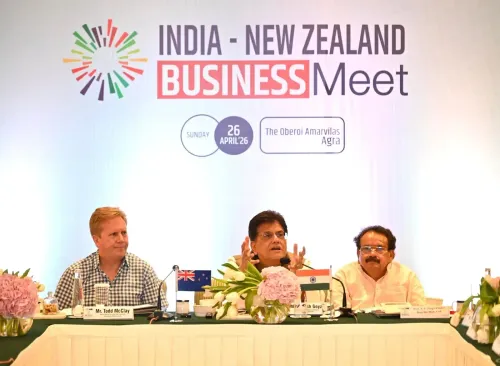
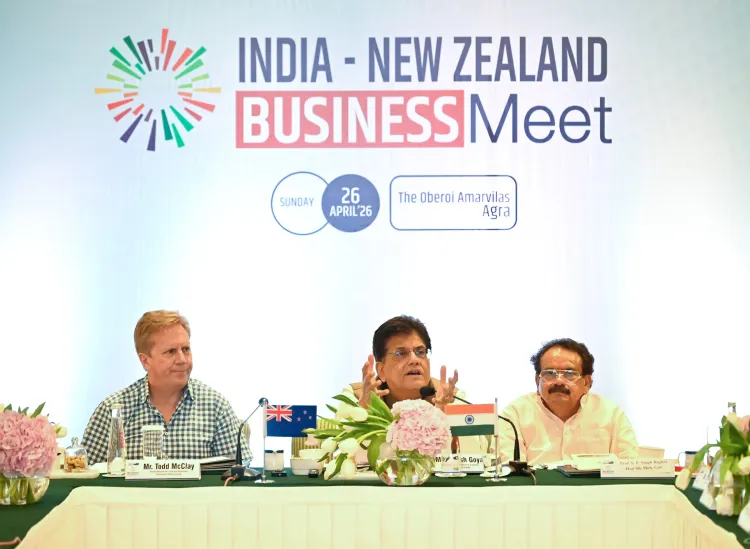
A day before the signing, on Sunday, April 27, both ministers participated in an Industry Engagement Programme in Agra, spotlighting the city's leather footwear sector. Agra accounts for approximately 75 per cent of India's total leather footwear production and holds a Geographical Indication (GI) tag for its leather products, also featuring as a flagship product under the government's One District One Product (ODOP) scheme.
The Commerce Ministry noted that New Zealand's raw leather resources, combined with India's manufacturing expertise, present a compelling complementarity. Both ministers, alongside industry representatives, expressed intent to position Agra as a global sourcing destination, an employment engine, and an export powerhouse. If executed, this could inject significant investment into a city whose artisanal economy has faced structural challenges over the past decade.
Why This FTA Matters Now: The Geopolitical Context
The timing of this agreement carries strategic weight beyond economics. Global trade flows are under significant pressure — tensions in West Asia are disrupting shipping routes, while US-China trade friction and reciprocal tariff threats are reshuffling supply chains worldwide. India, which has been actively pursuing trade diversification, sees FTAs with stable, resource-rich democracies like New Zealand as part of a broader hedging strategy.
Notably, India has been accelerating its FTA agenda in recent years — agreements with the UAE (2022) and Australia (2022, interim) have already demonstrated tangible export gains. The New Zealand pact fits into this pattern of prioritising high-trust bilateral deals over multilateral frameworks that have stalled, such as the Regional Comprehensive Economic Partnership (RCEP), which India famously walked away from in 2019.
The pact also includes robust provisions on non-tariff barriers, with commitments to streamline customs procedures, enhance regulatory cooperation, and strengthen sanitary and phytosanitary (SPS) measures — areas that have historically caused friction even where tariffs are low. As both governments move toward ratification, implementation timelines and sector-specific rules of origin will be the next critical benchmarks to watch.
Point of View
India is quietly locking in bilateral deals with stable, resource-rich partners rather than waiting for stalled multilateral frameworks. The 5,000-visa-per-year professional pathway is the deal's sleeper provision: it signals that India is now negotiating labour mobility as a trade asset, not just an afterthought. However, the real test will be implementation — India's FTA with ASEAN, signed in 2009, saw years of under-utilisation due to non-tariff barriers that paperwork never resolved. If the Agra leather cluster ambition translates into actual export growth, this deal will be remembered as a model; if not, it risks joining the shelf of agreements that looked better on signing day than in practice.
NationPress
16 Sept 2026
Frequently Asked Questions
What is the India-New Zealand Free Trade Agreement about?
The India-New Zealand FTA is a comprehensive bilateral trade agreement signed on April 28, 2025, at Bharat Mandapam, New Delhi. It aims to double bilateral trade to $5 billion within five years, facilitate $20 billion in New Zealand investment into India over 15 years, and open duty-free or reduced-tariff market access across goods, services, and professional mobility.
Which Indian sectors are excluded from the India-New Zealand FTA tariff concessions?
India has kept dairy products, onions, sugar, spices, edible oils, and rubber outside the scope of tariff concessions under the FTA. This was done to protect domestic farmers and sensitive agricultural industries from import competition.
How many Indian professionals can go to New Zealand under the new FTA visa pathway?
The FTA includes a temporary employment visa pathway for up to 5,000 Indian professionals per year, with each visa allowing a stay of up to three years in New Zealand. This targets skilled sectors such as IT, engineering, healthcare, and financial services.
What New Zealand products will get duty-free or reduced tariff access to India?
New Zealand exports including wool, coal, timber, wine, seafood, cherries, avocados, blueberries, sheep meat, and forestry products will receive duty-free or significantly reduced tariff access to India. Products like Manuka honey, infant formula, kiwifruit, and apples will benefit from reduced duties or quota-based concessions.
Why is the India-New Zealand FTA significant given current global trade conditions?
The FTA comes at a time of significant global trade disruption, including West Asia tensions affecting shipping routes and US-China tariff friction reshuffling supply chains. The deal positions India to diversify its trade partnerships and secure stable market access, fitting into India's broader strategy of accelerating bilateral FTAs after walking away from the multilateral RCEP agreement in 2019.