How Do Several Key Bridges Showcase India’s Infrastructure Vision?
Synopsis
Explore how India's magnificent bridges like Atal Setu and Chenab Bridge are not just infrastructure marvels but also symbols of the nation's progress and ambition. Witness the engineering excellence that transforms connectivity across diverse landscapes, enabling a brighter future.
Key Takeaways
Bridges symbolize India's infrastructural progress.
Atal Setu enhances connectivity in Mumbai.
Chenab Bridge is the highest railway arch bridge globally.
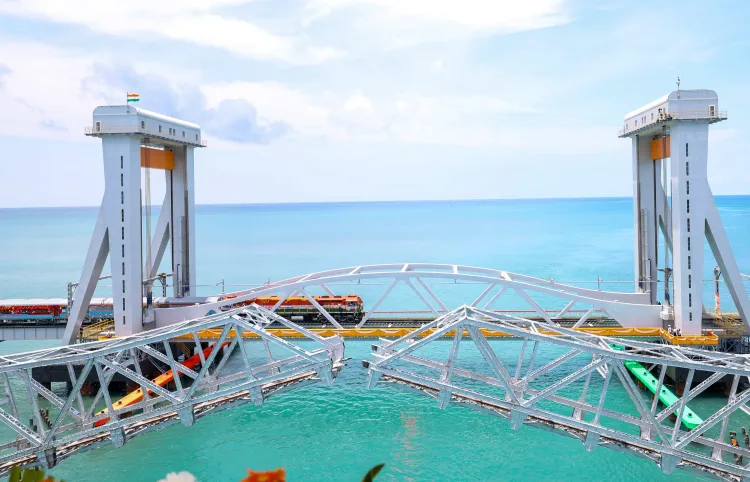
Pamban Bridge features a vertical lift for ship passage.
Innovative engineering ensures safety and longevity.
New Delhi, Dec 20 (NationPress) As India advances, its bridges – from Atal Setu to Chenab Bridge – stand as significant symbols of a nation in motion, constantly pushing forward and carving its own path, as stated by an official announcement on Saturday.
The bridges of India transcend mere infrastructure; they embody a vision of connectivity in a country characterized by vast diversity. They ascend from mountainous terrains, penetrate monsoon clouds, and glide over some of the subcontinent's most turbulent waters.
“Across every corner of this expansive landscape, numerous bridges reflect India's ambition and resilience. The Bogibeel Bridge and the New Saraighat Bridge in Assam, spanning the formidable Brahmaputra, facilitate both road and rail, enhancing connectivity. Likewise, the Digha–Sonpur Bridge in Bihar significantly improves transit across the Ganga River with its robust rail-cum-road design,” the announcement elaborated.
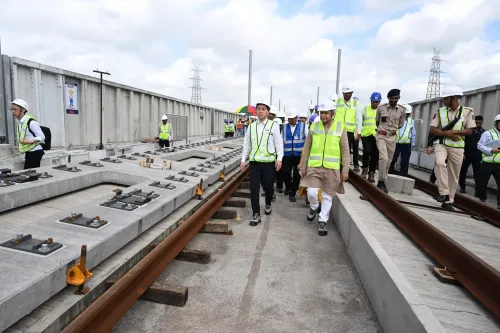
Stretching boldly across the Arabian Sea, the Atal Setu, also referred to as the Mumbai Trans Harbour Link (MTHL), signifies Mumbai's most significant stride towards a future unencumbered by traffic and time constraints.
Extending 16.5 kilometers over the sea and an additional 5.5 kilometers on land, the project was approved at a cost of Rs. 17,843 crore, making it India's longest sea bridge. Even amidst the unprecedented challenges brought on by the Covid-19 pandemic, the project remained on schedule.
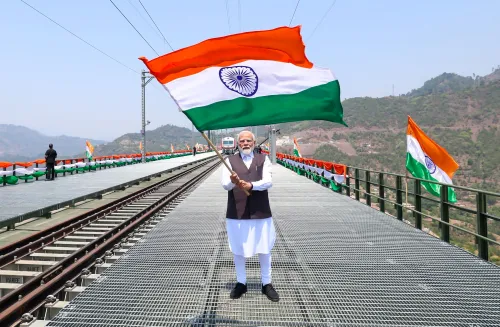
India's engineering capabilities have reached remarkable heights with the completion of the Chenab Bridge, recognized as the highest railway arch bridge globally.
Standing at 359 meters above the Chenab River, this bridge is a vital segment of the Udhampur–Srinagar–Baramulla Railway Link (USBRL). With Vande Bharat trains expected to operate on this route, travel time between Katra and Srinagar will shrink to approximately three hours.
The 1,315-meter-long steel arch structure is designed to endure wind speeds of up to 260 km/h and has a projected lifespan of 120 years. Constructed at a cost of Rs 1,486 crore, the Chenab Rail Bridge symbolizes India's ambition, technical sophistication, and advancing infrastructural capabilities, according to the statement.
The newly built Pamban Bridge, linking Rameswaram to the mainland, is India's inaugural vertical lift railway sea bridge. Constructed at a cost exceeding Rs. 700 crore, the 2.07 km structure features a vertical lift section of 72.5 meters that can elevate by 17 meters, enabling ships to pass safely without interrupting train services.
Through innovative engineering and advanced technology, over 1,400 tons of fabrication, lift-span launches, 99 girders, and extensive track and electrification work at sea were completed without any injuries.
Constructed using stainless reinforcement, high-performance protective coatings, and fully welded joints, the bridge promises enhanced durability and reduced maintenance needs. It has also been designed for future expansion, allowing for a second railway line.
Point of View
The construction of these bridges illustrates India's commitment to enhancing infrastructure and connectivity. They reflect a vision that prioritizes progress while embracing the unique challenges presented by the country's diverse geography.
NationPress
6 Oct 2026
Frequently Asked Questions
What is the significance of the Chenab Bridge?
The Chenab Bridge is recognized as the highest railway arch bridge in the world, playing a crucial role in the Udhampur–Srinagar–Baramulla Railway Link , significantly reducing travel time between Katra and Srinagar .
How does the Pamban Bridge improve connectivity?
The Pamban Bridge , being India's first vertical lift railway sea bridge, allows ships to pass beneath it without disrupting train services, thus enhancing connectivity between Rameswaram and the mainland.
What are the features of the Atal Setu?
The Atal Setu , also known as the Mumbai Trans Harbour Link , spans 16.5 kilometers over the Arabian Sea and is India's longest sea bridge, significantly improving traffic flow in the region.
What is the construction cost of the Chenab Bridge?
The Chenab Rail Bridge was constructed at a cost of Rs 1,486 crore and is designed to withstand extreme weather conditions.
What technologies were used in the construction of the Pamban Bridge?
The Pamban Bridge utilized advanced engineering techniques, including high-performance protective coatings and stainless reinforcement, to ensure durability and longevity.