JD.com plans 3 million robots to fully automate logistics in 5 years
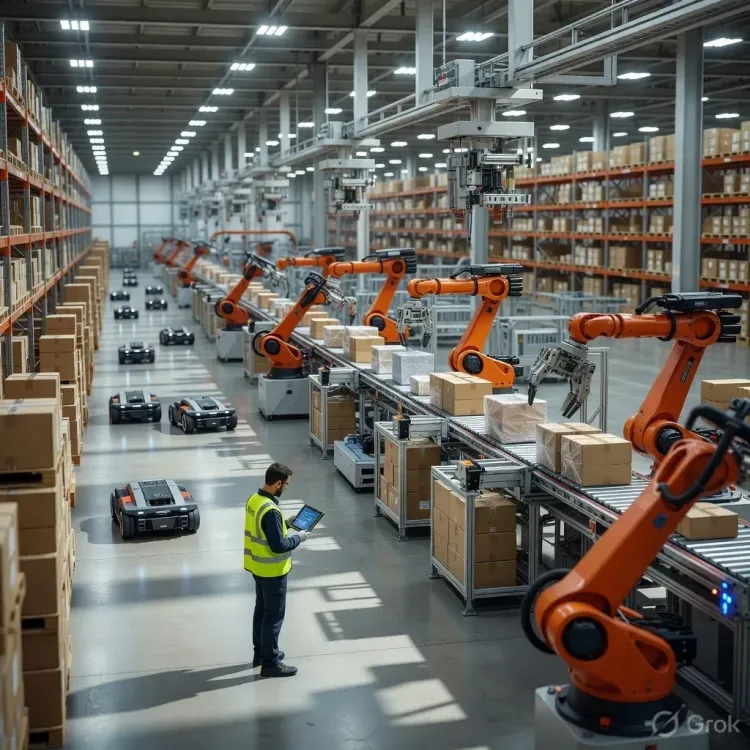
Synopsis
JD.com has announced a plan to deploy 3 million robots, 1 million driverless vehicles, and 100,000 drones over five years — while its 'Nirvana Plan' promises to retrain, not replace, its 700,000-strong courier workforce. The scale is unprecedented for a single commercial operator.
Key Takeaways
JD Logistics unveiled the industrial Wolf Robot series at a Beijing event on 9 September 2026 , targeting full supply-chain automation.
The company plans to procure 3 million robots , 1 million unstaffed vehicles , and 100,000 delivery drones over the next five years , according to technology committee chairman Cao Peng .
Wolf Robot units can operate in temperatures as low as minus 20 degrees Celsius and include automated pharmacy dispatchers and delivery drones.
JD.com and its ecosystem currently employ approximately 700,000 delivery and logistics workers whose frontline roles face automation.
Founder Liu Qiangdong 's Nirvana Plan , announced earlier in 2026 , aims to retrain couriers and warehouse staff for robot servicing and maintenance roles.
JD.com, one of China's largest e-commerce operators, has unveiled an ambitious five-year roadmap to deploy 3 million robots, 1 million unstaffed vehicles, and 100,000 delivery drones across its national logistics network, marking one of the most aggressive automation bets in the global supply-chain industry. The announcement was made at a company event in Beijing on Wednesday, 9 September 2026, where JD Logistics introduced its industrial Wolf Robot series to the public.
Wolf Robot Series: What JD Logistics Unveiled
The Wolf Robot system is engineered to handle picking, sorting, transportation, and last-mile delivery with minimal human intervention, according to Liu Lige, head of embodied intelligence robots at JD Logistics. The lineup includes specialised units rated for cold-chain environments as low as minus 20 degrees Celsius, automated pharmacy dispatchers, and delivery drones, Liu said. The system is designed specifically for repetitive, labour-intensive tasks and operations in demanding conditions.
Scale and Timeline of the Automation Push
Over the next five years, JD Logistics aims to procure the full fleet of robotic and autonomous assets to build what the company describes as a fully automated supply chain, according to Cao Peng, chairman of the company's technology committee. The scale of the procurement — 3 million robots alone — would represent one of the largest single robotics deployments by any commercial entity globally. The move reflects China's broader industrial pivot toward AI-driven automation across manufacturing and logistics sectors.
Why It Matters: 700,000 Workers in the Balance
The automation drive comes as JD.com and its ecosystem companies continue to employ approximately 700,000 delivery and logistics personnel — a workforce whose frontline roles are directly in the path of the planned machine takeover. The sheer scale of potential displacement has drawn scrutiny from labour advocates and industry observers. The company's response centres on a workforce transition initiative rather than outright redundancies.
The Nirvana Plan: Retraining Over Redundancy
Earlier this year, JD.com founder Liu Qiangdong outlined the company's so-called Nirvana Plan, a structured initiative to retrain couriers and warehouse staff for technical roles such as robot servicing and maintenance. The plan is positioned as a commitment to retaining frontline workers even as automation spreads through the logistics chain. Whether the retraining pipeline can absorb workers at the pace of robotic deployment remains an open question that analysts and regulators are likely to watch closely.
What's Next: Competitive and Regulatory Backdrop
JD Logistics's announcement arrives as Chinese tech giants race to embed AI and robotics into core operations, spurred by government-level support for intelligent manufacturing and growing pressure on margins in the e-commerce sector. Rivals including Alibaba's logistics arm Cainiao and Meituan have also been scaling autonomous delivery capabilities. How quickly JD.com can operationalise its Wolf Robot fleet — and how regulators respond to mass automation in a sector employing hundreds of thousands — will define the next chapter of China's logistics transformation.
Point of View
Three-million-robot pledge is less a logistics story than a stress test for China's social contract around automation — the company is essentially asking whether a 'Nirvana Plan' retraining scheme can politically neutralise the displacement of 700,000 workers fast enough to avoid regulatory blowback. What mainstream coverage underweights is the supply-side constraint: sourcing and integrating robots at this scale requires a domestic robotics manufacturing base that is itself still maturing, making the timeline as much a bet on China's industrial policy as on JD's own execution. The cold-chain and pharmacy-dispatch specialisations also hint at a deliberate move into higher-margin, regulated verticals where human labour costs are acute. If the Nirvana Plan fails to absorb workers at pace, JD.com could become the test case that shapes how Beijing legislates workforce transition obligations for all large-platform employers.
NationPress
24 Oct 2026
Frequently Asked Questions
What is JD.com's robot deployment plan?
JD.com 's logistics arm plans to procure 3 million robots , 1 million unstaffed vehicles , and 100,000 delivery drones over the next five years to build a fully automated supply chain. The plan was announced at a Beijing event on 9 September 2026 by technology committee chairman Cao Peng .
What is the JD.com Wolf Robot?
The Wolf Robot is an industrial robot series unveiled by JD Logistics designed to pick, sort, transport, and deliver goods with minimal human intervention. According to Liu Lige , head of embodied intelligence robots at JD Logistics , the lineup includes cold-environment units rated to minus 20 degrees Celsius , automated pharmacy dispatchers, and delivery drones.
What is JD.com's Nirvana Plan?
The Nirvana Plan is a workforce transition initiative announced by JD.com founder Liu Qiangdong earlier in 2026 to retrain couriers and warehouse staff for technical roles such as robot servicing and maintenance. It is the company's primary response to concerns about job displacement as automation expands across its logistics operations.
How many workers does JD.com employ in logistics?
JD.com and its ecosystem companies currently employ approximately 700,000 delivery and logistics personnel. These frontline workers are most directly affected by the company's five-year automation roadmap.
How does JD.com's automation plan compare to rivals?
JD Logistics 's target of 3 million robots over five years is among the most ambitious robotic procurement pledges made by any commercial logistics operator globally. Chinese rivals including Alibaba 's Cainiao and Meituan have also been scaling autonomous delivery capabilities, but no comparable fleet-size commitment has been publicly announced by a single competitor.