Will MP Government Roll Out an AI Policy for Public Welfare? CM Yadav Speaks at Regional Conference
Click to start listening
Synopsis
Madhya Pradesh’s Chief Minister Mohan Yadav announced a pioneering AI policy to bolster governance and prioritize public welfare at the Regional AI Impact Conference. This initiative aims to position AI as a cornerstone of transparent governance, ensuring the state’s growth aligns with technological advancement for the benefit of its citizens.
Key Takeaways
- Madhya Pradesh is introducing a dedicated AI policy for public welfare.
- The policy aims to enhance governance and ensure transparency.
- AI will be integrated into citizen-centric services.
- Concerns about job losses due to AI are addressed by state officials.
- Madhya Pradesh is leading in data generation for AI governance.
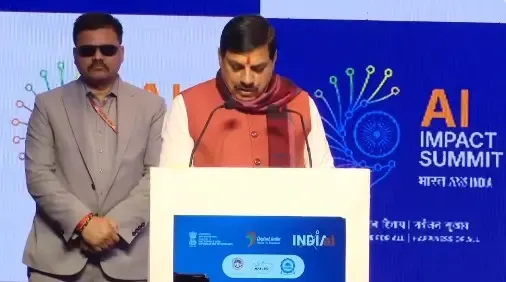
Bhopal, Jan 15 (NationPress) The Chief Minister of Madhya Pradesh, Mohan Yadav, declared on Thursday that the state will roll out a specialized Artificial Intelligence (AI) policy designed to enhance governance and foster public welfare. During the Regional AI Impact Conference, held in partnership with the India AI Mission in Bhopal, Yadav emphasized that the state's efforts are directed towards making AI a fundamental element of transparent, efficient, and citizen-focused governance, with backing from the central government.
“On this significant occasion, I am proud to announce the Madhya Pradesh government's initiative to develop an AI policy aimed at improving governance and ensuring the well-being of our citizens. The application of AI should prioritize public welfare,” asserted the Chief Minister.
At the conference, Yadav also introduced the Madhya Pradesh Space Tech Policy, showcasing the state’s commitment to utilizing cutting-edge technologies for growth and innovation.
Key officials from the state, including Chief Secretary Anurag Jain and Additional Chief Secretary (Science and Technology) Sanjay Dubey, presented the state’s flagship AI vision document titled ‘AI for People, Planet and Progress: Madhya Pradesh Roadmap to Impact’.
In his address, Chief Secretary Anurag Jain noted that upcoming generations will be more research-oriented, with AI serving a crucial role across various sectors. He acknowledged concerns regarding potential job losses due to AI integration but reassured that these fears are misplaced.
“The implementation of AI will not threaten job opportunities. Although certain roles may evolve or be replaced, new prospects will arise. Similar concerns were raised during the onset of computerization, which ultimately resulted in increased employment,” Jain stated.
Furthermore, highlighting the significance of data in AI-driven governance, Additional Chief Secretary Sanjay Dubey pointed out that Madhya Pradesh has become a forerunner in data generation.
“Madhya Pradesh is the first state in India to possess its own authentic, internally generated data, rather than relying on outsourced data. We are also aiding other states, such as Kerala and Jammu and Kashmir, in establishing their own data ecosystems,” Dubey remarked.
The conference attracted participation from specialists representing Digital India Bhashini, UIDAI, the National e-Governance Division (NeGD), various state governments, and international organizations like Google, Microsoft, Deloitte, and EY.
This event served as a precursor to the upcoming India AI Impact Summit, scheduled for February 16 to 20 in New Delhi, aimed at enhancing collaboration between academia and industry in AI-driven governance, technology, and innovation.
Point of View
The Madhya Pradesh government's commitment to introducing an AI policy reflects a growing trend towards technological integration in governance. This initiative not only aims to enhance public welfare but also positions the state as a leader in the adoption of AI technologies. It is essential to monitor the implementation and impact of such policies, as they could serve as a model for other states.
NationPress
15/01/2026
Frequently Asked Questions
What is the purpose of the AI policy being introduced by Madhya Pradesh?
The AI policy aims to strengthen governance and prioritize public welfare by integrating Artificial Intelligence into citizen-centric services.
How will AI affect job opportunities in Madhya Pradesh?
While some jobs may be transformed or replaced, the Chief Secretary assures that new job opportunities will emerge, similar to the effects of past technological advancements.
What other technology policies were introduced at the conference?
Alongside the AI policy, the Madhya Pradesh Space Tech Policy was also unveiled, focusing on leveraging advanced technologies for development.
Who participated in the Regional AI Impact Conference?
Experts from organizations like Digital India Bhashini, UIDAI, and global firms such as Google and Microsoft participated in the conference.
What is the significance of data in AI governance?
Data is crucial for AI-driven governance, and Madhya Pradesh is leading in authentic data generation, which supports its AI initiatives.