Navee WaveFly 5X: China's consumer wing-in-ground-effect craft takes flight
Synopsis
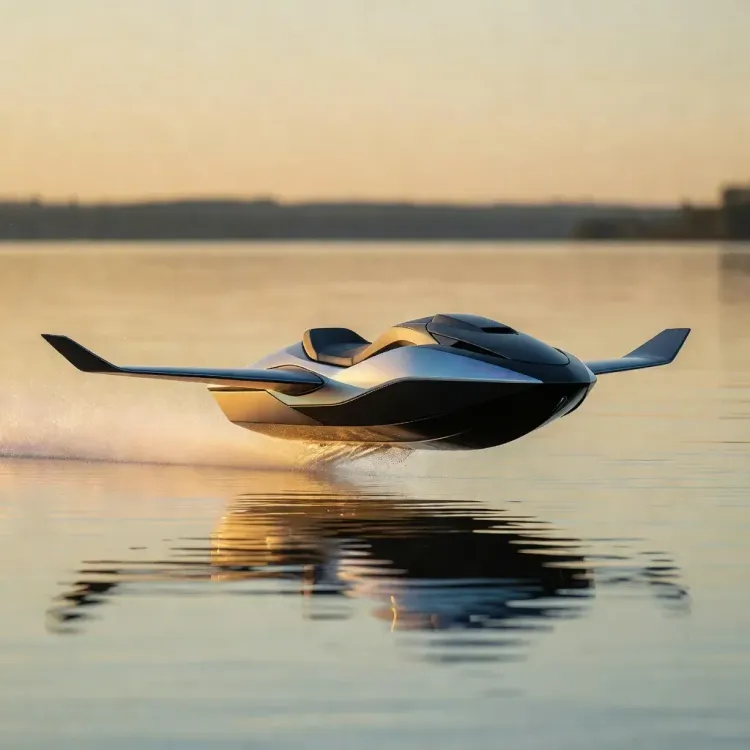
Chinese mobility startup Navee flew what it calls the world's first consumer wing-in-ground-effect craft — the WaveFly 5X — just 30–50cm above Lake Taihu on 4 June 2026, reviving Soviet-era 'sea monster' physics in a two-seat, no-pilot-licence vehicle capable of 85 km/h and an 80 km range.
Key Takeaways
Navee completed the maiden flight of the WaveFly 5X on Lake Taihu, Suzhou on 4 June 2026 .
The craft flies 30cm to 50cm above the water surface using wing-in-ground-effect aerodynamics, reaching speeds of up to 85 km/h .
Maximum payload is 140 kg and range is up to 80 kilometres per charge, with hot-swappable batteries rechargeable in minutes.
According to Navee , users will not require a pilot's licence or professional flight training, as the craft is classified operationally closer to a boat.
The launch is part of China's broader push to develop its low-altitude economy, encompassing drones, eVTOL aircraft, and surface-skimming watercraft.
Chinese mobility company Navee completed the maiden flight of its WaveFly 5X — billed as the world's first consumer-oriented wing-in-ground-effect (WIG) craft — on Lake Taihu in Suzhou, eastern Jiangsu province, on Thursday, 4 June 2026. The demonstration marks a significant step toward commercialising a propulsion concept once confined to Soviet Cold War military experiments, now repackaged as an accessible personal watercraft.
How the WaveFly 5X works
The WaveFly 5X exploits ground-effect aerodynamics, riding on a cushion of compressed air trapped between its wings and the water surface. According to the company, the craft flies at just 30cm to 50cm above the water, a height that dramatically reduces aerodynamic drag and boosts energy efficiency compared with conventional watercraft or low-altitude aircraft.
The reduced drag allows the vehicle to reach speeds of up to 85 km/h while drawing significantly less power than a comparable aircraft operating at altitude. The design also eliminates the need for dedicated airstrips or marine terminals, as the craft can taxi, take off, and dock directly from calm waterways.
No pilot's licence required
Navee says the WaveFly 5X is deliberately engineered to be operated more like a boat than an aircraft, meaning users would not require a pilot's licence or professional flight training under the company's intended regulatory framework. The two-seat vehicle carries a maximum payload of 140 kg and offers a range of up to 80 kilometres per charge.
The craft uses hot-swappable batteries that can be recharged in minutes, addressing one of the core practical limitations of electric mobility vehicles. That combination of speed, range, and rapid energy replenishment positions the WaveFly 5X as a credible option for short-haul water-surface commuting and leisure use.
Reviving the 'sea monster' concept
Wing-in-ground-effect vehicles have a storied — and largely dormant — history. The Soviet Union's Caspian Sea Monster, an enormous ekranoplan developed during the Cold War, demonstrated the physics but never achieved commercial viability. Several aerospace and defence programmes globally have revisited the concept, including the US Defense Advanced Research Projects Agency's Liberty Lifter project, but consumer-grade WIG craft have remained elusive.
Navee's push into the segment arrives as China accelerates development of its broader low-altitude economy, a national strategic priority encompassing electric vertical take-off and landing aircraft, cargo drones, and now surface-skimming watercraft. Industry analysts note that regulatory clarity around WIG vehicles remains an open question in most markets.
What's next
Navee has not disclosed a commercial launch date or pricing for the WaveFly 5X, but the Lake Taihu maiden flight signals the company is moving toward production readiness. The key variables to watch are how Chinese maritime and aviation regulators classify WIG craft — as boats, aircraft, or a hybrid category — and whether international markets adopt comparable frameworks that could open export opportunities for Navee and rivals entering this nascent segment.
Point of View
Where regulatory fast-tracking and domestic supply chains give local startups a structural advantage over Western counterparts still navigating fragmented aviation rules. What mainstream coverage tends to underplay is the classification question: if regulators treat WIG craft as boats rather than aircraft, the licensing barrier collapses overnight, unlocking a mass market that no comparable vehicle has ever reached. The Soviet ekranoplan failed not because the physics were wrong but because military scale and Cold War logistics made commercialisation impossible — Navee is betting that electric drivetrains and hot-swap batteries solve exactly those constraints. Investors and incumbents in the personal watercraft and urban air mobility spaces should watch how China's maritime and civil aviation authorities define this category, because that regulatory call will determine whether WIG vehicles become a niche curiosity or a genuinely disruptive transport layer.
NationPress
21 Oct 2026
Frequently Asked Questions
What is the Navee WaveFly 5X?
The Navee WaveFly 5X is a two-seat, consumer-oriented wing-in-ground-effect craft that flies 30–50cm above water using compressed air trapped between its wings and the surface. It reaches speeds of up to 85 km/h , carries a maximum payload of 140 kg , and offers a range of up to 80 kilometres per charge.
Do you need a pilot's licence to fly the WaveFly 5X?
According to Navee , the WaveFly 5X is designed to be operated like a boat rather than an aircraft, meaning users would not require a pilot's licence or professional flight training. Regulatory classification of WIG craft varies by jurisdiction and remains an evolving area.
Where did the WaveFly 5X complete its maiden flight?
The maiden flight took place on Lake Taihu in Suzhou, eastern Jiangsu province, China , on Thursday, 4 June 2026 . The calm inland lake provided ideal conditions to demonstrate the craft's ground-effect capabilities.
What is wing-in-ground-effect technology?
Wing-in-ground-effect (WIG) technology exploits the aerodynamic phenomenon where a wing flying very close to a surface generates a cushion of compressed air that reduces drag and increases lift efficiency. The concept was most famously used in the Soviet Union's massive Caspian Sea Monster ekranoplan during the Cold War , but has never previously been commercialised for consumer use.
How does the WaveFly 5X fit into China's low-altitude economy?
The WaveFly 5X is part of China's national push to develop a low-altitude economy encompassing drones, electric vertical take-off and landing aircraft, and surface-skimming watercraft. Navee's demonstration on 4 June 2026 signals that WIG vehicles are entering the commercial phase of this broader strategic initiative.