Nvidia Hosts Korea's President for Full-Stack AI Push
Synopsis
South Korean President Lee Jae Myung met Nvidia chief executive Jensen Huang in San Francisco on 27 July 2026, with Nvidia describing the engagement as 'Korea's AI moment' aimed at accelerating the country's full-stack artificial intelligence ambitions through partnerships with leading technology and research figures.
Key Takeaways
South Korean President Lee Jae Myung met Nvidia CEO Jensen Huang in San Francisco on 27 July 2026 .
Nvidia framed the meeting as advancing South Korea's full-stack AI ambitions , covering hardware, software, and infrastructure layers.
South Korea's National AI Strategy (2019) targets a top global AI ranking by 2030 , making Nvidia a key strategic partner.
The meeting reflects a wider pattern of allied governments securing direct partnerships with US chip and AI leaders.
Korean technology firms, AI researchers, and academic institutions are the primary stakeholders positioned to benefit from any resulting agreements.
Concrete investment commitments or supply agreements, if announced, would mark a significant step in US–South Korea technology cooperation.
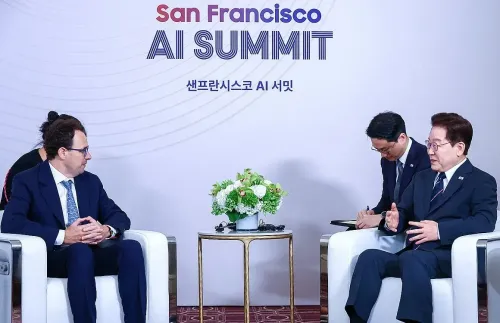
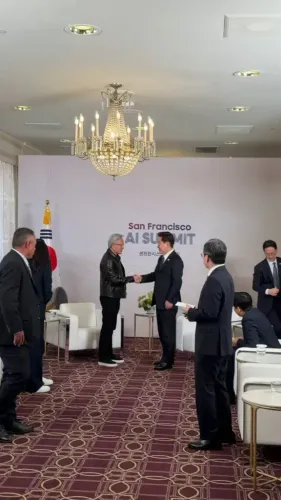
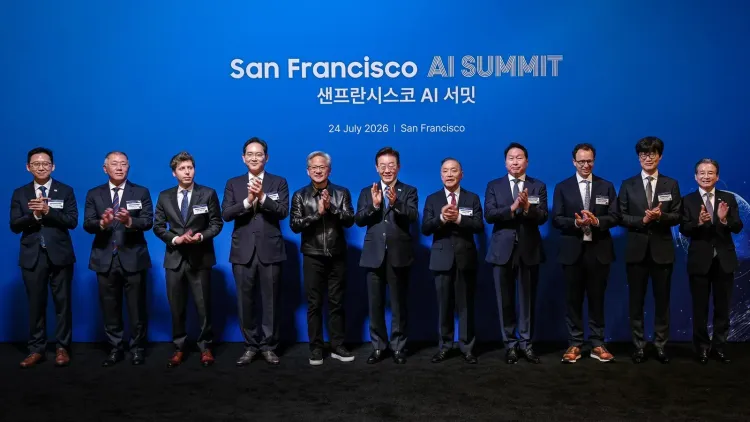
Chip giant Nvidia announced on Monday, 27 July 2026 that South Korean President Lee Jae Myung travelled to San Francisco to meet Nvidia chief executive Jensen Huang alongside leading figures from technology, industry, and research, as part of an effort to accelerate South Korea's full-stack artificial intelligence ambitions.
Context
Nvidia's official corporate account described the gathering as Korea's AI moment, noting that President Lee Jae Myung joined Jensen Huang and 'some of the biggest names in technology, industry and research' in San Francisco. The meeting signals a high-level diplomatic and commercial push by Seoul to secure partnerships with the world's leading AI hardware provider. Nvidia's graphics processing units remain the dominant compute platform underpinning large-scale AI model training globally.
The phrase 'full-stack AI ambitions' used by Nvidia suggests the discussions ranged beyond chip procurement to encompass software frameworks, data infrastructure, and applied AI deployment — the complete technology layer required to build a sovereign AI ecosystem.
Policy Backdrop
South Korea released its National Strategy for Artificial Intelligence in 2019, setting a goal to rank among the world's top AI nations by 2030. That strategy has driven sustained government investment in AI research centres, semiconductor fabrication, and talent development. South Korea is home to major semiconductor manufacturers whose supply chains intersect directly with Nvidia's own production and distribution networks.
The San Francisco meeting fits a broader pattern of allied nations formalising technology partnerships with US-based chip and AI companies to diversify their supply chains and build competitive domestic capabilities. For Seoul, deepening ties with Nvidia is both an industrial and a geopolitical signal.
Stakeholders and Impact
Korean technology conglomerates, AI start-ups, and academic research institutions stand to benefit most directly from any partnership frameworks agreed in San Francisco. Access to Nvidia's latest GPU architectures and software platforms — including its AI computing ecosystem — could accelerate the deployment of large language models and industrial AI applications across South Korea's economy.
For Nvidia, the engagement with a sitting head of state underscores the company's growing role not merely as a hardware vendor but as a strategic partner in national AI programmes. The meeting also reinforces Jensen Huang's position as a central interlocutor between Silicon Valley and foreign governments pursuing AI sovereignty.
What's Next
Observers will watch for concrete announcements on investment commitments, joint research programmes, or preferential supply agreements between Nvidia and Korean entities. South Korea's domestic AI investment rollout and any follow-up US–South Korea technology dialogues will indicate how much of the San Francisco momentum translates into binding policy or commercial deals. The meeting sets a precedent for other allied governments seeking similar high-level access to the US AI hardware ecosystem.
Point of View
The optics of a presidential visit to Silicon Valley signal that AI infrastructure is now treated as a matter of national strategic priority, not merely industrial policy. This mirrors a broader arc in which governments across Asia and Europe are racing to lock in preferential relationships with US chip makers before supply constraints or regulatory shifts alter the landscape. The durability of any outcomes will depend on whether the meeting produces binding agreements or remains a high-profile signal without structural follow-through.
NationPress
27 Jul 2026
Frequently Asked Questions
Why did South Korea's President meet Jensen Huang in San Francisco?
South Korean President Lee Jae Myung travelled to San Francisco to meet Nvidia CEO Jensen Huang and other technology leaders to advance South Korea's full-stack AI ambitions, spanning hardware, software, and research infrastructure.
What is South Korea's AI strategy?
South Korea launched its National Strategy for Artificial Intelligence in 2019, aiming to place the country among the world's top AI nations by 2030 through investment in research, semiconductor manufacturing, and AI talent.
What does 'full-stack AI' mean in this context?
'Full-stack AI' refers to building a complete, end-to-end artificial intelligence ecosystem — from chip-level hardware and data infrastructure to software frameworks and real-world applications — rather than relying on any single layer.
What is Nvidia's role in national AI programmes?
Nvidia supplies the graphics processing units that power most large-scale AI model training worldwide, making it a critical partner for governments and companies building sovereign AI capabilities.
What could come out of the Korea–Nvidia San Francisco meeting?
Potential outcomes include investment commitments, joint research programmes, or preferential GPU supply agreements that would help South Korea accelerate its domestic AI development goals.