Nvidia showcases MGX 'AI factory' push with 80+ partners at GTC Taipei

Synopsis
Nvidia used its GTC Taipei showcase to position the MGX modular server platform, the upcoming Vera Rubin architecture and 800 VDC power delivery as the foundation of 'AI factories' for the agentic era, with over 80 systems, power and cooling partners joining chief executive Jensen Huang on stage.
Key Takeaways
Nvidia's corporate account spotlighted 80+ partners joining Jensen Huang at GTC Taipei .
The pitch centres on MGX , Nvidia's modular reference design for AI servers.
Next-generation Vera Rubin GPUs and 800 VDC power delivery were named as key building blocks.
Partners span systems, power and cooling , reflecting bundled AI infrastructure procurement.
The framing targets the agentic era of more compute-intensive AI workloads.
Taipei venue underscores Taiwan's central role in the AI hardware supply chain.
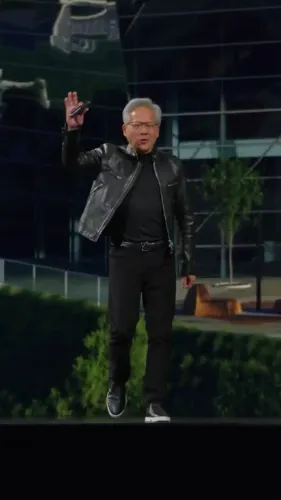
Chip giant Nvidia used its GTC Taipei showcase to position its MGX modular server platform as the backbone of next-generation 'AI factories', flanked by more than 80 partners who joined chief executive Jensen Huang on stage. The corporate account framed the event as a demonstration of how the company's reference designs, paired with its upcoming Vera Rubin architecture and 800 VDC power delivery, are intended to accelerate large-scale AI deployment. The post was published on 2 June 2026.
'What does it take to build an AI factory ready for the agentic era?' the company asked in the post, adding that '80+ partners joined Jensen Huang at #NVIDIAGTC Taipei to show how NVIDIA MGX is making it possible.' The message highlighted partners 'spanning systems, power, and cooling' as central to the platform's rollout.
Context
Nvidia has, since 2023-24, used its GPU Technology Conference circuit to brand massive GPU clusters as 'AI factories' — facilities engineered end-to-end to train and serve large AI models. MGX is the company's modular reference architecture, designed to let server makers, power suppliers and cooling specialists assemble compatible building blocks rather than design bespoke systems from scratch.
The Taipei edition of GTC is a fixture in Nvidia's calendar because Taiwan sits at the heart of its supply chain, home to the foundry and assembly partners that translate its chip designs into shipping hardware. Anchoring the announcement in Taipei underscores that geography.
Policy backdrop
The push lands against a backdrop of tightening US export controls on advanced AI chips and surging global demand for compute, both of which have made supply-chain choreography a strategic concern for hyperscalers and governments alike. Nvidia's successive GPU generations — Hopper, Blackwell and now the forthcoming Rubin family referenced in the post — have each been positioned as the next platform for these AI factories.
The reference to 800 VDC power delivery points to a broader industry shift toward higher-voltage direct-current distribution inside data centres, a response to the rising electrical loads of dense GPU racks. Cooling partners, similarly, reflect the move from air to liquid systems as per-rack power climbs.
Stakeholders and impact
The most immediate beneficiaries of an expanded MGX ecosystem are systems integrators, data-centre operators and AI developers seeking faster paths from chip availability to deployed clusters. For Taiwanese original design manufacturers, certification under MGX is a route to higher-value AI server business.
For India, where the government's IndiaAI Mission and state-level data-centre policies have set ambitions for sovereign compute, the MGX template is relevant because domestic operators procuring Nvidia-based clusters typically buy through the same partner ecosystem on display in Taipei. The mention of partners across systems, power and cooling signals that procurement decisions are increasingly bundled rather than chip-by-chip.
The phrase 'agentic era' in the post nods to a shift in AI workloads from single-shot inference toward autonomous, multi-step agents — a use case that is far more compute-intensive in aggregate and which Nvidia is using to justify ever-larger cluster footprints.
What's next
Attention will turn to rollout timelines for Rubin-based systems and to which additional vendors secure MGX certification at subsequent GTC stops. For buyers in India and elsewhere, the practical question is when Rubin-class hardware will be available through local channel partners and at what price band relative to existing Blackwell-generation systems.
If the partner count continues to expand at the pace Nvidia advertised in Taipei, the competitive pressure on rival accelerator vendors to assemble comparable end-to-end ecosystems — rather than sell silicon alone — will intensify through the remainder of the year.
Point of View
Not just silicon it sells. By bundling Rubin-class GPUs with an 800 VDC power story and a deep partner bench, it raises the switching cost for hyperscalers tempted by rival accelerators. The 'agentic era' framing also conveniently justifies ever-larger cluster sizes, aligning marketing with the company's commercial interest in compute escalation. For policy watchers in India, the takeaway is that sovereign-AI ambitions will, for now, run through this partner lattice.
NationPress
17 Oct 2026
Frequently Asked Questions
What is the Vera Rubin GPU?
Vera Rubin is the next-generation Nvidia GPU architecture referenced in the post, succeeding the Blackwell family. Nvidia is positioning it as the compute engine for upcoming large-scale AI factory deployments.
Why is 800 VDC important for data centres?
800 VDC, or 800-volt direct-current power delivery, supports the very high electrical loads of dense GPU racks more efficiently than older lower-voltage designs. It is part of an industry shift to handle rising AI compute power demand.
Why did Nvidia hold GTC in Taipei?
Taipei anchors Nvidia's supply chain because Taiwan hosts the foundry, server and component partners that build its hardware. Holding GTC there underscores those manufacturing and integration relationships.
What does the 'agentic era' mean in AI?
The 'agentic era' refers to a shift from single-shot AI responses toward autonomous AI agents that plan and execute multi-step tasks. Such workloads are significantly more compute-intensive, which Nvidia cites as justification for larger AI factory build-outs.