Nvidia Pushes AI Worlds Grounded in Physics at SIGGRAPH 2026
Synopsis
Nvidia on 20 July 2026 declared that its AI research prioritises worlds governed by physics and responsive in real time, not just visually realistic ones. Speaking ahead of SIGGRAPH 2026, the company said the goal spans games, films, robots, and factory digital twins — framing physics-grounded generative AI as a unified creative and industrial platform.
Key Takeaways
Nvidia stated on 20 July 2026 that its research targets AI-generated worlds that 'behave realistically and respond in real time,' not just look real.
The company identified four output categories: games, films, robots, and factory digital twins — signalling a platform-level ambition.
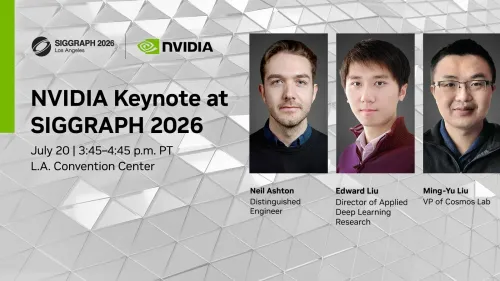
The announcement was tied to SIGGRAPH 2026 , the premier annual conference for computer graphics and interactive techniques.
Nvidia's Omniverse platform, launched in 2020 , established the company's physics-based digital-twin foundation that this research extends.
The emphasis on real-time, physics-accurate simulation is particularly consequential for robotics and embodied AI , where simulation fidelity directly affects real-world performance.
Industrial and manufacturing stakeholders, including those in India's expanding smart-factory sector, are among the potential beneficiaries of more accessible digital-twin tooling.
Chip giant Nvidia on Monday, 20 July 2026 outlined its vision for AI-generated worlds that are not merely visually convincing but physically accurate and responsive in real time, sharing the statement ahead of and in connection with SIGGRAPH 2026.
Context
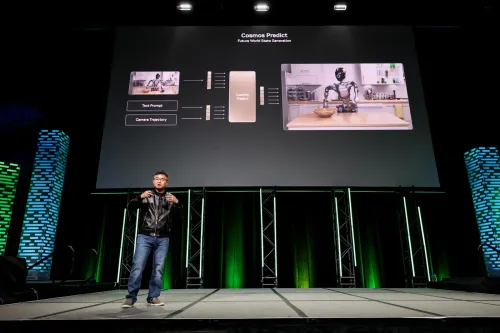
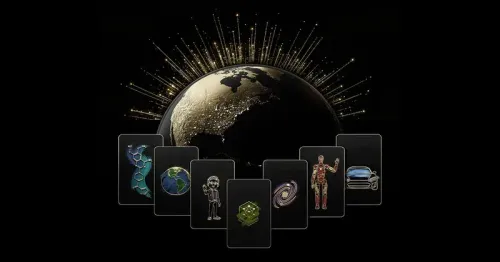
In its post on X, Nvidia stated that its research goal is to 'expand the canvas of creativity with AI-generated worlds that are grounded in 3D, governed by physics and directed by creators.' The company drew a deliberate line between outputs that merely look real and those that 'behave realistically and respond in real time.' The framing covers a wide output spectrum — games, films, robots, and factory digital twins — signalling that the ambition is platform-level, not product-specific.
SIGGRAPH, the Association for Computing Machinery's annual conference on computer graphics and interactive techniques, is the premier venue where the graphics, simulation, and AI communities converge. Nvidia's statement positions the company's research agenda squarely at that intersection.
Policy Backdrop
Nvidia introduced its Omniverse platform in 2020 as a physics-based, collaborative 3D simulation environment designed for digital-twin workflows across industries. The current emphasis on 'worlds governed by physics' is a direct continuation of that trajectory, extending it into AI-generative territory.
The broader industry has been moving toward physically accurate synthetic data as a foundation for training AI models — particularly for embodied AI and robotics, where a simulation gap between virtual training and real-world deployment has long been a limiting factor. Nvidia's framing directly addresses that gap by insisting that realism must be behavioural, not just visual.
Stakeholders and Impact
Game developers and visual-effects studios stand to gain from AI tools that can generate physically plausible environments at scale, reducing the manual labour of world-building. Industrial manufacturers using digital twins — virtual replicas of factory floors or supply chains — benefit when simulation physics are accurate enough to predict real-world outcomes reliably.
Robotics engineers represent perhaps the most consequential audience: training embodied AI agents in synthetic environments that obey real physics reduces the cost and risk of physical trials. Nvidia's emphasis on 'real-time' response further suggests that the target is not just pre-rendered content but interactive, live simulation — a requirement for autonomous systems.
For India, where manufacturing digitalisation under initiatives such as Make in India and smart-factory adoption is accelerating, tools that lower the barrier to digital-twin deployment could have downstream relevance for domestic industrial players and the growing base of Indian AI and robotics startups.
What's Next
Technical papers, live demonstrations, and tool releases tied to SIGGRAPH 2026 are expected to provide concrete detail on the research directions Nvidia has signalled. Subsequent developer events on Nvidia's calendar are likely to translate research announcements into accessible tooling for the broader developer community.
The company's consistent push to position its GPU architecture as the substrate for physically grounded AI simulation suggests that future product and platform updates will continue to blur the line between graphics rendering, physics simulation, and generative AI — a convergence that could redefine pipelines across entertainment, manufacturing, and autonomous systems.
Point of View
Films, robots, and factory digital twins under one research umbrella, Nvidia is signalling that its GPU platform aspires to be the universal substrate for any simulated reality. This mirrors a broader industry realisation that large language models and image generators have hit a ceiling of usefulness without grounding in physical causality. For policymakers and industrial planners in India, where digital-twin adoption in manufacturing is still nascent, the direction Nvidia is setting could shape procurement and skilling priorities over the next decade.
NationPress
21 Jul 2026
Frequently Asked Questions
What did Nvidia announce at SIGGRAPH 2026?
Nvidia outlined its research vision for AI-generated worlds that are physically accurate and responsive in real time, covering applications from games and films to robots and factory digital twins. The company did not announce a specific product but described the overarching goal as expanding creative possibilities through physics-governed, AI-generated 3D environments.
What is SIGGRAPH and why does Nvidia participate?
SIGGRAPH is the annual Association for Computing Machinery conference on computer graphics and interactive techniques, widely regarded as the top forum for advances in visual simulation and AI. Nvidia participates because its GPU architecture underpins much of the rendering, simulation, and AI research presented at the event.
What is Nvidia Omniverse and how does it relate to this?
Nvidia Omniverse, introduced in 2020, is a physics-based collaborative platform for 3D simulation and digital-twin workflows. The current research direction — AI worlds grounded in physics — is a direct extension of Omniverse's foundational approach, now augmented with generative AI capabilities.
How does Nvidia's physics-based AI simulation affect robotics?
Physics-accurate simulation allows robotics engineers to train AI agents in virtual environments that closely mirror real-world behaviour, reducing the cost and risk of physical trials. Nvidia's emphasis on real-time response is especially relevant here, as autonomous systems require live, not pre-rendered, environmental feedback.
What does Nvidia's AI simulation push mean for India?
India's expanding manufacturing sector and growing base of AI and robotics startups could benefit from more accessible digital-twin and simulation tools. As initiatives such as Make in India drive factory digitalisation, physics-grounded AI simulation platforms could lower barriers to adoption for domestic industrial players.