Nvidia Says Specialized AI Agents Cut Cost Per Token
Synopsis
Nvidia on 17 July 2026 said AI agents are growing more specialized through reinforcement learning post-training, and that lower inference cost per token directly raises the intelligence delivered per dollar — framing inference efficiency as the new frontier of AI competitiveness.
Key Takeaways
Nvidia posted on 17 July 2026 that AI agents are becoming domain-specialized through reinforcement learning post-training.
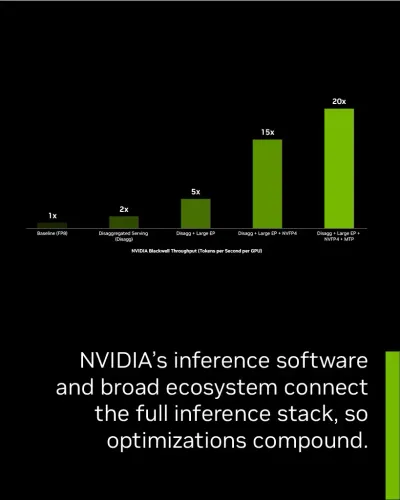
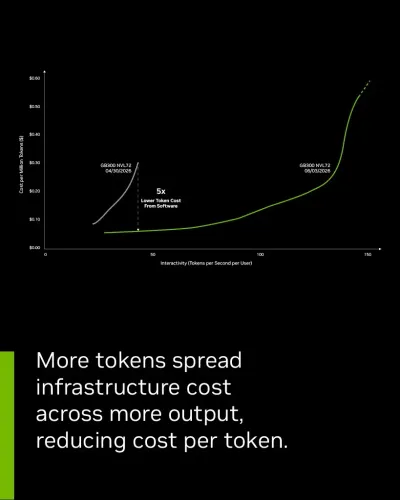
The company argued that every post-training rollout is an inference call, making token cost a direct lever on AI output quality per dollar.
Nvidia has powered AI workloads since launching the CUDA platform in 2006 , giving it deep stakes in inference economics.
Lower inference costs reduce barriers for Indian enterprises and startups to deploy specialized agentic AI systems.
The shift from general pre-training to domain-specific post-training is reshaping competitive dynamics across the global AI industry.
Nvidia developer conferences and new inference runtimes are the key milestones to watch for practical implementation of these economics.
Chip giant Nvidia on Friday, 17 July 2026, highlighted a pivotal shift in artificial intelligence development: AI agents are increasingly becoming domain-specialized through reinforcement learning post-training, and lower inference costs are directly amplifying the intelligence delivered per dollar spent on every training run.
Context
In its post, Nvidia stated that 'agents are becoming specialized, using reinforcement learning post-training to develop domain-specific skills.' The company drew a direct economic line: 'every post-training rollout is an inference call, so a lower cost per token flows straight into a higher Intelligence per Dollar on every run.' This framing positions inference efficiency not merely as a cost metric but as a multiplier for AI capability deployment.
The observation reflects a broad industry transition. For years, AI development was dominated by large-scale pre-training on general datasets. The frontier has now shifted toward post-training — techniques such as reinforcement learning from human feedback (RLHF) and reinforcement learning from AI feedback (RLAIF) — which sculpt general models into specialized agents for domains like medicine, law, finance, and software engineering.
Policy Backdrop
Nvidia has been the central hardware enabler of this AI era since it introduced the CUDA platform in 2006, establishing GPU-accelerated computing as the backbone of modern AI workloads. Its GPUs power the majority of large-scale model training and inference clusters operated by cloud providers and AI laboratories globally.
The economics Nvidia describes are significant for the Indian technology ecosystem, where cloud spending and AI adoption are growing rapidly. Lower token costs reduce the barrier for Indian enterprises and startups to deploy agentic AI systems, making the 'Intelligence per Dollar' argument directly relevant to cost-sensitive markets.
Stakeholders and Impact
AI developers and cloud providers are the most immediate stakeholders. For developers, cheaper post-training rollouts mean more experimental cycles and faster iteration toward specialized agents. For cloud providers, the efficiency gains translate into more competitive pricing and expanded addressable markets.
Indian technology companies investing in AI infrastructure — from large IT services firms to deep-tech startups — stand to benefit as GPU inference costs decline. The shift toward specialized agents also opens opportunities in vernacular language processing, healthcare diagnostics, and agricultural advisory systems, all areas where domain specificity is critical.
The broader implication is competitive: as inference becomes cheaper and post-training more accessible, the differentiation between AI players will increasingly rest on the quality and efficiency of their specialization pipelines rather than raw model size alone.
What's Next
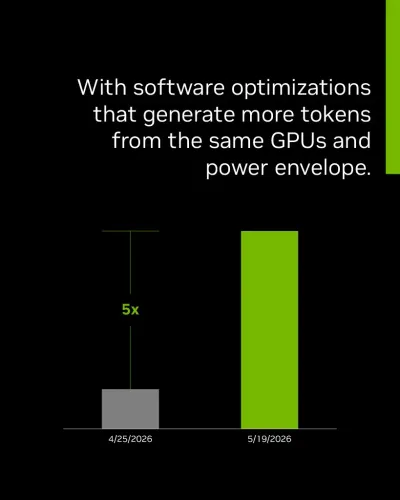
Industry attention will focus on Nvidia's upcoming developer conferences and product announcements for new inference runtimes or agent frameworks that operationalize the economics the company described. Any reduction in the cost per token at the hardware or software layer would validate the 'Intelligence per Dollar' thesis in practice.
As reinforcement learning post-training becomes the standard method for building specialized agents, demand for high-throughput, low-latency inference infrastructure — precisely Nvidia's core business — is expected to grow. The company's framing suggests it views this transition as a structural tailwind, not a temporary trend.
Point of View
' the company is positioning its inference hardware as the essential lever in the next phase of AI competition. This matters because the industry is visibly shifting from who can train the biggest model to who can specialize and deploy agents most efficiently. For India, where cost sensitivity shapes technology adoption, the inference-economics argument could accelerate enterprise AI uptake faster than raw capability benchmarks ever did. Nvidia is, in effect, writing the economic vocabulary that will govern how AI infrastructure investment is justified for the next several years.
NationPress
18 Jul 2026
Frequently Asked Questions
What did Nvidia say about AI agents in July 2026?
Nvidia said AI agents are becoming specialized using reinforcement learning post-training to develop domain-specific skills, and that lower inference cost per token directly increases the intelligence delivered per dollar on every post-training run.
What is reinforcement learning post-training in AI?
Reinforcement learning post-training is a technique applied after initial model training to refine and specialize a general AI model for specific domains — such as medicine, law, or finance — by rewarding desired behaviours, making the model more capable and efficient in targeted tasks.
Why does lower cost per token matter for AI development?
Since every post-training rollout is an inference call, reducing the cost per token makes it cheaper to run more training cycles, enabling developers to build more capable and specialized AI agents without proportionally increasing their compute budgets.
How does Nvidia benefit from the rise of specialized AI agents?
Nvidia's GPUs are the primary hardware used for AI inference and training globally. As demand for post-training rollouts and agentic AI systems grows, so does demand for Nvidia's chips and software platforms, making inference efficiency a core part of its business growth.
What does Nvidia's inference economics argument mean for Indian AI companies?
For Indian enterprises and startups, lower inference costs reduce the financial barrier to deploying specialized AI agents, making advanced AI applications in areas like healthcare, agriculture, and vernacular language processing more economically viable.