Nvidia's Jensen Huang Champions Open AI Models for Developers
Synopsis
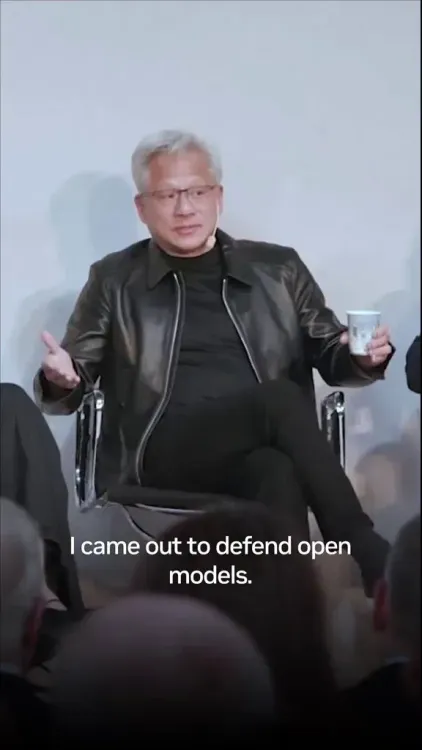
Chip giant Nvidia posted CEO Jensen Huang's argument that open, accessible AI models are foundational to future industries. The statement reinforces Nvidia's long-standing position that developer freedom on open models expands the AI ecosystem — and, directly, demand for its GPUs.
Key Takeaways
Nvidia posted CEO Jensen Huang's remarks on 19 October 2026 stating that 'entire industries will be built on open models.' Huang argued that developers need the 'freedom to build' on open and accessible AI models.
Nvidia has backed open developer tooling through its CUDA platform since the mid-2000s, tying ecosystem growth to hardware demand.
The post enters a live industry debate between proponents of open-weight models and closed, proprietary AI systems.
Hardware vendors like Nvidia have a structural incentive to favour openness, as broader model deployment drives more GPU compute demand.
For India's AI startup and developer community, open models have enabled local-language and domain-specific applications that proprietary platforms have under-served.
The compute giant that powers virtually every major AI training run just made its clearest public argument yet for keeping artificial intelligence models open — and the stakes for the global developer community could not be higher. Chip giant Nvidia posted on X on Monday, 19 October 2026, amplifying remarks by founder and CEO Jensen Huang on why open, accessible AI models are foundational to the next wave of industry creation.
Huang's Case: Open Models, Entire Industries
The post distils Huang's argument to its sharpest edge: 'Entire industries will be built on open models. Developers need the freedom to build them.' It is a statement that doubles as both a prediction and a policy position — one that lands with particular weight coming from the CEO of the company whose GPUs sit at the centre of virtually every large-model training run on the planet.
The logic is straightforward. When models are openly available, developers at startups, research labs, and independent ventures can fine-tune, deploy, and build products without negotiating API access or absorbing proprietary licensing costs. That freedom accelerates adoption — and accelerated adoption means more compute demand, which is exactly where Nvidia's business lives.
Why a Hardware Giant Is the Loudest Voice for Open Software
Nvidia's advocacy for open AI tooling is not new. The company has cultivated its CUDA developer platform since the mid-2000s, building an ecosystem that made its GPUs the default substrate for deep learning long before large language models became a mainstream conversation. The playbook is consistent: lower barriers for builders, grow the overall market, sell more silicon.
The open-versus-closed model debate has sharpened considerably as leading AI labs have split between releasing model weights publicly and keeping them behind proprietary APIs. Hardware vendors like Nvidia have a structural incentive to back openness — a broader, more competitive developer field running diverse open-weight models drives more training and inference workloads than a market concentrated around a handful of closed systems.
What It Means for India's Developer Ecosystem
For India, which hosts one of the world's largest concentrations of software developers and a rapidly expanding AI startup scene, Huang's framing carries direct relevance. Open models have already enabled Indian startups and academic groups to build domain-specific applications in local languages and health, agriculture, and legal verticals — areas where proprietary model providers have historically offered thin coverage. Nvidia's public endorsement of this trajectory signals continued hardware and software support for the open-model stack that many of these builders depend on.
The next concrete signals to watch: statements from Nvidia executives at upcoming GTC or earnings events, and any related software or developer-program announcements tied to open-model infrastructure.
The message from Santa Clara is unambiguous — open models are not a transitional phase. According to Jensen Huang, they are the foundation on which the next generation of industries gets built.
Point of View
And open models are the fastest way to expand that breadth. The open-versus-closed debate is increasingly a proxy battle for platform lock-in: closed-model providers capture margin at the application layer, while hardware vendors like Nvidia benefit from a fragmented, competitive model landscape that maximises compute consumption. Huang's framing — 'entire industries' built on open models — is a forward projection that, if accurate, positions Nvidia as the indispensable infrastructure layer regardless of which models win. For emerging markets like India, this stance has policy-adjacent implications, as it supports the case for sovereign or open-source AI development over dependence on foreign proprietary systems.
NationPress
19 Oct 2026
Frequently Asked Questions
What did Jensen Huang say about open AI models?
Jensen Huang argued that 'entire industries will be built on open models' and that developers need the freedom to build on open, accessible AI systems. Nvidia amplified these remarks on its official X account on 19 October 2026.
Why does Nvidia support open AI models?
Nvidia's business is built on selling GPUs used to train and run AI models. Open models encourage broader developer participation, which increases overall compute demand and directly benefits Nvidia's hardware sales.
What is the difference between open and closed AI models?
Open-weight AI models have their parameters released publicly, allowing anyone to download, fine-tune, and deploy them. Closed models are accessed only through proprietary APIs controlled by the developing company, with no access to the underlying weights.
How does Nvidia's stance on open models affect Indian developers?
Indian AI startups and researchers have relied heavily on open-weight models to build applications in local languages and specialised domains. Nvidia's advocacy for open models signals continued hardware and software support for the infrastructure these builders depend on.
What is Nvidia CUDA and how does it relate to open AI?
CUDA is Nvidia's parallel-computing platform launched in the mid-2000s that made its GPUs the standard substrate for deep learning. It represents Nvidia's long-standing strategy of lowering barriers for developers to grow the overall AI ecosystem and, in turn, demand for its chips.