Nvidia's Jensen Huang Takes GTC Berlin Stage for Europe's AI Push

Synopsis
Chip giant Nvidia's CEO Jensen Huang took the stage at NVIDIA GTC Berlin on 25 October 2026, spotlighting AI factories, AI agents, robotics and healthcare as the pillars of Europe's accelerating artificial-intelligence buildout, backed by EU policy funding and the continent's sovereign-compute drive.
Key Takeaways
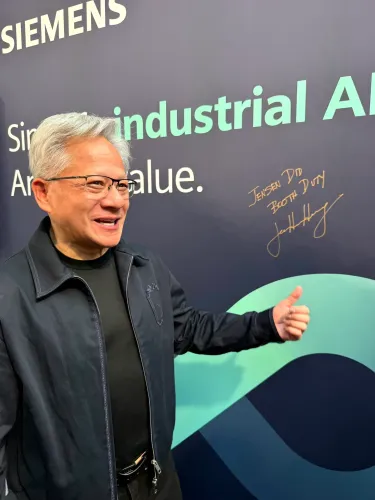
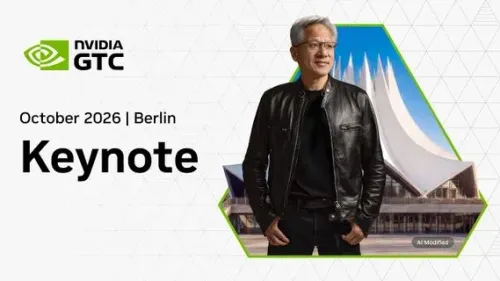
Nvidia CEO Jensen Huang headlined NVIDIA GTC Berlin on 25 October 2026 , Nvidia's flagship European GPU Technology Conference.
Nvidia identified four focus areas for Europe: AI factories , AI agents, robotics , and healthcare .
The EU reached political agreement on the AI Act in 2023 , the world's first comprehensive AI regulatory framework, shaping how European operators deploy AI infrastructure.
European governments are funding national AI compute initiatives under the EU's 2021–2027 Multiannual Financial Framework , creating large procurement opportunities for infrastructure providers.
Nvidia has pursued a deliberate strategy of regional GTC events and data-centre partnerships to embed its hardware and software stack in sovereign European AI programmes.
Europe's AI moment has a face, a stage, and a very loud GPU. Chip giant Nvidia brought its full weight to the continent on Sunday, 25 October 2026, as Chief Executive Jensen Huang headlined NVIDIA GTC Berlin — the company's flagship GPU Technology Conference — to lay out how artificial intelligence is being woven into the fabric of European industry, from hospital wards to factory floors.
In a post on X, Nvidia declared, 'Europe is building its AI future, and we're all in,' framing Huang's Berlin appearance as a statement of long-term continental commitment. The company highlighted four pillars that defined the event: AI factories, AI agents, robotics, and healthcare — a sweep that signals Nvidia sees Europe not as a single market but as a multi-sector AI buildout in progress.
AI Factories and the Sovereign Compute Race
The 'AI factory' framing is deliberate and politically loaded. Across Europe, national governments are racing to stand up dedicated AI compute infrastructure — high-density data centres stocked with accelerated chips — partly to satisfy the European Union's drive for technological sovereignty. The EU published its original AI strategy back in 2018 and has since backed it with real money under the 2021–2027 Multiannual Financial Framework, channelling funds into member-state compute initiatives.
Nvidia has pursued a deliberate pattern of embedding its hardware and software stack inside those national programmes, using regional GTC events as a combination of product showcase and diplomatic relationship-building. Berlin is the latest, and perhaps the most pointed, instalment of that strategy.
The EU AI Act and What It Means for Nvidia's European Bet
The timing matters. EU institutions reached political agreement on the landmark AI Act in 2023 — the world's first comprehensive legal framework for artificial intelligence systems — and its provisions are progressively coming into force. For Nvidia, whose chips power the vast majority of large-scale AI training runs on the continent, the regulatory environment shapes how customers build and what assurances they need from infrastructure suppliers.
By showing up in Berlin with a keynote that explicitly touches healthcare AI and robotics — two sectors the AI Act scrutinises most closely — Nvidia is signalling that it intends to be a solutions partner for compliance-conscious European operators, not just a component vendor.
Robotics and Healthcare: The Sectors Europe Is Watching
Huang's GTC Berlin agenda placing robotics and healthcare alongside AI factories and agents is a deliberate signal about where European enterprise demand is heading. Healthcare providers across the continent are under pressure to improve diagnostic speed and reduce clinical backlogs; robotics adoption in manufacturing hubs from Germany to Poland is accelerating as labour costs rise. Both are arenas where Nvidia's platform — from inference chips to developer software — plays a direct enabling role.
Nvidia has long used its GTC conference circuit to seed relationships before major procurement cycles open. With European governments actively funding sovereign AI capacity and enterprise buyers watching the regulatory clock, Berlin 2026 is the company planting a very large flag at a very consequential moment.
The AI factories of Europe are being built. Nvidia just made clear who wants to supply the machinery.
Point of View
The company is cementing itself as the default infrastructure layer before procurement decisions harden. The AI Act's risk-based compliance tiers — especially in healthcare and robotics — actually favour established platform vendors with end-to-end stacks, giving Nvidia a structural edge over fragmented challengers. For the broader industry, GTC Berlin illustrates how the competitive battleground for AI dominance has shifted from Silicon Valley demo halls to the policy corridors and data-centre tenders of Brussels, Berlin and beyond.
NationPress
26 Oct 2026
Frequently Asked Questions
What is NVIDIA GTC Berlin?
NVIDIA GTC Berlin is Nvidia's GPU Technology Conference held in Berlin, Germany, where the company showcases its latest AI hardware, software platforms and industry applications to European enterprise, government and research audiences.
What did Jensen Huang announce at GTC Berlin 2026?
Nvidia's post highlighted four key themes from Huang's keynote — AI factories, AI agents, robotics and healthcare — as the pillars of Europe's AI development, though specific product announcements have not been independently verified from the event.
What is an AI factory according to Nvidia?
An AI factory, in Nvidia's framing, refers to a purpose-built data-centre facility densely packed with accelerated computing hardware designed to train and run large AI models at scale — the fundamental infrastructure layer for national and enterprise AI programmes.
How does the EU AI Act affect Nvidia's business in Europe?
The EU AI Act, agreed politically in 2023, classifies AI applications by risk level, imposing stricter requirements on high-risk uses such as healthcare and robotics — sectors Nvidia directly targets. This regulatory landscape encourages European customers to work with established, compliant platform vendors, broadly benefiting Nvidia's end-to-end stack.
Why is Europe investing in sovereign AI compute?
European governments are funding national AI compute infrastructure under the EU's 2021–2027 Multiannual Financial Framework to reduce reliance on external technology suppliers, build domestic AI capability, and align with the EU's broader digital sovereignty strategy outlined since its 2018 AI strategy.