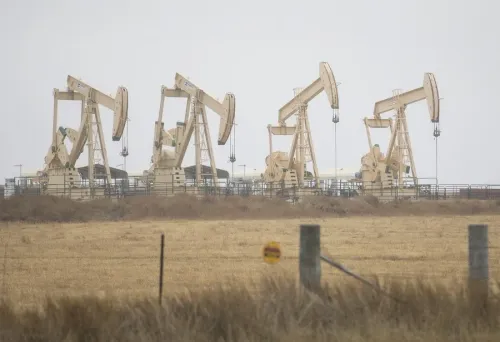
Crude Oil Prices Surpass $83 Per Barrel Amid Rising Middle East Tensions

Synopsis
As geopolitical tensions rise, crude oil prices have surged beyond $83 per barrel, driven by supply disruptions in the Strait of Hormuz. This increase poses significant implications for India's import costs and overall energy security.
Key Takeaways
Oil Prices Surge: Crude oil prices have crossed $83 per barrel due to geopolitical tensions.
Impact on India: Rising oil prices could significantly increase India’s import expenses.
Strategic Reserves: India maintains a 25-day reserve for crude oil and products.
Diversification of Sources: India has diversified its oil imports to enhance energy security.
Financial Expenditure: India spent $137 billion on oil imports in 2025.
New Delhi, March 5 (NationPress) In light of rising tensions in the Middle East, crude oil prices surged by over 2 percent on Thursday due to supply issues following the closure of the Strait of Hormuz by Iran.
During early trading, the April contract for the benchmark crude on the Intercontinental Exchange was priced at $83.26 per barrel, reflecting a rise of approximately 2.43 percent from the last closing price.
Simultaneously, the April contract for West Texas Intermediate on the NYMEX climbed 2.63 percent to reach $76.63 per barrel.
Reports indicate that a container ship navigating the Strait of Hormuz was struck by a projectile, resulting in damage to the vessel.
An ongoing rise in oil prices could significantly affect India's import expenses. A $1 increase in oil prices over a year can raise the import bill by approximately ₹16,000 crore.
Fortunately, India maintains a relatively stable position regarding crude oil, LPG, and LNG, boasting a reserve of crude oil that lasts for 25 days and products that also cover 25 days, including quantities in transit on vessels heading to Indian ports, according to government officials.
India imports over 85 percent of its crude oil needs, with around 50 percent sourced from Middle Eastern nations via the Strait of Hormuz, where supply has been disrupted due to the ongoing conflict with Iran.
To mitigate risks, India has diversified its oil imports by increasing purchases from Africa, Russia, and the United States, thereby enhancing its energy security through strategic reserves.
In recent years, India has bolstered its energy security by diversifying oil imports to include countries outside the Gulf, leading to a scenario where a significant portion of its supplies no longer transit through the Strait of Hormuz.
In the financial year ending March 31, 2025, India spent $137 billion on crude oil imports. From April 2025 to January 2026, the first ten months of the current fiscal year, the country allocated $100.4 billion for the import of 206.3 million tonnes of crude oil.
Point of View
The rising oil prices due to regional conflicts highlight the necessity for India to enhance its energy security. Diversifying oil sources is not just prudent but essential for minimizing economic risks associated with fluctuating global oil prices.
NationPress
16 Sept 2026
Frequently Asked Questions
What caused the rise in crude oil prices?
The rise in crude oil prices is attributed to escalating tensions in the Middle East, particularly due to the closure of the Strait of Hormuz by Iran.
How much has crude oil increased?
Crude oil prices have increased by over 2 percent, reaching approximately $83.26 per barrel.
What will be the impact on India's economy?
An increase in oil prices will raise India's import bill, with estimations suggesting that a $1 rise in oil prices could lead to an additional expenditure of around ₹16,000 crore.
How does India secure its oil supply?
India has diversified its oil sources by increasing imports from Africa, Russia, and the U.S., while also building strategic reserves.
What percentage of oil does India import?
India imports over 85 percent of its crude oil requirements, with a significant portion coming from Middle Eastern countries.