Orange lichen may signal rare earth deposits, Chinese study finds
Synopsis
Chinese scientists have found that a vivid orange lichen, Xanthoria elegans, accumulates rare earth elements from carbonatite rock below — making it a visible, low-cost field indicator for undiscovered REE deposits. Combined with drone-based hyperspectral imaging, the method could reshape global rare earth prospecting.
Key Takeaways
A study published in Economic Geology on July 27 identifies the orange lichen Xanthoria elegans as a surface indicator of rare earth-enriched carbonatite deposits.
The research involved Peking University and the Chinese Academy of Sciences , with fieldwork at the Bayan Obo mining area in Inner Mongolia and sites in Xinjiang .
Professor Li Yang described it as only the second biological mineral indicator discovered by Chinese scientists, after copper grass in the 1950s .
The lichen method can be combined with UAV and hyperspectral remote sensing technology to screen large areas for rare earth deposits at low cost.
The discovery has implications for diversifying global rare earth supply chains critical to EV, wind, and defence sectors.
A Chinese research team has identified a common orange-yellow lichen as a potential field indicator for undiscovered rare earth element (REE) deposits, a finding that could reshape low-cost mineral prospecting worldwide. The study, published in the peer-reviewed journal Economic Geology on July 27, argues that the lichen's vivid colouration makes it a visible, ground-level clue to rare earth-bearing carbonatite rock beneath the surface.
The discovery and what it means
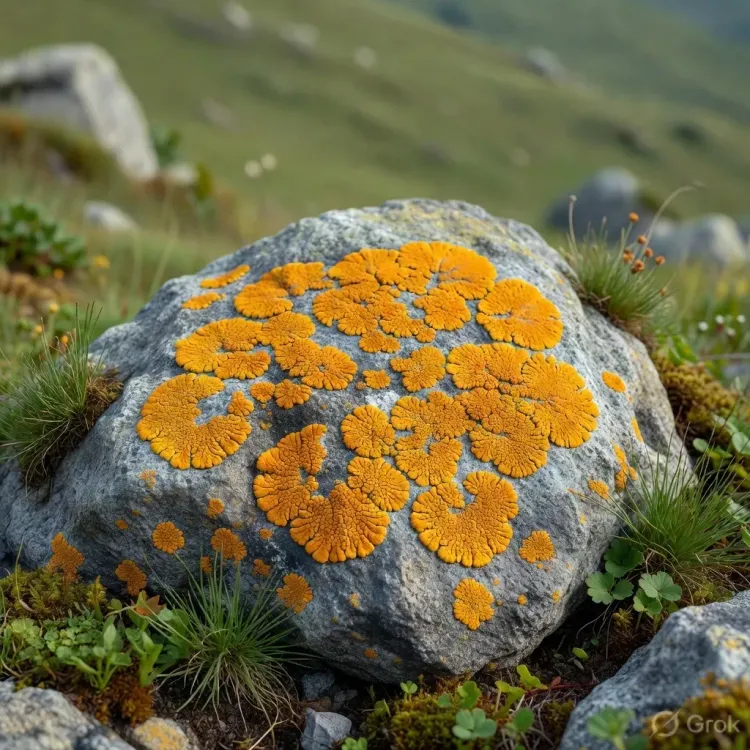
The research, titled 'Lichen as a Potential Exploration Tool for Rare Earth Element – Enriched Carbonatites', centres on Xanthoria elegans, a bright orange-yellow crustose lichen found on exposed rock surfaces across multiple climates. Scientists found the species accumulates rare earth elements from the underlying substrate, making its distinctive colour a surface-visible proxy for REE-enriched carbonatite formations below.
The team noted the lichen's colouration is easy to identify in the field, and said the discovery could be integrated with unmanned aerial vehicles (UAVs) and hyperspectral remote sensing technology to survey large, remote, or difficult terrain at scale — dramatically reducing the cost and time of traditional geological prospecting.
Why it matters for rare earth exploration
Rare earth elements are critical inputs for electric vehicle motors, wind turbines, defence electronics, and consumer devices. Identifying new deposits outside established supply chains has become a strategic priority for governments and mining companies globally. A low-cost biological indicator that can be cross-referenced with aerial imaging could accelerate that search considerably.
The research was conducted with involvement from Peking University and the Chinese Academy of Sciences, with fieldwork linked to the Bayan Obo mining area in Inner Mongolia — the world's largest known rare earth deposit — as well as sites in Xinjiang.
Historical context: a second biological indicator
Professor Li Yang of Peking University and the Chinese Academy of Sciences placed the finding in a long lineage of Chinese geobotanical research. Speaking on August 17, he said: 'This is the second time Chinese scientists have discovered a similar indicator – the first was copper grass in the 1950s – and both are original scientific discoveries in mineral exploration.'
Chinese scientists have pursued biological prospecting indicators for decades, and the copper grass precedent from the 1950s established a methodological tradition that this lichen study now extends to rare earths.
What's next
The researchers indicated that combining lichen mapping with UAV-mounted hyperspectral sensors could enable rapid screening of carbonatite-bearing regions across Africa, Central Asia, and other geologically prospective zones where ground access is limited. Mining companies and national geological surveys that adopt this dual biological-remote sensing approach could gain a meaningful edge in the global race to diversify rare earth supply chains.
The question now is whether international mining operators and government geological bodies will move quickly to validate and operationalise the method beyond China's existing deposit base.
Point of View
Deepening a paradox at the heart of the critical minerals race. By embedding geobotanical prospecting into drone-based remote sensing workflows, China could identify and stake new REE-bearing carbonatite zones globally before rivals even begin ground surveys. Mainstream coverage focuses on the scientific novelty, but the strategic implication is sharper: a nation that controls both the largest known deposits and the most scalable detection method holds a compounding advantage. The real watch item is whether this technique surfaces significant new deposits outside China's borders — and who controls those finds.
NationPress
8 Oct 2026
Frequently Asked Questions
What did Chinese scientists discover about lichen and rare earth elements?
Chinese scientists found that the orange-yellow lichen Xanthoria elegans accumulates rare earth elements from carbonatite rock, making it a visible surface indicator of potential REE deposits below. The study was published in Economic Geology on July 27 and involved researchers from Peking University and the Chinese Academy of Sciences .
How can lichen be used to find rare earth deposits?
The lichen's distinctive orange-yellow colour signals the presence of rare earth-enriched carbonatite rock beneath the surface. Researchers say the method can be scaled by combining ground-level lichen identification with UAV -mounted hyperspectral remote sensing cameras to survey large or remote areas efficiently.
Where was the rare earth lichen research conducted?
The research is linked to fieldwork at the Bayan Obo mining area in Inner Mongolia , the world's largest known rare earth deposit, and also at sites in Xinjiang . The study was led by researchers affiliated with Peking University and the Chinese Academy of Sciences .
Why does this rare earth discovery matter globally?
Rare earth elements are essential for electric vehicles, wind turbines, defence systems, and consumer electronics. A low-cost, scalable prospecting method using a common lichen could help identify new deposits worldwide, potentially diversifying supply chains that are currently concentrated in China .
Is this the first time a plant or organism has been used to find mineral deposits?
No. Professor Li Yang noted on August 17 that this is the second such discovery by Chinese scientists — the first being copper grass identified in the 1950s as an indicator of copper deposits. Both are considered original contributions to the field of geobotanical mineral exploration.