Alibaba's Qwen AI drafts Pakistan deal in real time for Joe Tsai

Synopsis
Alibaba chairman Joe Tsai used the Qwen AI app on his smartphone to draft a comprehensive Pakistan technology partnership agreement in real time during PM Shehbaz Sharif's visit to Alibaba's Hangzhou HQ — turning a surprise on-the-spot demand into a signed deal covering AI, cloud, healthcare, e-commerce, and digital payments.
Key Takeaways
Joe Tsai , chairman of Alibaba Group , used the Qwen AI app to draft a technology partnership agreement in real time on 25 May 2026 at Alibaba's Hangzhou headquarters .
Pakistani Prime Minister Shehbaz Sharif made an impromptu demand for a "comprehensive strategic agreement" on the spot, repeating "now" and "right now," according to attendees at the signing ceremony.
Tsai , a Yale Law School -trained lawyer, input keywords into Qwen on his smartphone; the AI generated the backbone of the agreement, which he then presented to Sharif .
The signed deal covers AI infrastructure , cloud computing , healthcare , e-commerce , and digital payments .
The agreement deepens Alibaba 's existing presence in Pakistan through platforms including Daraz and Alibaba Cloud .
The visit is part of Sharif 's four-day China trip aimed at accelerating Pakistan 's digital economy with Chinese technology partners.
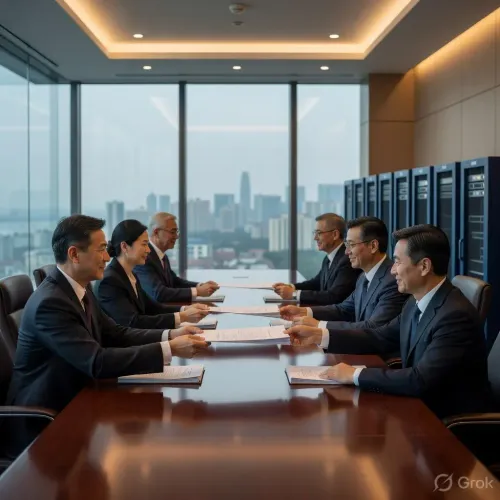
Alibaba Group chairman Joe Tsai used the company's Qwen AI app to draft a sweeping technology partnership agreement on the spot during Pakistani Prime Minister Shehbaz Sharif's visit to Alibaba's headquarters in Hangzhou on Sunday, 25 May 2026 — turning what would normally be weeks of legal work into a same-day signing.
The surprise request that set it all in motion
Sharif, known domestically for "Sharif speed" — a phrase describing his drive to fast-track development projects — reportedly challenged Tsai during the visit, saying: "I want a comprehensive strategic agreement," and repeating "now" and "right now" to underscore his urgency, according to people who attended the signing ceremony. The request came on the first leg of Sharif's four-day China visit, during which he is seeking to deepen Pakistan's digital economy ties with Chinese technology firms.
How Qwen closed the gap
Tsai, who trained at Yale Law School and is qualified to practise law in the United States, decided to draft the agreement himself — using his smartphone to input a few keywords into Qwen, Alibaba's AI app powered by its in-house foundation models, one of the sources said. Qwen generated the backbone of the agreement, and Tsai then walked Sharif through the draft in real time. The episode is a rare, high-profile instance of generative AI being used directly in live, head-of-state-level diplomacy.
What the deal covers
The AI-assisted drafting facilitated a rapid dealmaking process that culminated in the signing of a broad technology partnership. The agreement spans AI infrastructure, cloud computing, healthcare, e-commerce, and digital payments, according to people familiar with the matter. Alibaba already has a significant footprint in Pakistan through Daraz, the e-commerce platform it owns, and through Alibaba Cloud services.
Why it matters
The deal extends China's technology influence in South Asia at a moment when Beijing is actively expanding digital infrastructure partnerships under the Belt and Road Initiative. For Pakistan, which is grappling with fiscal pressures and a nascent digital economy, access to Alibaba's AI, cloud, and payments stack could accelerate modernisation across multiple sectors. The signing also signals that Qwen is capable enough to be trusted in high-stakes, real-world legal drafting — a meaningful credibility marker for Alibaba's AI ambitions.
What's next
Details of implementation timelines and financial commitments under the partnership have not yet been disclosed. Sharif's remaining days in China are expected to yield further bilateral announcements, with Beijing and Islamabad both keen to deepen cooperation on digital infrastructure. Observers will be watching whether this agreement translates into concrete Alibaba Cloud deployments in Karachi and Lahore — and whether Qwen's role in the drafting becomes a reference case for AI in diplomatic deal-making.
Point of View
Real-world legal contexts, not just consumer chat. Mainstream coverage focuses on the diplomatic spectacle, but the deeper signal is that Chinese AI models are now being stress-tested at the level of head-of-state deal-making, a credibility benchmark that rivals like Baidu and even OpenAI have not yet publicly claimed. For Pakistan, the deal fits a pattern of Belt and Road digital expansion in which Beijing-aligned tech giants lock in infrastructure dependencies early, with cloud and payments as the long-term monetisation layer. The speed of signing, enabled by AI, also compresses the negotiating leverage that slower bureaucratic processes normally provide — a dynamic that smaller economies entering such agreements should scrutinise carefully.
NationPress
9 Oct 2026
Frequently Asked Questions
What did Alibaba's Qwen AI do during Shehbaz Sharif's China visit?
Alibaba's Qwen AI app was used by chairman Joe Tsai to draft a comprehensive technology partnership agreement in real time during PM Shehbaz Sharif's visit to Alibaba's Hangzhou headquarters on 25 May 2026. Tsai input a few keywords into Qwen on his smartphone, the AI generated the framework of the deal, and Tsai then walked Sharif through the draft before it was signed.
What does the Alibaba-Pakistan technology deal cover?
The signed agreement is a broad technology partnership spanning AI infrastructure, cloud computing, healthcare, e-commerce, and digital payments, according to people familiar with the matter. Financial terms and implementation timelines have not been disclosed.
Why did Joe Tsai draft the agreement himself using AI?
PM Sharif made an impromptu on-the-spot demand for a 'comprehensive strategic agreement,' repeating 'now' and 'right now,' according to attendees. Tsai, who is Yale Law School-trained and US-qualified, chose to draft it himself with Qwen's assistance rather than defer to a lengthy legal review process.
How does this deal fit into China-Pakistan relations?
The agreement extends China's digital technology footprint in Pakistan under the broader Belt and Road Initiative framework. Alibaba already operates in Pakistan through Daraz, its e-commerce platform, and Alibaba Cloud, making this partnership a deepening of existing ties rather than a new entry.
What does this mean for Alibaba's Qwen AI model?
The public use of Qwen in live, head-of-state-level legal drafting is a rare and high-profile credibility signal for Alibaba's AI capabilities. It positions Qwen as a serious enterprise tool and could accelerate adoption among businesses and governments considering Chinese AI platforms.